陽
See also: 阳
| ||||||||
Translingual
Han character
陽 (Kangxi radical 170, 阜+9, 12 strokes, cangjie input 弓中日一竹 (NLAMH), four-corner 76227, composition ⿰阝昜)
Derived characters
- 鐊 (𬭏), 𫉤, 𥳜, 𤺹, 𪤝, 𫶖
Related characters
- 阳 (Simplified form of 陽)
References
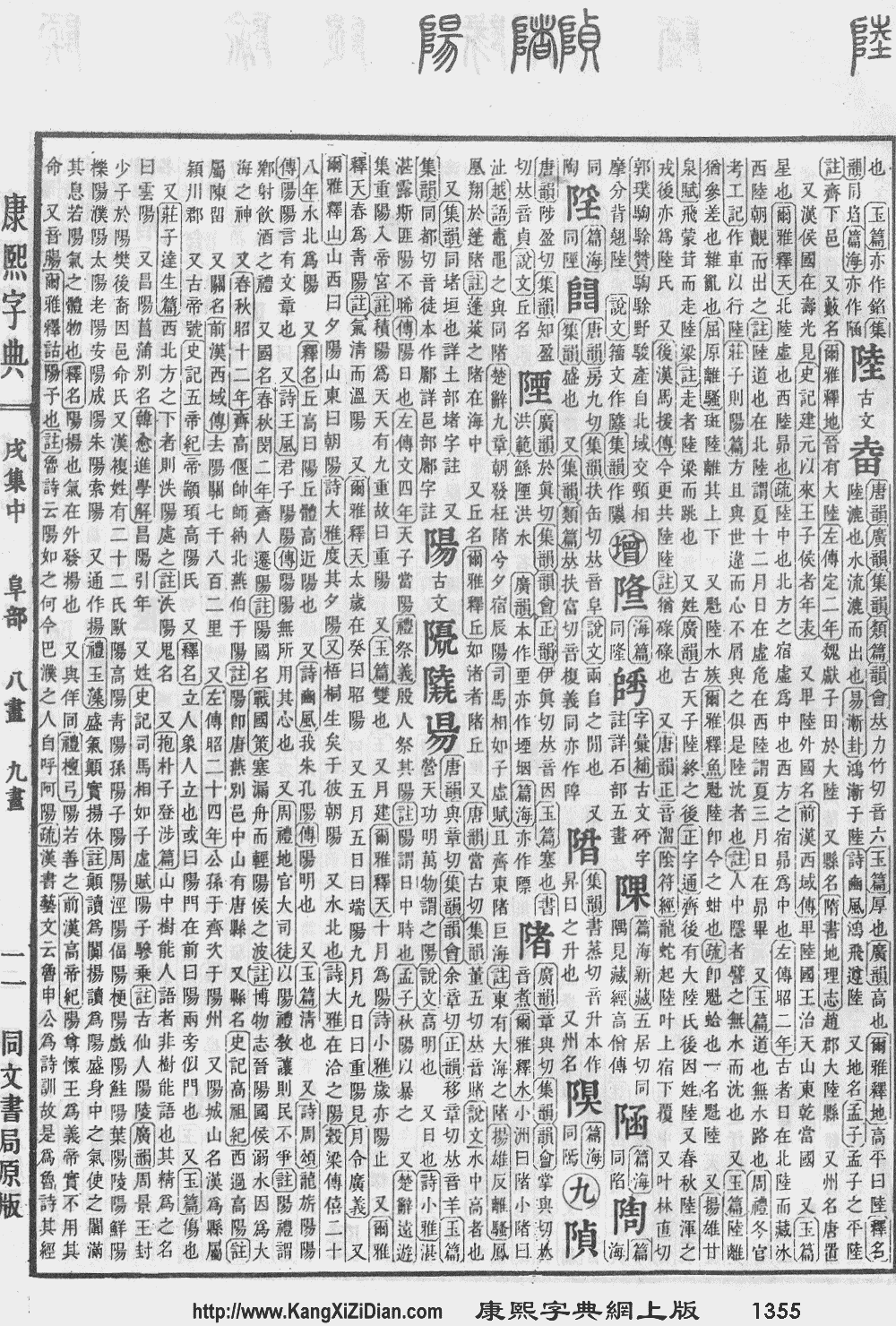
- Kangxi Dictionary: page 1355, character 15
- Dai Kanwa Jiten: character 41725
- Dae Jaweon: page 1859, character 14
- Hanyu Da Zidian (first edition): volume 6, page 4144, character 3
- Unihan data for U+967D
Chinese
| trad. | 陽 | |
|---|---|---|
| simp. | 阳 | |
| alternative forms | ||
Glyph origin
| Historical forms of the character 陽 |
|---|
| Western Zhou |
| Bronze inscriptions |
 |
Characters in the same phonetic series (昜) (Zhengzhang, 2003)
| Old Chinese | |
|---|---|
| 湯 | *l̥ʰaːŋ, *l̥ʰaːŋs, *hljaŋ |
| 踼 | *l̥ʰaːŋ, *l̥ʰaːŋʔ, *l'aːŋ, *l'aːŋs |
| 蝪 | *l̥ʰaːŋ |
| 薚 | *l̥ʰaːŋ |
| 簜 | *l̥ʰaːŋ, *l'aːŋʔ |
| 盪 | *l̥ʰaːŋ, *l̥ʰaːŋs, *l'aːŋʔ |
| 偒 | *l̥ʰaːŋʔ |
| 蕩 | *l̥ʰaːŋs, *l'aːŋʔ |
| 燙 | *l̥ʰaːŋs |
| 啺 | *l'aːŋ |
| 碭 | *l'aːŋ, *l'aːŋs |
| 婸 | *l'aːŋʔ |
| 愓 | *l'aːŋʔ |
| 璗 | *l'aːŋʔ |
| 崵 | *l'aːŋʔ, *laŋ |
| 逿 | *l'aːŋs |
| 暢 | *l̥ʰaŋs |
| 畼 | *l̥ʰaŋs |
| 腸 | *l'aŋ |
| 場 | *l'aŋ |
| 傷 | *hljaŋ, *hljaŋs |
| 殤 | *hljaŋ |
| 觴 | *hljaŋ |
| 慯 | *hljaŋ, *hljaŋs |
| 禓 | *hljaŋ, *laŋ |
| 塲 | *hljaŋ |
| 陽 | *laŋ |
| 楊 | *laŋ |
| 揚 | *laŋ |
| 瘍 | *laŋ |
| 煬 | *laŋ, *laŋs |
| 鍚 | *laŋ |
| 暘 | *laŋ |
| 颺 | *laŋ, *laŋs |
| 昜 | *laŋ |
| 輰 | *laŋ |
| 敭 | *laŋ |
| 鰑 | *laŋ |
| 諹 | *laŋ, *laŋs |
| 瑒 | *laŋ, *rlaːŋʔ |
| 鸉 | *laŋ |
| 餳 | *ljaːŋ |
Phono-semantic compound (形聲/形声, OC *laŋ) and ideogrammic compound (會意/会意) : semantic 阜 (“hill”) + phonetic 昜 (OC *laŋ, “sunshine”) – sun shining on a hill.
Etymology
Either Sino-Tibetan or a Mainland Southeast Asian (MSEA) Wanderwort; compare Burmese လင်း (lang:, “bright”), Lepcha ᰣᰦᰜᰩᰵ (a-lóṅ, “reflective light”), Thai ปลั่ง (bplàng, “bright; shiny”) (Schuessler, 2007).
STEDT provisionally sets up Proto-Kuki-Chin *klaaŋ-I, klaan-II (“shine; light; bright”) and compares it to the following:
Pronunciation
Definitions
陽
- (philosophy) “male” principle; yang in yin-yang
- sun
- male genitals
- open; overt
- positive
- convex; in relief
- human world; this world
- (Chinese phonetics, of a syllable) closed with a nasal consonantal coda
- south side of mountain or north side of river
- (literary) to feign; to pretend
- alt. forms: 佯 (yáng)
- a surname
See also
| The tones (of Chinese) in Mandarin · 聲調/声调 (shēngdiào) (layout · text) | ||||||||||
|---|---|---|---|---|---|---|---|---|---|---|
| 平仄 (píngzè) | 平 (píng) 平聲/平声 (píngshēng) |
仄 (zè) 仄聲/仄声 (zèshēng) | ||||||||
| 平上去入 (píngshǎngqùrù) 四聲/四声 (sìshēng) |
平 (píng) 平聲/平声 (píngshēng) |
上 (shǎng) 上聲/上声 (shǎngshēng) |
去 (qù) 去聲/去声 (qùshēng) |
入 (rù) 入聲/入声 (rùshēng) | ||||||
| 標調方法/标调方法 (biāodiào fāngfǎ) 標調法/标调法 |
四角標調法/四角标调法 | ꜀◌ | ꜂◌ | ◌꜄ | ◌꜆ | |||||
| [Term?] | ◌〪 | ◌〫 | ◌〬 | ◌〭 | ||||||
| 傍點/傍点 | ∅ | ◌〮 | ◌〯 | ∅ | ||||||
| 四聲八調/四声八调 | 陰平/阴平 (yīnpíng) | 陽平/阳平 (yángpíng) | 陰上/阴上 (yīnshǎng) | 陽上/阳上 (yángshǎng) | 陰去/阴去 (yīnqù) | 陽去/阳去 (yángqù) | 陰入/阴入 (yīnrù) | 陽入/阳入 (yángrù) | ||
| 陰/阴 (yīn) | 陽/阳 (yáng) | |||||||||
| 標調方法/标调方法 (biāodiào fāngfǎ) 標調法/标调法 |
四角標調法/四角标调法 | ꜀◌ | ꜁◌ | ꜂◌ | ꜃◌ | ◌꜄ | ◌꜅ | ◌꜆ | ◌꜇ | |
| The tones (of Standard Mandarin) in Mandarin · 聲調/声调 (shēngdiào) (layout · text) | ||||||||||
|---|---|---|---|---|---|---|---|---|---|---|
| 四聲/四声 (sìshēng) | 陰平/阴平 (yīnpíng) 一聲/一声 |
陽平/阳平 (yángpíng) 二聲/二声 (èrshēng) |
上聲/上声 (shǎngshēng) 三聲/三声 (sānshēng) |
去聲/去声 (qùshēng) 四聲/四声 (sìshēng) |
輕聲/轻声 (qīngshēng) | |||||
Compounds
- 一曲陽關/一曲阳关
- 一陽生/一阳生
- 三陽/三阳 (Sānyáng)
- 三陽交泰/三阳交泰
- 上陽宮/上阳宫
- 三陽開泰/三阳开泰
- 不陰不陽/不阴不阳
- 中陽/中阳 (Zhōngyáng)
- 丹陽/丹阳 (dānyáng)
- 亢陽/亢阳
- 伯陽/伯阳
- 何陽店/何阳店 (Héyángdiàn)
- 信陽/信阳 (Xìnyáng)
- 偪陽/偪阳 (Fúyáng)
- 元陽/元阳 (Yuányáng)
- 克里陽 (Kèlǐyáng)
- 六陽會首/六阳会首
- 六陽首級/六阳首级
- 六陽魁首/六阳魁首
- 出太陽/出太阳
- 初陽/初阳 (chūyáng)
- 南陽/南阳 (Nányáng)
- 向陽/向阳 (xiàngyáng)
- 君子陽陽/君子阳阳
- 咸陽 (Xiányáng)
- 咸陽宮/咸阳宫
- 咸陽火
- 唱陽關/唱阳关
- 壯陽/壮阳 (zhuàngyáng)
- 壽陽/寿阳
- 壽陽公主/寿阳公主
- 壽陽妝/寿阳妆
- 夕陽/夕阳 (xīyáng)
- 夕陽工業/夕阳工业
- 夕陽簫鼓/夕阳箫鼓
- 夕陽餘暉/夕阳余晖
- 大小歐陽/大小欧阳
- 太陽/太阳 (tàiyáng)
- 太陽光譜/太阳光谱
- 太陽地/太阳地 (tàiyángdì)
- 太陽島/太阳岛 (Tàiyángdǎo)
- 太陽年/太阳年
- 太陽旗/太阳旗 (tàiyángqí)
- 太陽日/太阳日 (tàiyángrì)
- 太陽時/太阳时
- 太陽曆/太阳历
- 太陽河/太阳河 (Tàiyánghé)
- 太陽燈/太阳灯 (tàiyángdēng)
- 太陽爐/太阳炉
- 太陽病/太阳病
- 太陽眼鏡/太阳眼镜 (tàiyáng yǎnjìng)
- 太陽神/太阳神 (tàiyángshén)
- 太陽穴/太阳穴
- 太陽糕/太阳糕 (tàiyánggāo)
- 太陽系/太阳系 (Tàiyángxì)
- 太陽能/太阳能 (tàiyángnéng)
- 太陽能房/太阳能房
- 太陽膏/太阳膏
- 太陽自轉/太阳自转
- 太陽輻射/太阳辐射
- 太陽閃焰/太阳闪焰
- 太陽電池/太阳电池 (tàiyáng diànchí)
- 太陽電波/太阳电波
- 太陽風/太阳风 (tàiyángfēng)
- 太陽餅/太阳饼 (tàiyángbǐng)
- 太陽鳥/太阳鸟
- 太陽麻/太阳麻
- 太陽黑子/太阳黑子
- 安陽/安阳 (Ānyáng)
- 安陽河/安阳河
- 官陽/官阳 (Guānyáng)
- 小陽春/小阳春 (xiǎoyángchūn)
- 山陽笛/山阳笛
- 岳陽/岳阳 (Yuèyáng)
- 岳陽樓/岳阳楼 (Yuèyánglóu)
- 崇陽/崇阳 (Chóngyáng)
- 嵩陽書院/嵩阳书院
- 平陽/平阳 (píngyáng)
- 平陽公主/平阳公主
- 弋陽腔/弋阳腔 (yìyángqiāng)
- 彭陽/彭阳 (Péngyáng, “Pengyang”)
- 待陽/待阳 (Dàiyáng)
- 德陽/德阳 (Déyáng)
- 悠陽/悠阳
- 悲犬咸陽
- 愆陽/愆阳
- 擲果河陽/掷果河阳
- 斜陽/斜阳 (xiéyáng)
- 日陽/日阳 (rìyáng)
- 昆陽/昆阳
- 昭陽/昭阳 (zhāoyáng)
- 昭陽殿/昭阳殿 (Zhāoyáng Diàn)
- 晉陽秋/晋阳秋
- 景陽/景阳 (Jǐngyáng)
- 景陽宮井/景阳宫井
- 景陽崗/景阳岗
- 暮陽/暮阳 (Mùyáng)
- 月陽/月阳
- 有腳陽春/有脚阳春
- 朝陽/朝阳
- 朝陽方案/朝阳方案
- 朝陽花/朝阳花 (cháoyánghuā)
- 朝陽鳴鳳/朝阳鸣凤
- 桂陽/桂阳 (Guìyáng)
- 棗陽/枣阳 (Zǎoyáng)
- 樅陽/枞阳 (Zōngyáng)
- 歐陽/欧阳 (Ōuyáng)
- 正陽門/正阳门 (Zhèngyángmén)
- 正陽關/正阳关
- 歲陽/岁阳
- 殘陽/残阳 (cányáng)
- 沔陽/沔阳 (Miǎnyáng)
- 汾陽/汾阳 (Fényáng)
- 汾陽宮/汾阳宫
- 河陽/河阳
- 泃陽/泃阳 (Jūyáng)
- 泌陽/泌阳 (Bìyáng)
- 河陽衰鬢/河阳衰鬓
- 洛陽/洛阳 (Luòyáng)
- 洛陽才子/洛阳才子
- 洛陽橋/洛阳桥
- 洛陽紙貴/洛阳纸贵 (luòyángzhǐguì)
- 海陽/海阳 (Hǎiyáng)
- 渭陽/渭阳 (wèiyáng)
- 渭陽之思/渭阳之思
- 渭陽之情/渭阳之情
- 滎陽/荥阳 (Xíngyáng)
- 滏陽河/滏阳河
- 漢陽/汉阳 (Hànyáng)
- 潁陽/颍阳
- 漁陽弄/渔阳弄
- 漁陽摻撾/渔阳掺挝
- 漁陽鞞鼓/渔阳鞞鼓
- 潘河陽/潘河阳
- 潯陽三隱/浔阳三隐
- 瀋陽/沈阳 (Shěnyáng)
- 火性強陽/火性强阳
- 炕陽/炕阳
- 炎陽/炎阳
- 炎陽炙人/炎阳炙人
- 烈陽/烈阳
- 燮理陰陽/燮理阴阳
- 玉陽/玉阳 (Yùyáng)
- 玉陽真君/玉阳真君
- 田陽/田阳 (Tiányáng)
- 當陽/当阳 (Dāngyáng)
- 發陽/发阳
- 白雪陽春/白雪阳春
- 皮裡陽秋/皮里阳秋 (pílǐyángqiū)
- 真太陽日/真太阳日
- 睢陽/睢阳
- 秋陽/秋阳
- 端陽/端阳 (Duānyáng)
- 端陽競渡/端阳竞渡
- 純陽/纯阳
- 純陽祖師/纯阳祖师
- 紫陽/紫阳 (Zǐyáng)
- 綿陽/绵阳 (Miányáng)
- 老陽/老阳 (lǎoyáng)
- 脫陽/脱阳
- 臥理淮陽/卧理淮阳
- 華陽國志/华阳国志
- 萯陽/𰰷阳
- 蘭陽平原/兰阳平原
- 蘭陽溪/兰阳溪 (Lányángxī)
- 衡陽/衡阳 (Héngyáng)
- 衡陽雁去/衡阳雁去
- 被髮陽狂/被发阳狂
- 補陽/补阳
- 襄陽/襄阳 (Xiāngyáng)
- 豔陽/艳阳 (yànyáng)
- 豔陽天/艳阳天 (yànyángtiān)
- 豔陽高照/艳阳高照
- 貴陽/贵阳 (Guìyáng)
- 資陽/资阳 (Zīyáng, “Ziyang”)
- 賓陽/宾阳 (Bīnyáng)
- 遮陽/遮阳 (zhēyáng)
- 還陽/还阳
- 鄖陽/郧阳 (Yúnyáng)
- 鄔陽/邬阳 (Wūyáng)
- 鄱陽湖/鄱阳湖 (Póyáng Hú)
- 酉陽雜俎/酉阳杂俎
- 重陽/重阳 (Chóngyáng)
- 重陽日/重阳日
- 重陽木/重阳木
- 重陽節/重阳节 (Chóngyángjié)
- 鎖陽/锁阳 (suǒyáng)
- 長陽/长阳 (Chángyáng)
- 開陽/开阳 (Kāiyáng)
- 陰差陽錯/阴差阳错 (yīnchāyángcuò)
- 陰盛陽衰/阴盛阳衰 (yīnshèngyángshuāi)
- 陰虛陽浮/阴虚阳浮
- 陰錯陽差/阴错阳差
- 陰陽/阴阳 (yīnyáng)
- 陰陽不將/阴阳不将
- 陰陽五行/阴阳五行
- 陰陽交錯/阴阳交错
- 陰陽人/阴阳人 (yīnyángrén)
- 陰陽兩隔/阴阳两隔
- 陰陽合曆/阴阳合历
- 陰陽和/阴阳和
- 陰陽學/阴阳学
- 陰陽家/阴阳家 (yīnyángjiā)
- 陰陽對轉/阴阳对转
- 陰陽怪氣/阴阳怪气 (yīnyángguàiqì)
- 陰陽易位/阴阳易位
- 陰陽曆/阴阳历 (yīnyánglì)
- 陰陽水/阴阳水
- 陰陽海/阴阳海
- 陰陽生/阴阳生
- 陰陽祕書/阴阳秘书
- 陰陽移/阴阳移
- 陰陽臉/阴阳脸
- 陰陽間隔/阴阳间隔
- 陽世/阳世 (yángshì)
- 陽中/阳中
- 陽九/阳九
- 陽九之會/阳九之会
- 陽九之阨/阳九之阨
- 陽侯/阳侯
- 陽侯之患/阳侯之患
- 陽傘/阳伞 (yángsǎn)
- 陽儒陰釋/阳儒阴释
- 陽光/阳光 (yángguāng)
- 陽光普照/阳光普照
- 陽光法案/阳光法案
- 陽入/阳入 (yángrù)
- 陽具/阳具 (yángjù)
- 陽剛/阳刚 (yánggāng)
- 陽去/阳去 (yángqù)
- 陽和/阳和
- 陽報/阳报
- 陽塘/阳塘 (Yángtáng)
- 陽墳/阳坟
- 陽壽/阳寿 (yángshòu)
- 陽奉陰違/阳奉阴违 (yángfèngyīnwéi)
- 陽宅/阳宅 (yángzhái)
- 陽平/阳平 (yángpíng)
- 陽德/阳德
- 陽性/阳性 (yángxìng)
- 陽性植物/阳性植物
- 陽文/阳文 (yángwén)
- 陽新/阳新 (Yángxīn)
- 陽日/阳日 (yángrì)
- 陽明/阳明 (yángmíng)
- 陽明先生/阳明先生
- 陽明哲學/阳明哲学
- 陽明大學/阳明大学
- 陽明學派/阳明学派
- 陽明山/阳明山
- 陽春/阳春 (yángchūn)
- 陽春有腳/阳春有脚
- 陽春白雪/阳春白雪 (yángchūnbáixuě)
- 陽春麵/阳春面 (yángchūnmiàn)
- 陽景/阳景
- 陽曆/阳历 (yánglì)
- 陽月/阳月 (Yángyuè)
- 陽朔/阳朔 (Yángshuò)
- 陽極/阳极 (yángjí)
- 陽極射線/阳极射线
- 陽氣/阳气
- 陽江/阳江 (Yángjiāng)
- 陽湖派/阳湖派
- 陽溝/阳沟 (yánggōu)
- 陽烏/阳乌 (yángwū)
- 陽燧/阳燧
- 陽物/阳物 (yángwù)
- 陽狂/阳狂
- 陽狂自免/阳狂自免
- 陽珓/阳珓 (yángjiào)
- 陽秋/阳秋 (yángqiū)
- 陽羨/阳羡
- 陽聲/阳声
- 陽聲韻/阳声韵
- 陽臺/阳台 (yángtái)
- 陽臺春夢/阳台春梦
- 陽臺雲雨/阳台云雨
- 陽萎/阳萎 (yángwěi)
- 陽虛發熱/阳虚发热
- 陽調/阳调
- 陽識/阳识
- 陽谷/阳谷
- 陽起石/阳起石 (yángqǐshí)
- 陽道/阳道
- 陽遂足/阳遂足
- 陽邏/阳逻 (Yángluó)
- 陽間/阳间 (yángjiān)
- 陽關/阳关 (Yángguān)
- 陽關三疊/阳关三叠
- 陽關大道/阳关大道 (yángguān dàdào)
- 陽關道/阳关道 (yángguāndào)
- 陽阿/阳阿
- 陽陵虎符/阳陵虎符
- 陽陽/阳阳
- 陽離子/阳离子 (yánglízǐ)
- 陽電/阳电 (yángdiàn)
- 陽電子/阳电子 (yángdiànzǐ)
- 陽面/阳面
- 陽韻/阳韵
- 陽順陰違/阳顺阴违
- 陽鳥/阳鸟
- 雙陽/双阳 (shuāngyáng)
- 雲陽/云阳 (Yúnyáng)
- 雲陽市/云阳市
- 青陽/青阳 (Qīngyáng)
- 頂陽骨/顶阳骨
- 頹陽/颓阳
- 顛倒陰陽/颠倒阴阳
- 首陽山/首阳山
- 驕陽/骄阳 (jiāoyáng)
- 高陽/高阳 (Gāoyáng)
- 高陽公子/高阳公子
- 高陽狂客/高阳狂客
- 高陽酒徒/高阳酒徒
- 魯陽揮戈/鲁阳挥戈
- 鳳陽花鼓/凤阳花鼓
- 鳴鳳朝陽/鸣凤朝阳
- 鳳鳴朝陽/凤鸣朝阳
- 龍陽/龙阳 (lóngyáng)
Japanese
Readings
Etymology 1
| Kanji in this term |
|---|
| 陽 |
| ひ Grade: 3 |
| kun’yomi |
Noun
References
- Matsumura, Akira, editor (2006), 大辞林 [Daijirin] (in Japanese), Third edition, Tōkyō: Sanseidō, →ISBN
Korean
Etymology
From Middle Chinese 陽 (MC yang). Recorded as Middle Korean 야ᇰ (yang) (Yale: yang) in Hunmong Jahoe (訓蒙字會 / 훈몽자회), 1527.
Compounds
Vietnamese
Han character
- This term needs a translation to English. Please help out and add a translation, then remove the text
{{rfdef}}.
Compounds
- dương lịch (陽曆)
This article is issued from Wiktionary. The text is licensed under Creative Commons - Attribution - Sharealike. Additional terms may apply for the media files.