亮
| ||||||||
| ||||||||
Translingual
| Stroke order (Mainland China) | |||
|---|---|---|---|
 | |||
Alternative forms
- In mainland China, the bottom component is written 几 while in other regions, the bottom component is written 儿 which is the historical form found in the Kangxi dictionary.
- A CJK compatibility ideograph exists at
U+F977for a duplicate code point in the KS X 1001 character set used in South Korea.
Han character
亮 (Kangxi radical 8, 亠+7, 9 strokes, cangjie input 卜口月山 (YRBU), four-corner 00217, composition ⿳亠口冗 or ⿱⿳亠口冖几(G) or ⿱⿳亠口冖儿(HTJK or U+F977))
References
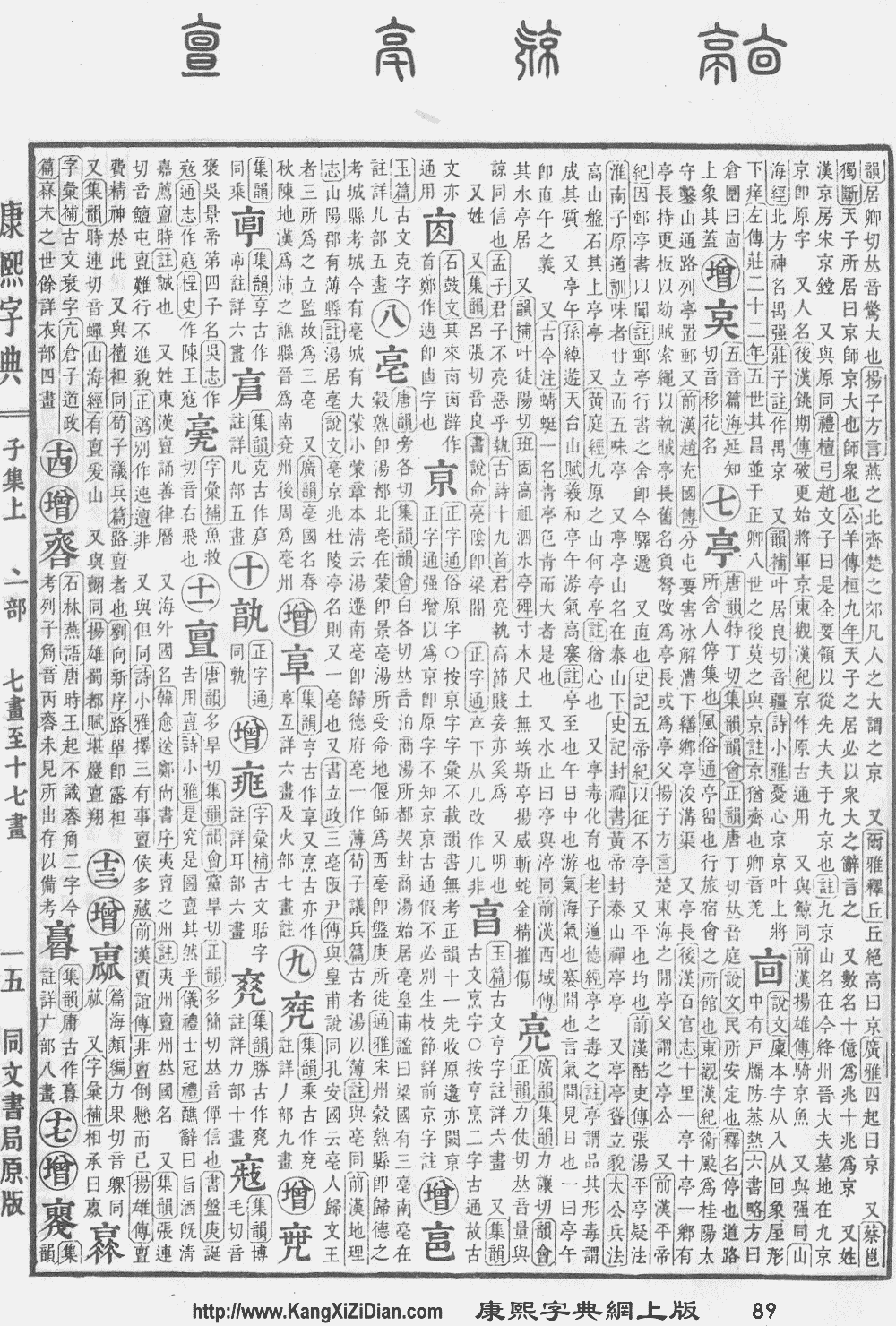
- Kangxi Dictionary: page 89, character 4
- Dai Kanwa Jiten: character 304
- Dae Jaweon: page 188, character 10
- Hanyu Da Zidian (first edition): volume 1, page 286, character 3
- Unihan data for U+4EAE
- Unihan data for U+F977
Chinese
| trad. | 亮 | |
|---|---|---|
| simp. # | 亮 | |
| alternative forms | 𠅙 | |
Glyph origin
| Historical forms of the character 亮 | ||||||||||||||
|---|---|---|---|---|---|---|---|---|---|---|---|---|---|---|
| ||||||||||||||
|
References: Mostly from Richard Sears' Chinese Etymology site (authorisation),
|


Ideogrammic compound (會意/会意) and phono-semantic compound (形聲/形声, OC *raŋs) : semantic 人 (“person”) + phonetic 京 (OC *kraŋ, “building; tower”).
Etymology
Part of an Austroasiatic word family; compare Khmer [script needed] (-rāṃṅa, “to be light; to be bright”) (Schuessler, 2007), from Proto-Mon-Khmer *raaŋʔ (“light; to shine”); as well as:
Alternatively, STEDT compares it to Proto-Kuki-Chin *klaaŋ-I, *klaan-II (“to shine; light; bright”).
Pronunciation
Definitions
亮
- bright; brilliant; radiant
- loud and clear
- (dialectal Mandarin, dialectal Wu, Xiang) lamp; light
- to shine; to illuminate
- ^亮^島/^亮^岛 [Eastern Min] ― Liông-dō̤ / [l̃uoŋ²⁴²⁻⁵³ (t-)no³³] [Bàng-uâ-cê / IPA] ― Liang Island, Beigan, Lienchiang (Matsu), ROC (Taiwan)
- (neologism) to be the highlight; to be epic
- to make one's voice loud and clear; to raise one's voice
- to reveal; to disclose
- a surname
Synonyms
| Variety | Location | Words |
|---|---|---|
| Classical Chinese | 光 | |
| Formal (Written Standard Chinese) | 光 | |
| Mandarin | Beijing | 光, 亮兒 † |
| Taiwan | 光 | |
| Jinan | 光, 亮兒 † | |
| Xi'an | 光, 亮 † | |
| Wuhan | 光 | |
| Chengdu | 光 | |
| Guilin | 光 | |
| Yangzhou | 光 | |
| Hefei | 光 | |
| Sokuluk (Gansu Dungan) | 光 | |
| Dagudi (Maliba) | 光 | |
| Reshuitang (Longling) | 光 | |
| Mae Salong (Lancang) | 光 | |
| Mae Sai (Tengchong) | 光 | |
| Cantonese | Guangzhou | 光 |
| Hong Kong | 光 | |
| Yangjiang | 光 | |
| Hepu (Lianzhou) | 光 | |
| Hepu (Shatian) | 光 | |
| Beihai | 光 | |
| Beihai (Nankang) | 光 | |
| Beihai (Yingpan) | 光 | |
| Beihai (Qiaogang - Cô Tô) | 光 | |
| Beihai (Qiaogang - Cát Bà) | 光, 亮 | |
| Fangchenggang (Fangcheng) | 光 | |
| Ho Chi Minh City (Guangfu) | 光 | |
| Móng Cái | 光 | |
| Bangkok (Guangfu) | 光 | |
| Gan | Nanchang | 光 |
| Hakka | Meixian | 光, 亮 |
| Shanghang | 光 | |
| Bangkok (Jiexi) | 光 | |
| Jin | Taiyuan | 光, 亮 † |
| Northern Min | Jian'ou | 光 |
| Eastern Min | Fuzhou | 光 |
| Southern Min | Xiamen | 光 |
| Chaozhou | 光 | |
| Shantou | 光 | |
| Jieyang | 光 | |
| Bangkok (Teochew) | 光 | |
| Chiang Mai (Teochew) | 光 | |
| Hat Yai (Teochew) | 光 | |
| Pontianak (Teochew) | 光 | |
| Puxian Min | Putian | 光 |
| Wu | Suzhou | 光 |
| Wenzhou | 光 | |
| Xiang | Changsha | 亮, 光 |
| Xiangxiang | 光 | |
| Shuangfeng | 光 | |
| Note | † - beam or lamplight | |
| Variety | Location | Words |
|---|---|---|
| Formal (Written Standard Chinese) | 燈 | |
| Mandarin | Taiwan | 燈 |
| Xi'an | 燈 | |
| Chengdu | 亮 | |
| Guilin | 燈 | |
| Malaysia | 火, 燈 | |
| Singapore | 燈 | |
| Sokuluk (Gansu Dungan) | 燈 | |
| Cantonese | Guangzhou | 燈 |
| Hong Kong | 燈 | |
| Taishan | 燈, 火 | |
| Singapore (Guangfu) | 燈, 火 | |
| Gan | Nanchang | 燈 |
| Hakka | Meixian | 燈 |
| Miaoli (N. Sixian) | 燈, 火 | |
| Pingtung (Neipu; S. Sixian) | 燈, 火 | |
| Hsinchu County (Zhudong; Hailu) | 燈, 火 | |
| Taichung (Dongshi; Dabu) | 燈, 火 | |
| Hsinchu County (Qionglin; Raoping) | 燈, 火 | |
| Yunlin (Lunbei; Zhao'an) | 燈, 火 | |
| Jin | Taiyuan | 燈 |
| Eastern Min | Fuzhou | 燈 |
| Southern Min | Xiamen | 燈 |
| Penang (Hokkien) | 燈, 火 | |
| Singapore (Hokkien) | 火 | |
| Manila (Hokkien) | 火, 燈 | |
| Singapore (Teochew) | 火, 燈 | |
| Waxiang | Guzhang (Gaofeng) | 燈 |
| Wu | Suzhou | 燈 |
| Ningbo | 燈, 亮 dated | |
| Wenzhou | 燈 | |
| Xiang | Changsha | 燈, 亮 |
| Xiangxiang | 燈 | |
- (loud and clear):
Compounds
- 不亮
- 了亮
- 亮像
- 亮光 (liàngguāng)
- 亮光光
- 亮光漆
- 亮光蠟/亮光蜡
- 亮兒/亮儿
- 亮堂 (liàngtáng)
- 亮堂堂
- 亮場子/亮场子
- 亮子 (liàngzi)
- 亮家堖/亮家垴 (Liàngjiānǎo)
- 亮富
- 亮察
- 亮巨星
- 亮底兒/亮底儿
- 亮底牌
- 亮度 (liàngdù)
- 亮晃晃
- 亮晶晶 (liàngjīngjīng)
- 亮梆子
- 亮槅
- 亮漆
- 亮灼灼
- 亮片
- 亮盒子搖/亮盒子摇
- 亮直
- 亮相 (liàngxiàng)
- 亮眼人
- 亮票
- 亮節/亮节
- 亮紅燈/亮红灯
- 亮紗/亮纱
- 亮色調/亮色调
- 亮藍/亮蓝
- 亮話/亮话 (liànghuà)
- 亮醜/亮丑
- 亮錚錚/亮铮铮
- 亮鐘/亮钟
- 亮陰/亮阴
- 亮麗/亮丽 (liànglì)
- 俐亮
- 傍亮兒/傍亮儿
- 光亮 (guāngliàng)
- 利亮
- 嘹亮 (liáoliàng)
- 大天亮
- 大天白亮
- 天亮 (tiānliàng)
- 宏亮 (hóngliàng)
- 寥亮 (liáoliàng)
- 庾亮
- 弼亮
- 心明眼亮 (xīnmíngyǎnliàng)
- 憀亮 (liáoliàng)
- 打亮梆子
- 敞亮 (chǎngliàng)
- 明亮 (míngliàng)
- 明亮亮
- 明亮隔
- 明淨敞亮/明净敞亮
- 晶亮
- 晶晶亮亮
- 月亮
- 月亮湖
- 月亮門兒/月亮门儿
- 油亮
- 洪亮 (hóngliàng)
- 清亮
- 漂亮
- 漂亮話/漂亮话 (piàolianghuà)
- 瀏亮/浏亮 (liúliàng)
- 火亮
- 烏亮/乌亮 (wūliàng)
- 照亮 (zhàoliàng)
- 熠熠閃亮/熠熠闪亮
- 爍亮/烁亮
- 發亮/发亮 (fāliàng)
- 白得發亮/白得发亮
- 眼明心亮 (yǎnmíngxīnliàng)
- 瞭亮/了亮
- 矇矇亮/蒙蒙亮 (mēngmēngliàng)
- 破天亮
- 簡朝亮/简朝亮
- 翼亮
- 虯鏤亮槅/虬镂亮槅
- 見亮/见亮
- 諸葛亮/诸葛亮 (Zhūgě Liàng)
- 豁亮 (huòliàng)
- 豁達明亮/豁达明亮
- 貞亮/贞亮 (zhēnliàng)
- 貞風亮節/贞风亮节
- 趁亮兒/趁亮儿
- 蹦兒亮/蹦儿亮
- 透亮
- 通亮
- 郭亮 (Guōliàng)
- 閃亮/闪亮 (shǎnliàng)
- 陳亮/陈亮
- 雪亮 (xuěliàng)
- 響亮/响亮 (xiǎngliàng)
- 響亮話/响亮话
- 高風亮節/高风亮节 (gāofēngliàngjié)
- 鮮亮/鲜亮 (xiānliàng)
- 鮮眉亮眼/鲜眉亮眼
- 麻麻亮
- 點亮/点亮 (diǎnliàng)
References
- “亮”, in 漢語多功能字庫 (Multi-function Chinese Character Database), 香港中文大學 (the Chinese University of Hong Kong), 2014–
Japanese
Readings
Compounds
Korean
Hanja
亮 (eum 량 (ryang))
- This term needs a translation to English. Please help out and add a translation, then remove the text
{{rfdef}}.
Vietnamese
Han character
亮: Hán Nôm readings: lượng, lương
- This term needs a translation to English. Please help out and add a translation, then remove the text
{{rfdef}}.