嚼
| ||||||||
Translingual
Han character
嚼 (Kangxi radical 30, 口+18, 21 strokes, cangjie input 口月田戈 (RBWI), four-corner 62046, composition ⿰口爵)
References
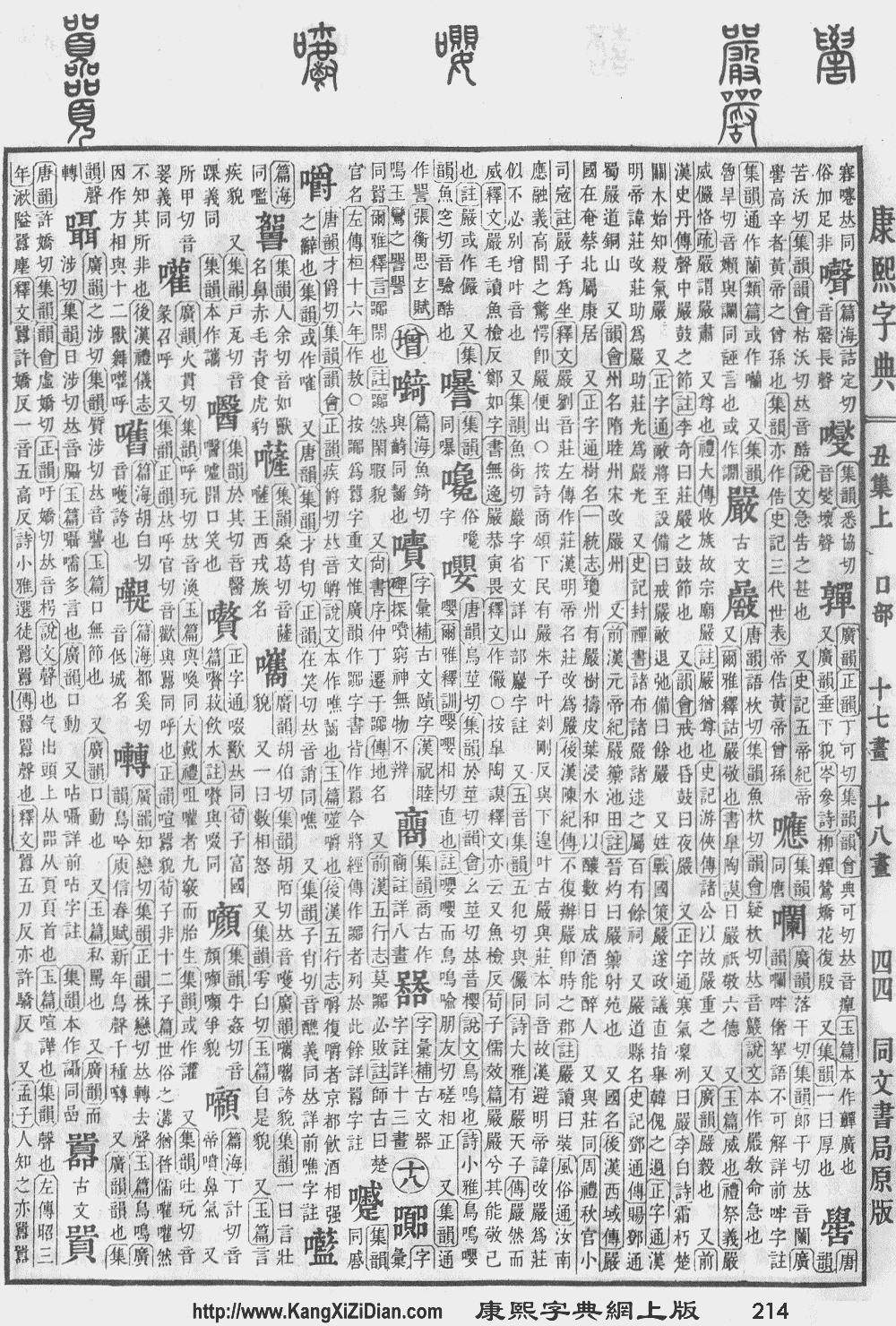
- Kangxi Dictionary: page 214, character 18
- Dai Kanwa Jiten: character 4602
- Dae Jaweon: page 437, character 8
- Hanyu Da Zidian (first edition): volume 1, page 704, character 8
- Unihan data for U+56BC
Chinese
| simp. and trad. |
嚼 | |
|---|---|---|
| alternative forms | 𪚅/𬺖 噍 (ziu6) Cantonese 𡁻 (ziu6) Cantonese | |
Glyph origin
Characters in the same phonetic series (爵) (Zhengzhang, 2003)
Phono-semantic compound (形聲/形声, OC *zewɢ) : semantic 口 (“mouth”) + phonetic 爵 (OC *ʔsewɢ).
Etymology 1
Schuessler (2003) links this word with Proto-Mon-Khmer *caʔ (“to eat”). Also compare Proto-Sino-Tibetan *dzaʔ (“to eat”).
Pronunciation
Definitions
嚼
Synonyms
Dialectal synonyms of 嚼 (“to chew”) [map]
| Variety | Location | Words |
|---|---|---|
| Formal (Written Standard Chinese) | 咀嚼 | |
| Mandarin | Beijing | 嚼 |
| Jinan | 嚼 | |
| Xi'an | 嚼 | |
| Wuhan | 嚼 | |
| Chengdu | 嚼 | |
| Yangzhou | 嚼 | |
| Hefei | 噍 | |
| Singapore | 嚼 | |
| Cantonese | Guangzhou | 噍 |
| Hong Kong | 噍 | |
| Yangjiang | 唵 | |
| Gan | Nanchang | 噍 |
| Hakka | Meixian | 噍 |
| Jin | Taiyuan | 咬, 喃 |
| Northern Min | Jian'ou | 哺 |
| Eastern Min | Fuzhou | 嚼 |
| Southern Min | Xiamen | 哺 |
| Quanzhou | 哺 | |
| Jinjiang | 哺 | |
| Zhangzhou | 哺 | |
| Taipei | 哺, 嗕 | |
| Taipei (Wanhua) | 哺 | |
| New Taipei (Sanxia) | 哺, 嗕 | |
| Kaohsiung | 哺 | |
| Yilan | 哺 | |
| Changhua (Lukang) | 哺 | |
| Taichung | 哺 | |
| Taichung (Wuqi) | 哺 | |
| Tainan | 哺 | |
| Taitung | 咬 | |
| Hsinchu | 哺 | |
| Kinmen | 哺 | |
| Penghu (Magong) | 哺 | |
| Manila (Hokkien) | 哺 | |
| Chaozhou | 哺 | |
| Jieyang | 哺 | |
| Leizhou | 哺 | |
| Haikou | 哺 | |
| Wu | Suzhou | 嚼 |
| Wenzhou | 嚼 | |
| Xiang | Changsha | 嚼, 噍 |
| Shuangfeng | 嚼 | |
Compounds
Pronunciation
Definitions
嚼
- (Hokkien) to chatter; to prattle; to talk incessantly (used mainly in compounds)
- 嚼嚼叫 [Hokkien, trad. and simp.]
- chia̍uh-chia̍uh-kiò [Pe̍h-ōe-jī]
- to chatter without ceasing
- (Taiwanese Hokkien, music, dated) paiban (played by hitting it on one's palm or knee)
- (Taiwanese Hokkien, music, dated) sound of a paiban
- (Taiwanese Hokkien, music, dated) to play the paiban
- (Taiwanese Hokkien, dated) to jump in a bouncing way like a rabbit
- 一直嚼來/一直嚼来 [Taiwanese Hokkien] ― it-ti̍t chhia̍uh lâi [Pe̍h-ōe-jī] ― to come keeping on jumping in a bouncing way
Japanese
Kanji
嚼
- This term needs a translation to English. Please help out and add a translation, then remove the text
{{rfdef}}.
Korean
Hanja
嚼 • (jak) (hangeul 작, revised jak, McCune–Reischauer chak)
- This term needs a translation to English. Please help out and add a translation, then remove the text
{{rfdef}}.
Vietnamese
This article is issued from Wiktionary. The text is licensed under Creative Commons - Attribution - Sharealike. Additional terms may apply for the media files.