唵

唵 U+5535, 唵
CJK UNIFIED IDEOGRAPH-5535
← 唴
[U+5534]
CJK Unified Ideographs 唶 →
[U+5536]

Translingual

Han character

唵 (Kangxi radical 30, 口+8, 11 strokes, cangjie input 口大中山 (RKLU), four-corner 64016, composition ⿰口奄)

References

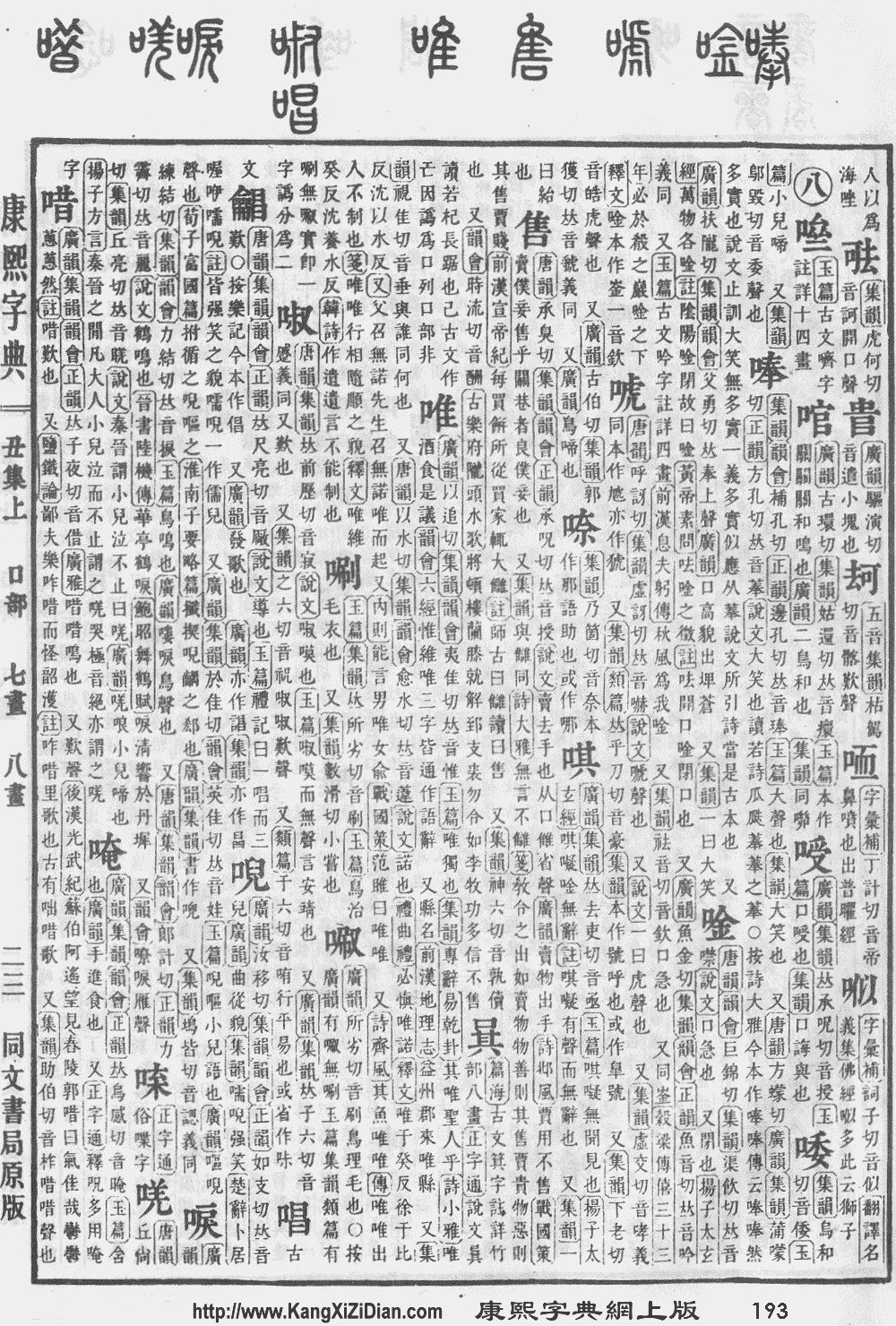
  • Kangxi Dictionary: page 193, character 27
  • Dai Kanwa Jiten: character 3770
  • Dae Jaweon: page 414, character 6
  • Hanyu Da Zidian (first edition): volume 1, page 638, character 14
  • Unihan data for U+5535

Chinese

Glyph origin

Etymology 1

trad. 唵
simp. # 唵

Schuessler (2007) suggests that this is an endoactive derivation from 喑 (OC *qɯːm, “mute; silent”).

Ultimately from Proto-Sino-Tibetan *m-ʔum ~ *mum (“to hold in mouth; to chew; to eat; to kiss”); compare Tibetan ཨུམ (um, “kiss”) (STEDT; Benedict, 1972; Coblin, 1986; Schuessler, 2007).

Pronunciation


Note: The zero initial /∅-/ is commonly pronounced with a ng-initial /ŋ-/ in some varieties of Cantonese, including Hong Kong Cantonese.

Rime
Character 唵
Reading # 1/1
Initial (聲) 影 (34)
Final (韻) 覃 (159)
Tone (調) Rising (X)
Openness (開合) Open
Division (等) I
Fanqie 烏感切
Baxter 'omX
Reconstructions
Zhengzhang
Shangfang
/ʔʌmX/
Pan
Wuyun
/ʔəmX/
Shao
Rongfen
/ʔɒmX/
Edwin
Pulleyblank
/ʔəmX/
Li
Rong
/ʔᴀmX/
Wang
Li
/ɒmX/
Bernard
Karlgren
/ʔămX/
Expected
Mandarin
Reflex
ǎn
Expected
Cantonese
Reflex
am2
Zhengzhang system (2003)
Character 唵
Reading # 1/1
No. 14333
Phonetic
component
奄
Rime
group
談
Rime
subdivision
3
Corresponding
MC rime
晻
Old
Chinese
/*qoːmʔ/

Definitions

唵

  1. (obsolete, rare) to hold in one's mouth
  2. to eat with one's hand

Etymology 2

trad. 唵
simp. # 唵

Learned borrowing from Sanskrit ॐ (oṃ).

Pronunciation


Rime
Character 唵
Reading # 1/1
Initial (聲) 影 (34)
Final (韻) 覃 (159)
Tone (調) Rising (X)
Openness (開合) Open
Division (等) I
Fanqie 烏感切
Baxter 'omX
Reconstructions
Zhengzhang
Shangfang
/ʔʌmX/
Pan
Wuyun
/ʔəmX/
Shao
Rongfen
/ʔɒmX/
Edwin
Pulleyblank
/ʔəmX/
Li
Rong
/ʔᴀmX/
Wang
Li
/ɒmX/
Bernard
Karlgren
/ʔămX/
Expected
Mandarin
Reflex
ǎn
Expected
Cantonese
Reflex
am2

Definitions

唵

  1. (Buddhism) om, aum
    Synonym: 嗡

Compounds

Etymology 3

trad. 唵
simp. # 唵

Pronunciation 1


Note: The zero initial /∅-/ is commonly pronounced with a ng-initial /ŋ-/ in some varieties of Cantonese, including Hong Kong Cantonese.
Definitions

唵

  1. An interjection indicating doubt: um

Pronunciation 2


Definitions

唵

  1. An interjection indicating response: mhm; uh-huh

Etymology 4

trad. 唵
simp. # 唵
alternative forms 食

Onomatopoeic.

Pronunciation


Definitions

唵

  1. (Hokkien, childish) to eat
Synonyms

Etymology 5

trad. 唵
simp. # 唵

Pronunciation


Definitions

唵

  1. Used in compounds.

Compounds

  • 唵噆

References

Japanese

Kanji

唵

(uncommon “Hyōgai” kanji)

  1. syllable

Readings

(Can we verify(+) this pronunciation?)

Etymology

Kanji in this term
唵
おん
Hyōgaiji
on’yomi

*/om/ → /omu/ → /oɴ/

From Middle Chinese 唵 (ʔʌmX), itself a transliteration of Sanskrit ॐ (oṃ).[1][2][3][4]

The goon pronunciation, so likely the initial borrowing.

Pronunciation

  • IPA(key): [õ̞ɴ]

Noun

唵(おん) or 唵(オン) • (on) 

  1. (Buddhism) om, aum
    Synonym: オーム (ōmu)

Interjection

唵(おん) or 唵(オン) • (on) 

  1. (Buddhism) om, aum
    Synonym: オーム (ōmu)

Derived terms

References

  1. “唵”, in 日本大百科全書:ニッポニカ (Nippon Dai Hyakka Zensho: Nipponica, “Encyclopedia Nipponica”)‎ (in Japanese), Tōkyō: Shogakukan, 1984
  2. Matsumura, Akira (1995) 大辞泉 [Daijisen] (in Japanese), First edition, Tōkyō: Shogakukan, →ISBN
  3. “唵”, in 世界大百科事典 第2版 (Sekai Dai-hyakka Jiten Dainihan, “Heibonsha World Encyclopedia Second Edition”)‎ (in Japanese), Tōkyō: Heibonsha, 1998
  4. Matsumura, Akira, editor (2006), 大辞林 [Daijirin] (in Japanese), Third edition, Tōkyō: Sanseidō, →ISBN

Korean

Hanja

唵 • (am, om) (hangeul 암, 옴, revised am, om, McCune–Reischauer am, om)

  1. This term needs a translation to English. Please help out and add a translation, then remove the text {{rfdef}}.

Vietnamese

Han character

唵: Hán Nôm readings: án, úm, ướm, ngàn, ngạn

  1. (Buddhism) om; aum

References

This article is issued from Wiktionary. The text is licensed under Creative Commons - Attribution - Sharealike. Additional terms may apply for the media files.