囡
| ||||||||
Translingual
Han character
囡 (Kangxi radical 31, 囗+3, 6 strokes, cangjie input 田女 (WV), four-corner 60404, composition ⿴囗女)
Derived characters
- 𥜫, 𦮗
References
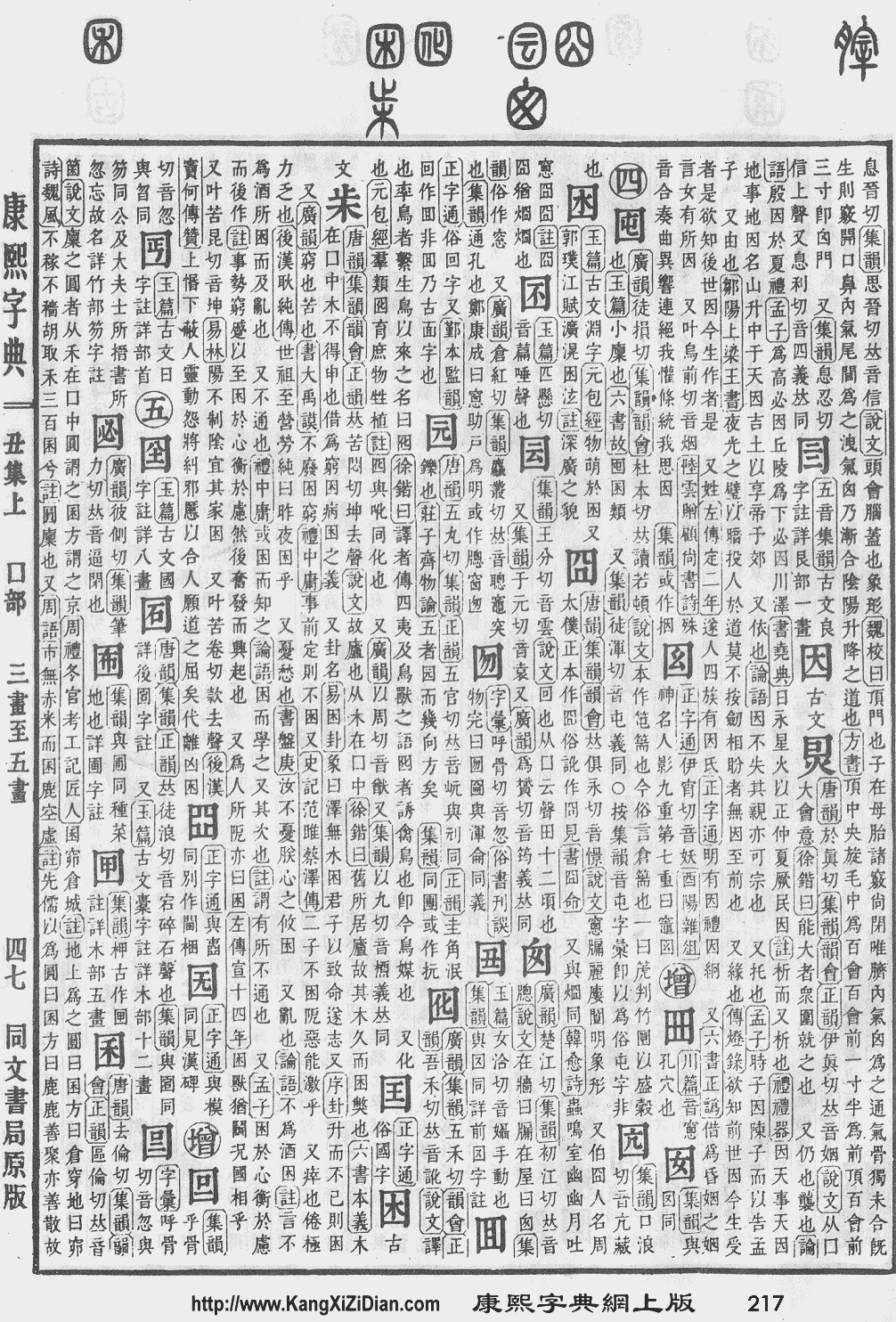
- Kangxi Dictionary: page 217, character 6
- Dai Kanwa Jiten: character 4696
- Dae Jaweon: page 444, character 5
- Hanyu Da Zidian (first edition): volume 1, page 713, character 8
- Unihan data for U+56E1
Chinese
Etymology 1
| trad. | 囡 | |
|---|---|---|
| simp. # | 囡 | |
| alternative forms | 囝 (especially referring to a boy) | |
Pan (2015) proposes that it is a contraction of 女兒/女儿, comparing it to 蝦/虾 (1ho; 1hoe), where 1hoe is a contraction of 蝦兒/虾儿, and noting that some Wu dialects pronounce 女 (6gniu) with a 麻 (MC mae)-final (/o/).
Pronunciation
Synonyms
Dialectal synonyms of 小孩 (“child; kid”) [map]
Dialectal synonyms of 女兒 (“daughter”) [map]
Compounds
Pronunciation
Compounds
- 囡囡 (neoi5-4 neoi5-1) (Cantonese)
Pronunciation
Compounds
- 囡仔 (Min Nan)
- 囡仔人 (Min Nan)
- 囡仔兄 (Min Nan)
- 囡仔囝 (Min Nan)
- 囡仔嬰/囡仔婴 (Min Nan)
- 囡仔工 (Min Nan)
- 囡仔性 (Min Nan)
- 囡仔栽 (Min Nan)
- 囡仔款 (Min Nan)
- 囡仔歌 (Min Nan)
- 囡仔疕 (Min Nan)
- 年尾囡仔 (Min Nan)
- 抾囡仔 (Min Nan)
- 查埔囡仔 (Min Nan)
- 查某囡仔 (Min Nan)
- 死囡仔 (Min Nan)
- 死囡仔脯 (Min Nan)
- 死囡仔䖙 (Min Nan)
- 猴囡仔 (Min Nan)
- 生囡仔 (Min Nan)
- 育囡仔 (Min Nan)
- 育囡仔歌 (Min Nan)
- 𨑨迌囡仔 (Min Nan)
- 騙囡仔/骗囡仔 (Min Nan)
References
- Dictionary of Chinese Character Variants (教育部異體字字典), B00480
- The template Template:R:nan:thcwda does not use the parameter(s):
1=267
Please see Module:checkparams for help with this warning.“(#)”, in 臺灣閩南語按呢寫, Ministry of Education, R.O.C., 2013.
Japanese
Vietnamese
Han character
囡: Hán Nôm readings: niếp
- This term needs a translation to English. Please help out and add a translation, then remove the text
{{rfdef}}.
References
This article is issued from Wiktionary. The text is licensed under Creative Commons - Attribution - Sharealike. Additional terms may apply for the media files.