开
| ||||||||
Translingual
| Stroke order | |||
|---|---|---|---|
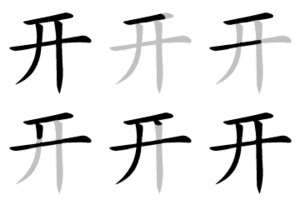 | |||
| Stroke order | |||
|---|---|---|---|
 | |||
Han character
开 (Kangxi radical 55, 廾+1, 4 strokes, cangjie input 一廿 (MT), four-corner 10440, composition ⿱一廾)
References
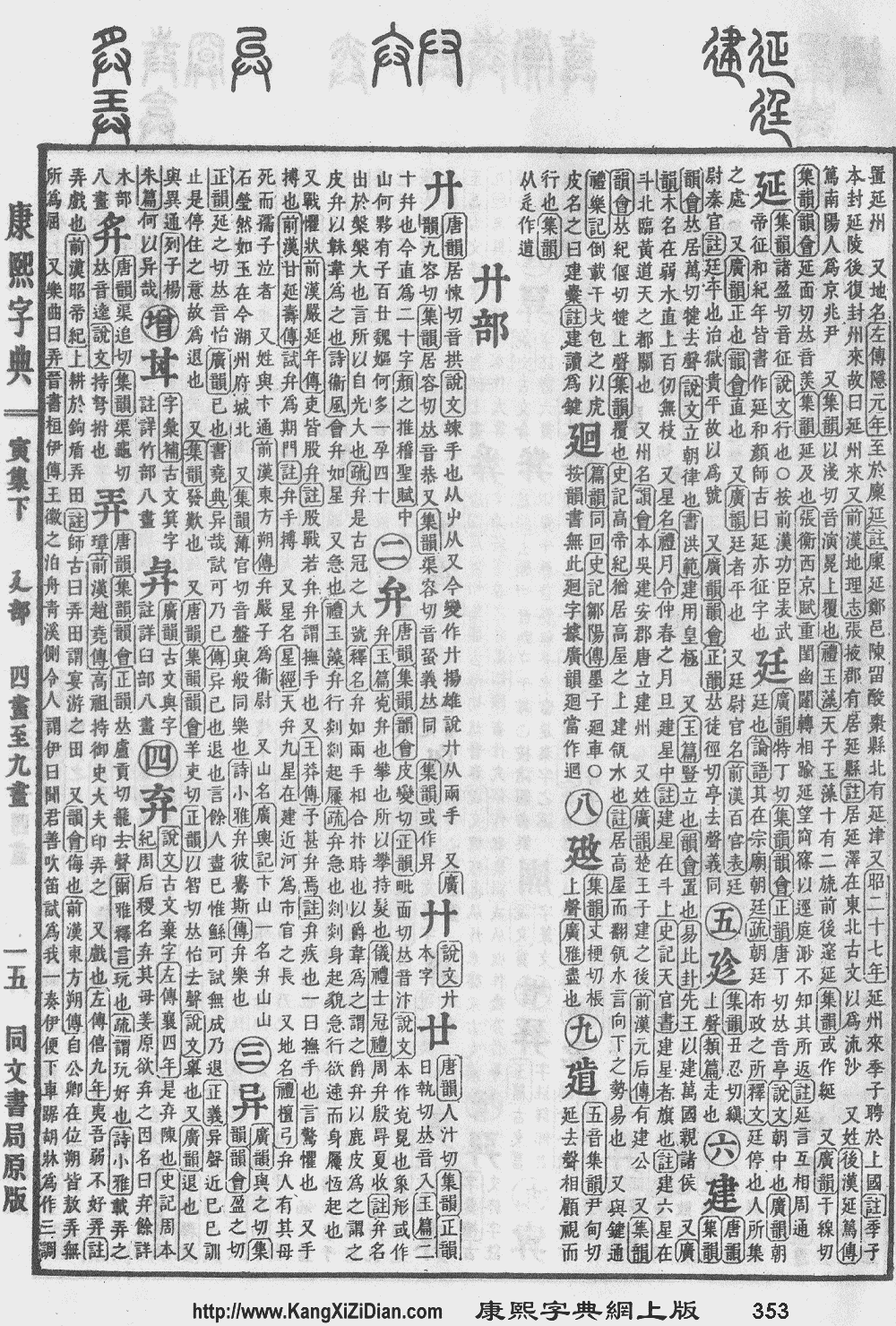
- Kangxi Dictionary: not present, would follow page 353, character 10
- Hanyu Da Zidian (first edition): volume 1, page 514, character 3
- Unihan data for U+5F00
Chinese
Glyph origin
Ideogrammic compound (會意/会意) : 干 + 干 (“trunk”). Two trunks are of the same height.
Also Simplified from 開 (elimination of 門).
As a component in composite characters, the part is not directly related to 開 and instead originally derives from 井 (such as in 刑, 型, etc.) or from 幵 (such as in 研, 形, etc.).
Etymology 1
| For pronunciation and definitions of 开 – see 幵 (“even, level”). (This character is a variant form of 幵). |
Etymology 2
| For pronunciation and definitions of 开 – see 開 (“to open; to unlatch; to unfasten; to start; to turn on; to switch on; etc.”). (This character is the simplified form of 開). |
Notes:
|
Vietnamese
Han character
- This term needs a translation to English. Please help out and add a translation, then remove the text
{{rfdef}}.
References
This article is issued from Wiktionary. The text is licensed under Creative Commons - Attribution - Sharealike. Additional terms may apply for the media files.