開
| ||||||||
| ||||||||
Translingual
Han character
開 (Kangxi radical 169, 門+4, 12 strokes, cangjie input 日弓一廿 (ANMT), four-corner 77441, composition ⿵門开(U+958B) or ⿵門幵(U+2F9EE))
References
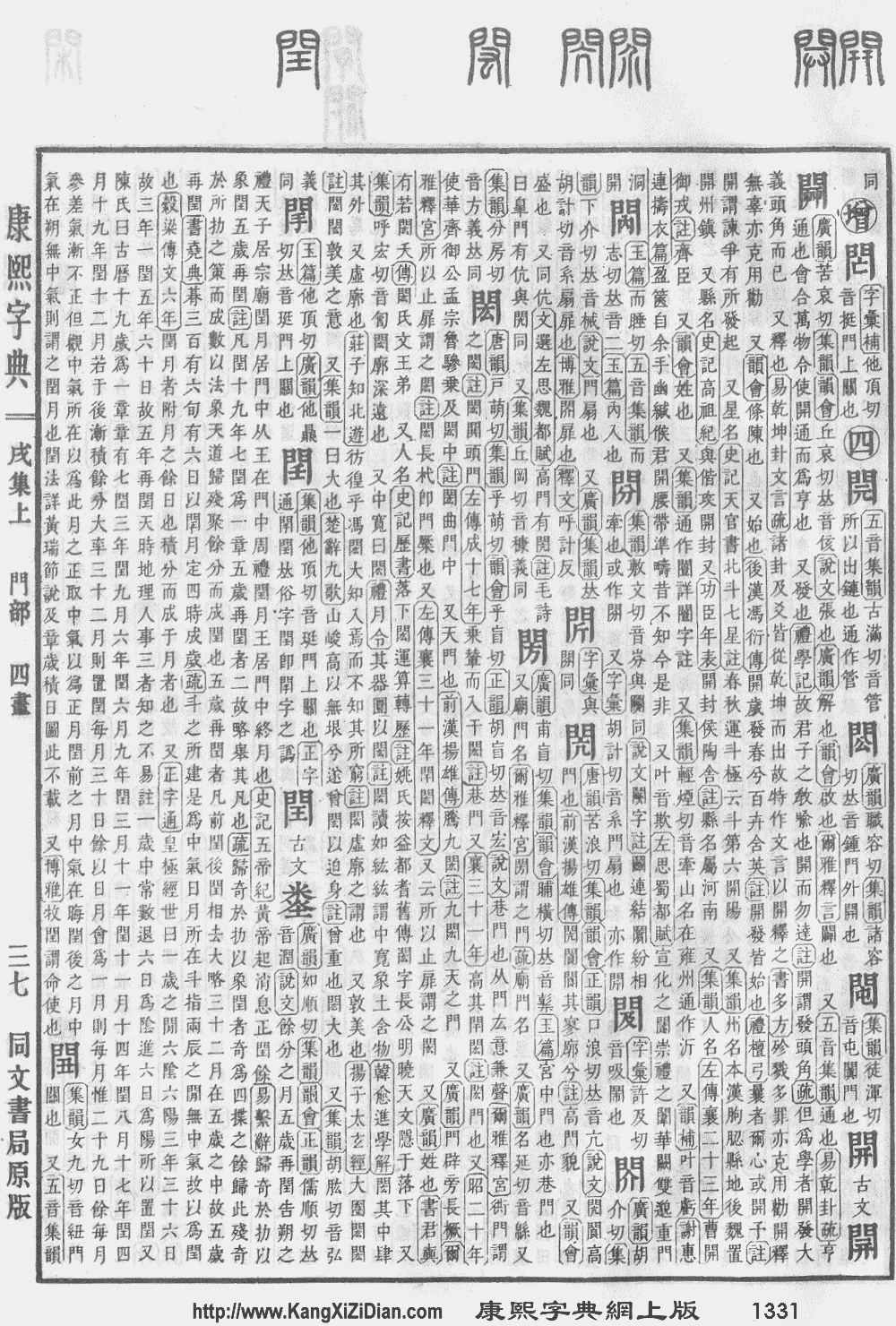
- Kangxi Dictionary: page 1331, character 5
- Dai Kanwa Jiten: character 41233
- Dae Jaweon: page 1835, character 15
- Hanyu Da Zidian (first edition): volume 7, page 4286, character 2
- Unihan data for U+958B
- Unihan data for U+2F9EE
Chinese
Glyph origin
| Historical forms of the character 開 | |||
|---|---|---|---|
| Warring States | Shuowen Jiezi (compiled in Han) | Liushutong (compiled in Ming) | |
| Qin slip script | Ancient script | Small seal script | Transcribed ancient scripts |
 |
 |
 |
 |
Ideogrammic compound (會意/会意) : 門 (“door”) + 一 (“latch”) + 廾 (“a pair of hands”) — a pair of hands opening a latched door. 一 and 廾 are combined into 开 since the seal script.
Compare 闢.
Etymology 1
| trad. | 開 | |
|---|---|---|
| simp. | 开* | |
| alternative forms | ||
According to STEDT, from Proto-Sino-Tibetan *m/s-k(w)a-j (“mouth; opening; spread; door; face; jaw”). Cognate with 戶 (OC *ɡʷaːʔ, “door”), Tibetan ཁ (kha, “mouth”), Tibetan སྒོ (sgo, “door”).
The word is possibly a colloquial variant of 闓 (OC *ŋ̊ʰɯːlʔ, *ŋ̊ʰɯːls) (Schuessler, 2007). Proto-Mien *kʰu̯ɔiᴬ (“to open”) (whence Iu Mien kʰɔi¹) and Thai ไข (kǎi) are Chinese loans (Ratliff, 2010).
Pronunciation
Definitions
開
- to open; to unlatch; to unfasten
- to start; to turn on; to switch on
- to make an opening; to open up
- (of a flower) to open out; to bloom
- (of a frozen river) to thaw
- to begin; to start
- to start; to set up; to open
- to remove (a ban or restriction)
- to boil (bubble and turn to vapour)
- to write out (a prescription, check, invoice, etc.)
- to book (a hotel room)
- to operate/run a business
- 係做木匠、在前開過一間細木舖、後來亦關唨咯、而家靜靠同人做工夫嚟過日子、 [Cantonese, trad.]
- From: 粵音指南·上卷, 卷之一 應對須知
- hai6 zou6 muk6 zoeng6-2, zoi6 cin4 hoi1 gwo3 jat1 gaan1 sai3 muk6 pou3-2, hau6 loi4 jik6 gwaan1 zo2 lo3, ji4 gaa1 zing6 kaau3 tung4 jan4 zou6 gung1 fu1 lai4 gwo3 jat6 zi2, [Jyutping]
- He used to work as a woodworker; he had operated a small wood shop, and later closed it as well; currently he only relies on working for other people to make a living.
系做木匠、在前开过一间细木铺、后来亦关唨咯、而家静靠同人做工夫嚟过日子、 [Cantonese, simp.]- 1905, T. B. Adam, An English-Chinese dictionary of the Foochow dialect:
- to hold (a meeting, exhibition, etc.)
- to pay
- to operate; to drive (a vehicle)
- apart; away
- (informal) Short for 開除/开除 (kāichú, “to fire; to sack; to discharge; to dismiss”).
- (informal) to eat up
- (Cantonese, archaic) Progressive aspect particle, used to express that an event is/was in progress.
- 1866, 花波 [Mary Lucy French], transl., 《述史淺譯》 [Bible History for the Least and the Lowest], volume 3, 雙門底福音堂, page 48:
- 㸃死呢、佢一日喺殿嗻拜開菩薩、仔入嚟殺死佢。 [Cantonese, trad.]
- dim2 sei2 ne1, keoi5 jat1 jat6 hai2 din3 syu3 baai3 hoi1 pou4 saat3, zai2 jap6 lei4 saat3 sei2 keoi5. [Jyutping]
- Soon after, when he [Sennacherib] was worshipping in the temple of his idol god, his sons rushed in, and smote him, and killed him. [original English]
How did he [Sennacherib] die? One day, when he was worshipping his idol god in the temple, his sons came in and killed him. [literal English translation]
点死呢、佢一日喺殿嗻拜开菩萨、仔入嚟杀死佢。 [Cantonese, simp.]
- 1899, 馬可福音中西字 [The Gospel according to St. Mark in English and Cantonese], Shanghai: American Presbyterian Mission Press, chapter 14, verse 18:
- 佢哋坐在席上、食開個時、耶穌話、我實在話你知、你哋之中、有一個共我同食嘅、是必賣我呀。 [Cantonese, trad.]
- keoi5 dei6 co5 zoi6 zik6 soeng6, sik6 hoi1 go3 si4, je4 sou1 waa6, ngo5 sat6 zoi6 waa6 nei5 zi1, nei5 dei6 zi1 zung1, jau5 jat1 go3 gung6 ngo5 tung4 sik6 ge3, si6 bit1 maai6 ngo5 aa3. [Jyutping]
- And as they sat and did eat [literally, were eating], Jesus said, Verily I say unto you, One of you which eateth with me shall betray me.
佢哋坐在席上、食开个时、耶稣话、我实在话你知、你哋之中、有一个共我同食嘅、是必卖我呀。 [Cantonese, simp.]
- (Cantonese) Inceptive and continuous aspect particle, used to express that an event has started and continues on for a while.
- 1954, 朱頂鶴, 陳雲, directed by 譚伯葉, 鄧轟, and 陳中堅, 好女十八嫁 [Eighteen Marriages of a Smart Girl], spoken by 阮母 (梁淑卿 [Leung Suk Hing]):
- 人哋屋企有開事㗎,人哋娶你返去希望沖喜㗎咋。 [Cantonese, trad.]
- jan4 dei6 uk1 kei2 jau5 hoi1 si6 gaa3, jan4 dei6 cou2 nei5 faan1 heoi3 hei1 mong6 cung1 hei2 gaa3 zaa1. [Jyutping]
- Their family has been having issues for a while; they're marrying you into the family in hopes of warding off ills.
人哋屋企有开事㗎,人哋娶你返去希望冲喜㗎咋。 [Cantonese, simp.]
- (Cantonese) Habitual aspect particle.
- (Cantonese) Converbal aspect particle used to express a condition or rationale.
- (Chinese phonetics) Short for 開口/开口 (kāikǒu, “open-mouthed”).
- (Hokkien) to spend (money)
- a surname
Antonyms
Compounds
- 不開/不开
- 不開交/不开交
- 不開眼/不开眼 (bùkāiyǎn)
- 丟開/丢开 (diūkāi)
- 丟開手/丢开手
- 伸開/伸开 (shēnkāi)
- 倒不開/倒不开
- 全開/全开
- 公開/公开 (gōngkāi)
- 公開信/公开信 (gōngkāixìn)
- 公開賽/公开赛 (gōngkāisài)
- 分開/分开 (fēnkāi)
- 剖開/剖开
- 劈開/劈开 (pīkāi)
- 勒開/勒开
- 半開化/半开化
- 半開眼/半开眼
- 半開門/半开门
- 召開/召开 (zhàokāi)
- 吃不開/吃不开
- 吃得開/吃得开
- 大開/大开
- 天開眼/天开眼
- 尋開心/寻开心 (xúnkāixīn)
- 對開/对开 (duìkāi)
- 小開/小开 (xiǎokāi)
- 展開/展开 (zhǎnkāi)
- 岔開/岔开
- 張開/张开 (zhāngkāi)
- 性開放/性开放
- 想不開/想不开 (xiǎngbùkāi)
- 想得開/想得开 (xiǎngdekāi)
- 想開/想开 (xiǎngkāi)
- 截開/截开
- 打開/打开 (dǎkāi)
- 扭開/扭开
- 抖開/抖开
- 抹不開/抹不开
- 拉開/拉开 (lākai)
- 拆開/拆开 (chāikāi)
- 拋開/抛开 (pāokāi)
- 挪開/挪开 (nuókāi)
- 捅開/捅开
- 推開/推开
- 掀開/掀开 (xiānkāi)
- 掙開/挣开
- 掉開/掉开
- 掰開/掰开 (bāikāi)
- 揭開/揭开 (jiēkāi)
- 搬開/搬开 (bānkāi)
- 撇開/撇开 (piēkāi)
- 撂開/撂开
- 撂開手/撂开手
- 撕開/撕开
- 撬開/撬开 (qiàokāi)
- 撥開/拨开 (bōkāi)
- 撒開/撒开
- 撐開/撑开
- 擇不開/择不开
- 擘開/擘开 (bòkāi)
- 擰開/拧开
- 擺不開/摆不开
- 擺開/摆开 (bǎikāi)
- 攤開/摊开 (tānkāi)
- 支開/支开
- 放開/放开 (fàngkāi)
- 敞開/敞开 (chǎngkāi)
- 散開/散开 (sànkāi)
- 敞開兒/敞开儿
- 敲開/敲开 (qiāokāi)
- 明開/明开
- 易開罐/易开罐 (yìkāiguàn)
- 未開/未开 (wèikāi)
- 格開/格开
- 沒開交/没开交
- 洞開/洞开 (dòngkāi)
- 滾開/滚开 (gǔnkāi)
- 登開/登开
- 發開/发开
- 白開水/白开水 (báikāishuǐ)
- 盛開/盛开 (shèngkāi)
- 看得開/看得开
- 看開/看开 (kànkāi)
- 眉開/眉开
- 睜開/睁开
- 磨不開/磨不开
- 窮開心/穷开心
- 綽開/绰开
- 綻開/绽开 (zhànkāi)
- 翻開/翻开 (fānkāi)
- 老開/老开 (lǎokāi)
- 蘭開夏/兰开夏
- 行開/行开
- 裂開/裂开 (lièkāi)
- 解開/解开 (jiěkāi)
- 計開/计开
- 說開/说开
- 調開/调开
- 談開/谈开
- 走不開/走不开
- 走得開/走得开
- 起開/起开
- 趕開/赶开
- 躲開/躲开 (duǒkai)
- 邁開/迈开 (màikāi)
- 避開/避开 (bìkāi)
- 鋪開/铺开
- 閃開/闪开 (shǎnkāi)
- 開OT/开OT
- 開不開/开不开
- 開交/开交 (kāijiāo)
- 開仗/开仗 (kāizhàng)
- 開伙
- 開伯爾山口/开伯尔山口 (Kāibó'ěr Shānkǒu)
- 開例/开例
- 開倒車/开倒车 (kāidàochē)
- 開價/开价 (kāijià)
- 開價兒/开价儿
- 開元/开元 (kāiyuán)
- 開元禮/开元礼
- 開元錄/开元录
- 開光/开光 (kāiguāng)
- 開先例/开先例
- 開具/开具 (kāijù)
- 開冬/开冬
- 開凍/开冻 (kāidòng)
- 開刀/开刀 (kāidāo)
- 開刃/开刃 (kāirèn)
- 開刃兒/开刃儿
- 開列/开列 (kāiliè)
- 開初/开初 (kāichū)
- 開創/开创 (kāichuàng)
- 開動/开动 (kāidòng)
- 開化/开化 (kāihuà)
- 開化史/开化史
- 開印/开印
- 開卷/开卷 (kāijuàn)
- 開卷考/开卷考
- 開取/开取
- 開口/开口 (kāikǒu)
- 開口呼/开口呼 (kāikǒuhū)
- 開口子/开口子
- 開口笑/开口笑 (kāikǒuxiào)
- 開口跳/开口跳
- 開口閉口/开口闭口 (kāikǒubìkǒu)
- 開司米/开司米 (kāisīmǐ)
- 開呵/开呵
- 開單/开单
- 開喪/开丧
- 開嗙/开嗙
- 開國/开国 (kāiguó)
- 開園/开园 (kāiyuán)
- 開地/开地
- 開坊/开坊
- 開堂/开堂
- 開基/开基 (kāijī)
- 開場/开场 (kāichǎng)
- 開場白/开场白 (kāichǎngbái)
- 開塞利/开塞利
- 開墒/开墒 (kāishāng)
- 開墾/开垦 (kāikěn)
- 開士/开士 (kāishì)
- 開外/开外
- 開夜車/开夜车 (kāiyèchē)
- 開天窗/开天窗 (kāitiānchuāng)
- 開天闢地/开天辟地 (kāitiānpìdì)
- 開始/开始 (kāishǐ)
- 開姆尼茨/开姆尼茨
- 開學/开学 (kāixué)
- 開宗明義/开宗明义 (kāizōngmíngyì)
- 開審/开审
- 開封/开封 (kāifēng)
- 開導/开导 (kāidǎo)
- 開小差/开小差 (kāi xiǎochāi)
- 開小差兒/开小差儿
- 開局/开局 (kāijú)
- 開尾韻/开尾韵
- 開屏/开屏 (kāipíng)
- 開展/开展 (kāizhǎn)
- 開山/开山 (kāishān)
- 開山刀/开山刀 (kāishāndāo)
- 開山斧/开山斧
- 開山機/开山机
- 開山祖師/开山祖师
- 開山門/开山门
- 開州/开州 (Kāizhōu, “Kaizhou”)
- 開工/开工 (kāigōng)
- 開差/开差
- 開市/开市 (kāishì)
- 開席/开席
- 開帳/开帐
- 開幕/开幕 (kāimù)
- 開幕式/开幕式 (kāimùshì)
- 開幫/开帮
- 開平/开平 (Kāipíng)
- 開平方/开平方
- 開平盤/开平盘
- 開年/开年 (kāinián)
- 開店/开店 (kāidiàn)
- 開庭/开庭 (kāitíng)
- 開廟/开庙
- 開弓/开弓 (kāigōng)
- 開弔/开吊 (kāidiào)
- 開弦弓/开弦弓 (Kāixiángōng)
- 開張/开张 (kāizhāng)
- 開征
- 開往/开往
- 開後門/开后门
- 開後門兒/开后门儿
- 開復/开复 (kāifù)
- 開徵/开征 (kāizhēng)
- 開心/开心 (kāixīn)
- 開心丸兒/开心丸儿
- 開心斧/开心斧
- 開心果/开心果 (kāixīnguǒ)
- 開快車/开快车
- 開恩/开恩 (kāi'ēn)
- 開悟/开悟 (kāiwù)
- 開懷/开怀 (kāihuái)
- 開懷兒/开怀儿
- 開戒/开戒
- 開戰/开战 (kāizhàn)
- 開戲/开戏
- 開戶/开户 (kāihù)
- 開房間/开房间 (kāi fángjiān)
- 開手/开手
- 開手錢/开手钱
- 開打/开打 (kāidǎ)
- 開拔/开拔
- 開拓/开拓 (kāituò)
- 開拍/开拍 (kāipāi)
- 開挖/开挖 (kāiwā)
- 開排/开排
- 開掘/开掘 (kāijué)
- 開採/开采 (kāicǎi)
- 開播/开播 (kāibō)
- 開支/开支 (kāizhī)
- 開放/开放 (kāifàng)
- 開放型/开放型
- 開敏/开敏
- 開啟/开启 (kāiqǐ)
- 開敞地/开敞地
- 開數/开数
- 開新板/开新板
- 開方/开方 (kāifāng)
- 開明/开明 (kāimíng)
- 開映/开映
- 開春/开春 (kāichūn)
- 開春兒/开春儿
- 開晴/开晴
- 開普敦/开普敦 (Kāipǔdūn)
- 開暢/开畅
- 開曠/开旷 (kāikuàng)
- 開會/开会 (kāihuì)
- 開朗/开朗 (kāilǎng)
- 開本/开本 (kāiběn)
- 開板/开板
- 開板兒/开板儿
- 開架/开架 (kāijià)
- 開業/开业 (kāiyè)
- 開槍/开枪 (kāiqiāng)
- 開槓/开杠 (kāigàng)
- 開標/开标 (kāibiāo)
- 開機/开机 (kāijī)
- 開歲/开岁
- 開氣兒/开气儿
- 開水/开水 (kāishuǐ)
- 開江/开江
- 開汽水/开汽水 (kāi qìshuǐ)
- 開河/开河 (kāihé)
- 開泰/开泰
- 開洋/开洋 (kāiyáng)
- 開洋葷/开洋荤
- 開消/开消
- 開涮/开涮 (kāishuàn)
- 開溜/开溜
- 開源/开源 (kāiyuán)
- 開源節流/开源节流
- 開演/开演 (kāiyǎn)
- 開濟/开济
- 開濬/开濬
- 開火/开火 (kāihuǒ)
- 開火兒/开火儿
- 開炮/开炮
- 開爐/开炉 (kāilú)
- 開片/开片 (kāipiàn)
- 開犁/开犁 (kāilí)
- 開獎/开奖 (kāijiǎng)
- 開玩笑/开玩笑 (kāi wánxiào)
- 開班/开班 (kāibān)
- 開球/开球
- 開瓢兒/开瓢儿
- 開瓶費/开瓶费
- 開疆/开疆 (kāijiāng)
- 開發/开发 (kāifā)
- 開發井/开发井
- 開發區/开发区 (kāifāqū)
- 開發商/开发商 (kāifāshāng)
- 開盤/开盘 (kāipán)
- 開盤價/开盘价
- 開盤子/开盘子
- 開眼/开眼 (kāiyǎn)
- 開眼界/开眼界
- 開砲/开炮
- 開碼頭/开码头
- 開礦/开矿 (kāikuàng)
- 開示/开示 (kāishì)
- 開票/开票 (kāipiào)
- 開禁/开禁 (kāijìn)
- 開私門/开私门
- 開秋/开秋
- 開科/开科
- 開秤/开秤
- 開竅/开窍 (kāiqiào)
- 開竅兒/开窍儿
- 開立/开立
- 開立方/开立方
- 開端/开端 (kāiduān)
- 開第/开第
- 開筆/开笔 (kāibǐ)
- 開筵/开筵
- 開篇/开篇
- 開紅燈/开红灯
- 開紅盤/开红盘
- 開素/开素
- 開綻/开绽
- 開綠燈/开绿灯 (kāi lǜdēng)
- 開編/开编
- 開線/开线
- 開縫/开缝
- 開缺/开缺
- 開罐器/开罐器 (kāiguànqì)
- 開罪/开罪 (kāizuì)
- 開罵/开骂 (kāimà)
- 開羅/开罗 (Kāiluó)
- 開考/开考 (kāikǎo)
- 開胃/开胃 (kāiwèi)
- 開脫/开脱 (kāituō)
- 開腔/开腔 (kāiqiāng)
- 開膛/开膛 (kāitáng)
- 開膠/开胶 (kāijiāo)
- 開臉/开脸
- 開臺/开台 (kāitái)
- 開臺/開台/开台 (kāitái)
- 開臺鑼鼓/開台鑼鼓/开台锣鼓 (kāitáiluógǔ)
- 開航/开航 (kāiháng)
- 開船/开船 (kāichuán)
- 開花/开花 (kāihuā)
- 開花兒/开花儿
- 開花帳/开花帐
- 開花期/开花期
- 開花豆/开花豆
- 開花豆兒/开花豆儿
- 開荒/开荒 (kāihuāng)
- 開荒劍/开荒剑
- 開葷/开荤 (kāihūn)
- 開落/开落
- 開蒙/开蒙
- 開藥方/开药方
- 開行/开行
- 開衫/开衫 (kāishān)
- 開衩/开衩 (kāichà)
- 開衩兒/开衩儿
- 開衫兒/开衫儿
- 開裂/开裂 (kāiliè)
- 開裾/开裾 (khui-ki) (Min Nan)
- 開襟/开襟
- 開襠褲/开裆裤 (kāidāngkù)
- 開解/开解
- 開言/开言 (kāiyán)
- 開訓/开训
- 開設/开设 (kāishè)
- 開診/开诊
- 開話/开话
- 開誠布公/开诚布公 (kāichéngbùgōng)
- 開誠相見/开诚相见
- 開課/开课 (kāikè)
- 開講/开讲 (kāijiǎng)
- 開議/开议 (kāiyì)
- 開豁/开豁
- 開賀/开贺
- 開賬/开账
- 開賽/开赛
- 開赴/开赴 (kāifù)
- 開路/开路 (kāilù)
- 開路神/开路神
- 開車/开车 (kāichē)
- 開辦/开办 (kāibàn)
- 開辦費/开办费
- 開通/开通
- 開進/开进
- 開運/开运
- 開道/开道 (kāidào)
- 開過眼/开过眼
- 開酒/开酒
- 開釋/开释 (kāishì)
- 開金/开金 (kāijīn)
- 開鋤/开锄
- 開銷/开销 (kāixiāo)
- 開鍋/开锅 (kāiguō)
- 開鏡/开镜
- 開鐮/开镰
- 開鑼/开锣 (kāiluó)
- 開鑿/开凿 (kāizáo)
- 開門/开门 (kāimén)
- 開門揖盜/开门揖盗 (kāiményīdào)
- 開門砲/开门炮
- 開門紅/开门红 (kāiménhóng)
- 開門見山/开门见山 (kāiménjiànshān)
- 開門錢/开门钱
- 開間/开间
- 開閘/开闸
- 開闊/开阔 (kāikuò)
- 開闊地/开阔地
- 開闔/开阖
- 開關/开关 (kāiguān)
- 開闢/开辟 (kāipì)
- 開除/开除 (kāichú)
- 開陽/开阳 (Kāiyáng)
- 開霽/开霁
- 開靜/开静
- 開面/开面
- 開靨/开靥
- 開革/开革
- 開領/开领
- 開頭/开头 (kāitóu)
- 開頭兒/开头儿 (kāitóur)
- 開頭炮/开头炮
- 開顏/开颜
- 開風/开风
- 開風氣/开风气
- 開飯/开饭 (kāifàn)
- 開飲機/开饮机
- 開館/开馆 (kāiguǎn)
- 開首/开首 (kāishǒu)
- 開鬨/开哄
- 開麥拉/开麦拉 (kāimàilā)
- 開齋/开斋 (kāizhāi)
- 開齋節/开斋节 (Kāizhāijié)
- 隔開/隔开 (gékāi)
- 離不開/离不开 (líbùkāi)
- 離開/离开 (líkāi)
- 頓開/顿开
- 飄開/飘开
- 鬆開/松开 (sōngkāi)
Descendants
Others:
Pronunciation
Pronunciation
Etymology 4
| trad. | 開 | |
|---|---|---|
| simp. | 开* | |
| alternative forms | 嗨 | |
(This etymology is missing or incomplete. Please add to it, or discuss it at the Etymology scriptorium.)
Synonyms

Korean
Etymology
From Middle Chinese 開 (MC khoj). Recorded as Middle Korean ᄀᆡ (koy) (Yale: koy) in Hunmong Jahoe (訓蒙字會 / 훈몽자회), 1527.
Compounds
- 개폐 (開閉, gaepye)
- 개강 (開講, gaegang)
- 개관 (開館, gaegwan)
- 개교 (開校, gaegyo)
- 개국 (開國, gaeguk)
- 개막 (開幕, gaemak)
- 개발 (開發, gaebal)
- 개방 (開放, gaebang)
- 개봉 (開封, gaebong)
- 개설 (開設, gaeseol)
- 개성 (開城, Gaeseong)
- 개시 (開始, gaesi)
- 개업 (開業, gaeeop)
- 개척 (開拓, gaecheok)
- 개최 (開催, gaechoe)
- 개표 (開票, gaepyo)
- 개학 (開學, gaehak)
- 개항 (開港, gaehang)
- 개회 (開會, gaehoe)
- 공개 (公開, gonggae)
- 전개 (展開, jeon'gae)
- 절개 (切開, jeolgae)
- 타개 (打開, tagae)
- 재개 (再開, jaegae)
- 개통 (開通, gaetong)
- 개화 (開化, gaehwa)
- 개학 (開學, gaehak)
- 개장 (開場, gaejang)
Vietnamese
References
- Trần (1999).
- Nguyễn et al. (2009).
- Bonet (1899).
- Génibrel (1898).
- Hồ (1976).