弥
| ||||||||
Translingual
| Japanese | 弥 |
|---|---|
| Simplified | 弥 |
| Traditional | 彌 |
Han character
弥 (Kangxi radical 57, 弓+5, 8 strokes, cangjie input 弓弓火 (NNF), composition ⿰弓尔(G) or ⿰弓尓(JHKT))
References
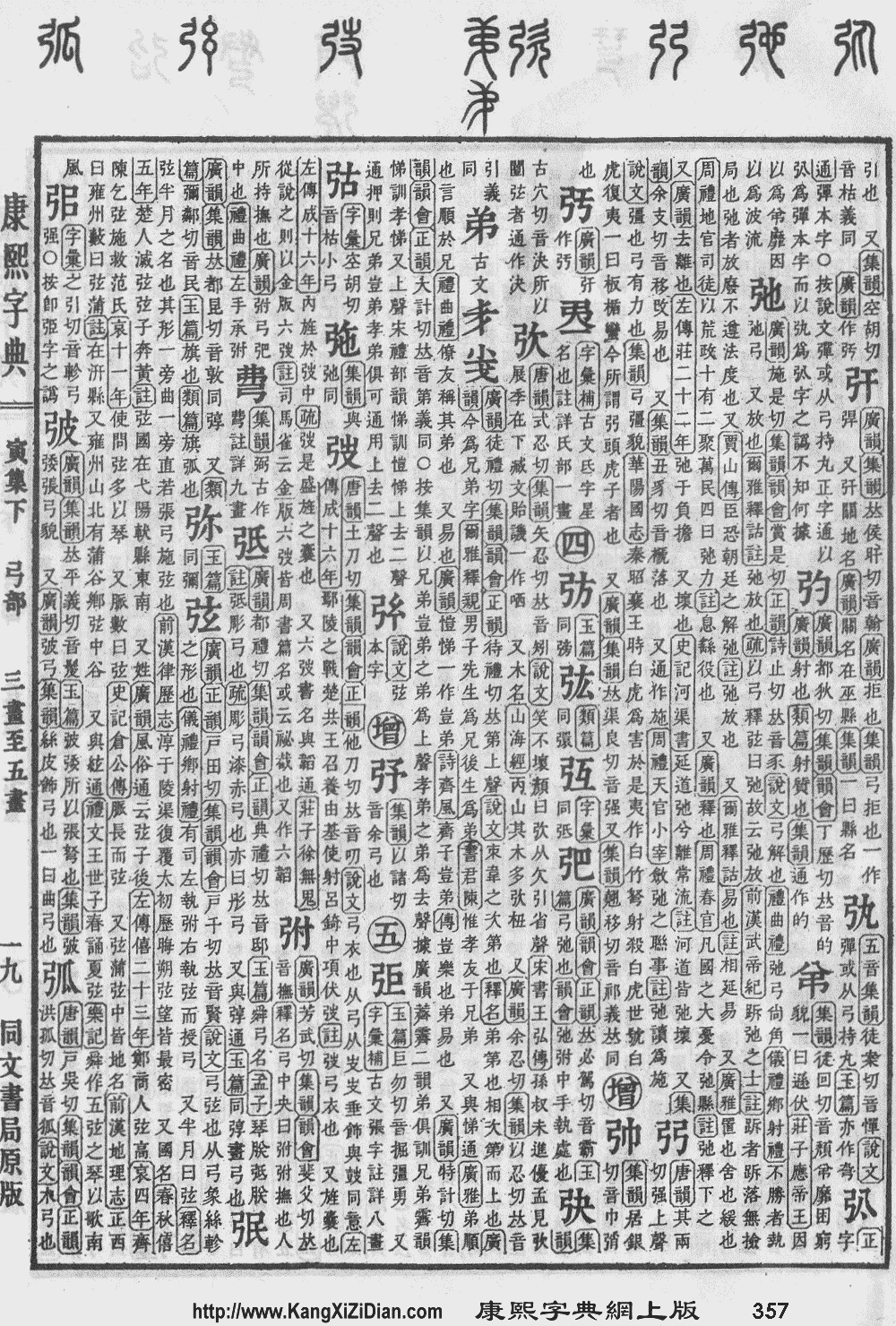
- Kangxi Dictionary: page 357, character 30
- Dai Kanwa Jiten: character 9753
- Dae Jaweon: page 674, character 12
- Hanyu Da Zidian (first edition): volume 2, page 993, character 6
- Unihan data for U+5F25
Chinese
Glyph origin
Characters in the same phonetic series (尔) (Zhengzhang, 2003)
Phono-semantic compound (形聲/形声, OC *mnel) : semantic 弓 (“bow”) + phonetic 尔 (OC *njelʔ)
Usage recorded as early the 6th century, found in the Yupian《玉篇》, which was used interchangeably with 彌.
Etymology 1
| For pronunciation and definitions of 弥 – see 彌 (“to relax a bow; to fill; to cover; etc.”). (This character is the simplified form of 彌). |
Notes:
|
Etymology 2
| For pronunciation and definitions of 弥 – see 瀰 (“full; overflowing; deep; expansive; full; etc.”). (This character is the simplified form of 瀰). |
Notes:
|
Japanese
| 弥 | |
| 彌 |
Kanji
弥
(common “Jōyō” kanji, shinjitai kanji, kyūjitai form 彌)
- go across; span; cover
- widely, extensively; far and wide
- increasingly; more and more
- for a long time; forever
Readings
Korean
Hanja
弥 (eum 미 (mi))
- This term needs a translation to English. Please help out and add a translation, then remove the text
{{rfdef}}.
This article is issued from Wiktionary. The text is licensed under Creative Commons - Attribution - Sharealike. Additional terms may apply for the media files.