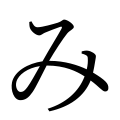
み
 | ||||||||
Japanese
| Stroke order | |||
|---|---|---|---|
 | |||
Pronunciation
- IPA(key): [mʲi]
Etymology 1
Derived in the Heian period from writing the man'yōgana kanji 美 in the cursive sōsho style.
Syllable
み • (mi)
See also
Etymology 2
| For pronunciation and definitions of み – see the following entries. | ||
| ||
| ||
| ||
| ||
| ||
| ||
| ||
| (This term, み, is the hiragana spelling of the above terms.) For a list of all kanji read as み, see Category:Japanese kanji read as み.) |
Etymology 3
| For pronunciation and definitions of み – see the following entries. | ||
| ||
| ||
| ||
| ||
| ||
| ||
| ||
| ||
| (This term, み, is the hiragana spelling of the above terms.) For a list of all kanji read as み, see Category:Japanese kanji read as み.) |
Etymology 4
From Old Japanese. ⟨mi1⟩ → /mi/.
Further derivation unclear. Theories include:[1]
- Might be a suffix all on its own.
- Might be a particle.
- Might be the 連用形 (ren'yōkei, “continuative or stem form”) of an auxiliary.
If derived from an auxiliary, this may be the suppositional / presumptive auxiliary む (mu). Possibly related to 目 (me, “eye”), 見る (miru, “to see”); compare English look like as used to describe the quality of something.
Suffix
み • (-mi)
- 味: (after an i-adjective stem) -ness; used for subjective "quality" of being, as opposed to suffix さ (sa), also translated as -ness, used for objective "degree" of being
- 暖かみ、厚み、面白み
- atatakami, atsumi, omoshiromi
- warmth, thickness, interest
- 暖かみ、厚み、面白み
- (Internet slang) (after other types of words as well) -ness[2][3]
- 外国みがある
- gaikoku-mi ga aru
- has a foreign country-ish vibe
- 外国みがある
- (after an i-adjective stem) place
- 高み、明るみ、深み
- takami, akarumi, fukami
- high place, bright place, deep place
- 高み、明るみ、深み
Usage notes
Sense 1 is sometimes confused or conflated with Sino-Japanese 味 (mi, “taste, flavor”), hence the ateji spelling.
See also
- さ (-sa)
Etymology 5
From Old Japanese. ⟨mi1⟩ → /mi/.
Considered to be from the 連用形 (ren'yōkei, “continuative or stem form”) of 見る (miru, “to try, to attempt”).[4]
Suffix
み • (-mi)
- (after verbs with opposite meanings in the ren'yōkei continuative or -zu negative continuative) indicates alternation of action or state, equivalent to the modern expression …たり…たり (…tari …tari)
- 降りみ降らずみ
- furimi furazumi
- sometimes raining and sometimes not raining → raining on and off
- 照りみ曇りみ
- terimi kumorimi
- sometimes shiny and sometimes cloudy
- 降りみ降らずみ
Etymology 6
Old Japanese. ⟨mi1⟩ → /mi/. Only used in waka since Early Middle Japanese.[5]
Suffix
み • (-mi)
- (obsolete, after an i-adjective stem) as, because; forming an adverbial clause: being
- 山を高み
- yama o takami
- as/because the mountain is high; the mountain being high
- 山を高み
- (obsolete, after an i-adjective stem) Expresses thinking or feeling, followed by verbs like 思ふ and す.
Etymology 7
From みろ.
References
- “み”, in 日本国語大辞典 (Nihon Kokugo Daijiten, “Nihon Kokugo Daijiten”) (in Japanese), concise edition, Tōkyō: Shogakukan, 2000
- 依田 綾乃 (2016) “ツイッターに用いられる「-み」の用法”, in 信大国語教育
- 宇野 和 (2018) “Twitterで見られる名詞に後接する接尾辞ミ : 「ぽさ」「らしさ」と比較して [A Study of the Suffix “mi” Connected with Nouns Often Used on Twitter : Comparing “posa” and “rashisa”]”, in 人間文化創成科学論叢
- Shōgaku Tosho (1988) 国語大辞典(新装版) [Unabridged Dictionary of Japanese (Revised Edition)] (in Japanese), Tōkyō: Shogakukan, →ISBN
- Matsumura, Akira, editor (2006), 大辞林 [Daijirin] (in Japanese), Third edition, Tōkyō: Sanseidō, →ISBN