や
 | ||||||||
Japanese
| Stroke order | |||
|---|---|---|---|
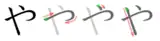 | |||
Etymology 1
Derived in the Heian period from writing the man'yōgana kanji 也 in the cursive sōsho style.
Pronunciation
- IPA(key): [ja̠]
Syllable
や • (ya)
See also
Pronunciation
- IPA(key): [ja̠]
Particle
や • (ya)
Usage notes
- Used to conjoin nouns, や (ya) may imply that the list is not limited to the nouns named. Contrast with と (to), the other particle typically used to conjoin nouns, which implies that the list is limited to the stated nouns.
- It is not used in legal documents or academic papers because it lacks comprehensiveness or exhaustiveness. For example, “AやB” often implies that in addition to A and B, something else is also included.
Etymology 3
Phonetic change of じゃ (ja) in the late Edo period
Verb
や • (ya)
- (Kansai, Shikoku, Hokuriku, Fukuoka) is, are
- Variation on the Japanese copula だ (da), associated with Kansai dialect, particularly Ōsaka. The use of や (ya) is common in fictional dialogue attributed to characters from Ōsaka.
- はよせーや! ― hayo sē ya! ― (dialect) Hurry the hell up!
- まあ、ぼちぼちやなあ。
- Mā, bochibochi ya nā.
- Well, things are slow. (a stereotypical Ōsaka expression)
- 2016, Makoto Shinkai, director, 君の名は。 [your name.], spoken by Mitsuha Miyamizu (Mone Kamishiraishi), Toho:
- もうこんな町嫌や!こんな人生嫌や!
- Mō konna machi iya ya! Konna jinsei iya ya!
- I'm sick of this town! I'm sick of living like this!
Usage notes
Conjugation
Conjugation of "や" (See Appendix:Japanese verbs.)
| Stem forms | ||||
|---|---|---|---|---|
| Imperfective (未然形) | や | ya | ||
| Continuative (連用形) | で | de | ||
| Terminal (終止形) | や | da | ||
| Attributive (連体形) | である | de aru | ||
| Hypothetical (仮定形) | なら であれ |
nara de are | ||
| Imperative (命令形) | - | - | ||
| Key constructions | ||||
| Passive | - | - | ||
| Causative | - | - | ||
| Potential | - | - | ||
| Volitional | やろう¹ | yarō¹ | ||
| Negative | やない | ya nai | ||
| Negative continuative | やのうて² やなくて² |
ya nōte² ya nakute² | ||
| Formal | です, だす³, どす³ | desu, dasu³, dosu³ | ||
| Perfective | やった | yatta | ||
| Conjunctive | で やって |
de yatte | ||
| Hypothetical conditional | ならば であれば やったら |
naraba de areba yattara | ||
| ¹ usually shortened to やろ (yaro). ² often replaced to an alternative expression とちごうて (to chigōte). ³ だす (dasu) is used in traditional Osaka dialect and どす (dosu) is used in traditional Kyoto dialect. | ||||
Alternative forms
- やー (yā)
Pronunciation
- IPA(key): [ja̠]
Inflection
Inflection of や
| Stem forms | |||
|---|---|---|---|
| Imperfective (未然形) | やだろ | ya daro | |
| Continuative (連用形) | やで | ya de | |
| Terminal (終止形) | やだ | ya da | |
| Attributive (連体形) | やな | ya na | |
| Hypothetical (仮定形) | やなら | ya nara | |
| Imperative (命令形) | やであれ | ya de are | |
| Key constructions | |||
| Informal negative | やではない やじゃない |
ya de wa nai ya ja nai | |
| Informal past | やだった | ya datta | |
| Informal negative past | やではなかった やじゃなかった |
ya de wa nakatta ya ja nakatta | |
| Formal | やです | ya desu | |
| Formal negative | やではありません やじゃありません |
ya de wa arimasen ya ja arimasen | |
| Formal past | やでした | ya deshita | |
| Formal negative past | やではありませんでした やじゃありませんでした |
ya de wa arimasen deshita ya ja arimasen deshita | |
| Conjunctive | やで | ya de | |
| Conditional | やなら(ば) | ya nara (ba) | |
| Provisional | やだったら | ya dattara | |
| Volitional | やだろう | ya darō | |
| Adverbial | やに | ya ni | |
| Degree | やさ | yasa | |
See also
- やだ (yada)
Etymology 5
| For pronunciation and definitions of や – see the following entry. | ||
| ||
| (This term, や, is the hiragana spelling of the above term.) For a list of all kanji read as や, see Category:Japanese kanji read as や.) |
Etymology 6
| For pronunciation and definitions of や – see the following entries. | ||
| ||
| (This term, や, is the hiragana spelling of the above term.) For a list of all kanji read as や, see Category:Japanese kanji read as や.) |
(The following entry is uncreated: 家.)
Etymology 7
| For pronunciation and definitions of や – see the following entry. | ||
| ||
| (This term, や, is the hiragana spelling of the above term.) For a list of all kanji read as や, see Category:Japanese kanji read as や.) |
Etymology 8
| Alternative spelling |
|---|
| 輻 |
Noun
References
- Matsumura, Akira, editor (2006), 大辞林 [Daijirin] (in Japanese), Third edition, Tōkyō: Sanseidō, →ISBN
Okinawan
Etymology
From Proto-Ryukyuan *wa, from Proto-Japonic *pa. Cognate with Japanese は (wa).
Pronunciation
- IPA(key): /ja/
Particle
や (ya)
- topic marker
- 今日や良い天気でーびる。
- Chū-ya ii tinchi dēbiru.
- It is a fine day.
- (literally, “today + as for + good + weather + is”)
- 今日や良い天気でーびる。
Usage notes
Used after words ending in long vowels.
References
- “や” in JLect - Japonic Languages and Dialects Database Dictionary, 2019.
- 1902, E. R. Edwards, nouts ɔn kəɹiən ən ˈluwˈtʃuwən, in lə mɛːtrə fɔnetik, p.114
This article is issued from Wiktionary. The text is licensed under Creative Commons - Attribution - Sharealike. Additional terms may apply for the media files.