弱
| ||||||||
Translingual
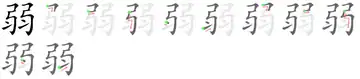
| Stroke order | |||
|---|---|---|---|
 | |||
Han character
弱 (Kangxi radical 57, 弓+7, 10 strokes, cangjie input 弓一弓戈一 (NMNIM), four-corner 17127, composition ⿰⿹弓冫⿹弓冫(GHTJ) or ⿰⿹弓⿱丿丿⿹弓⿱丿丿(KV))
References
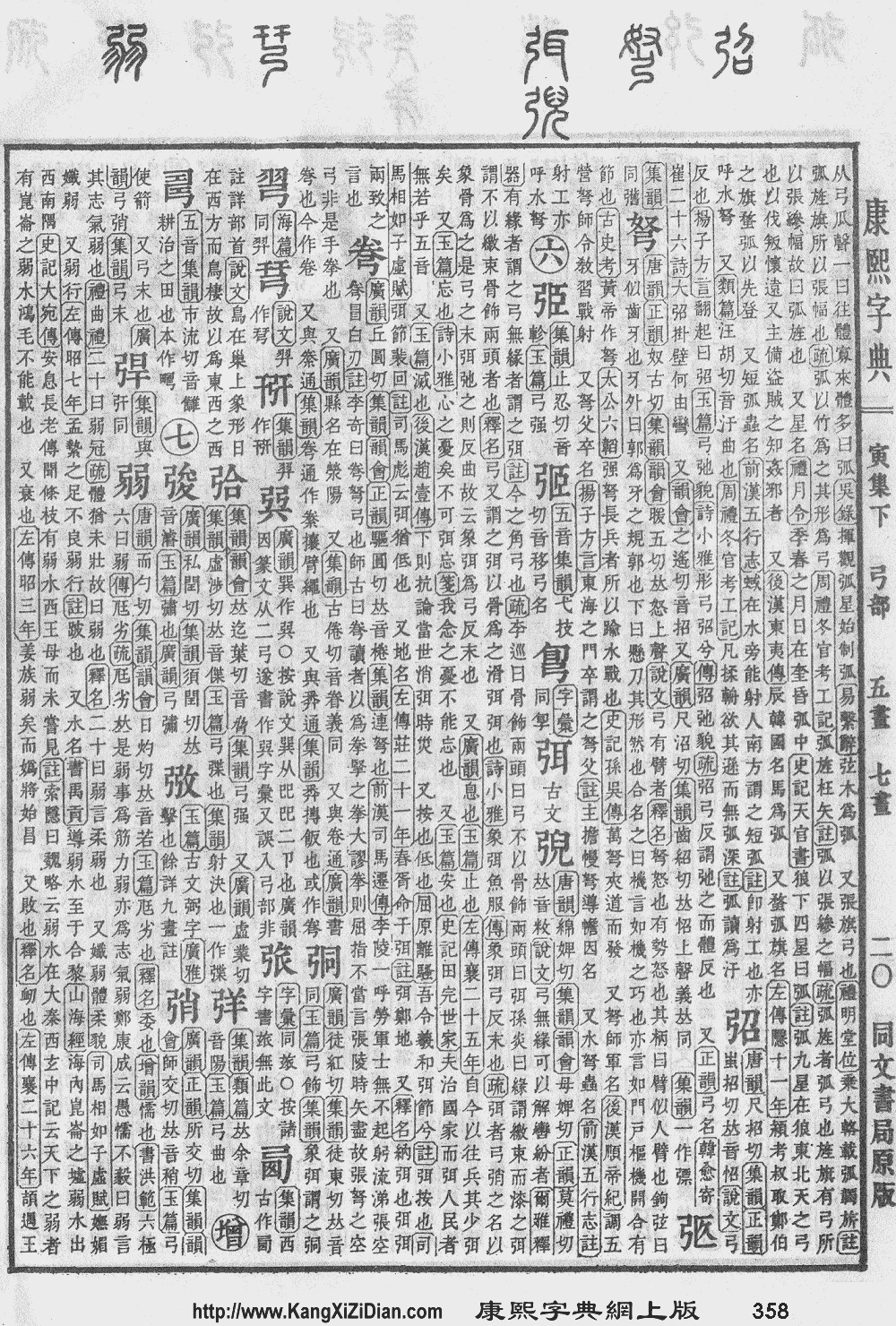
- Kangxi Dictionary: page 358, character 24
- Dai Kanwa Jiten: character 9791
- Dae Jaweon: page 675, character 17
- Hanyu Da Zidian (first edition): volume 2, page 996, character 16
- Unihan data for U+5F31
Chinese
| simp. and trad. |
弱 | |
|---|---|---|
| 2nd round simp. | ⿹弓冫 | |
| alternative forms | 𢐅 𭋘 | |
Glyph origin
| Historical forms of the character 弱 | ||
|---|---|---|
| Warring States | Shuowen Jiezi (compiled in Han) | Liushutong (compiled in Ming) |
| Qin slip script | Small seal script | Transcribed ancient scripts |
 |
 |
 |
Characters in the same phonetic series (弱) (Zhengzhang, 2003)
Ideogrammic compound (會意/会意) : 弓 (“bow”) + 彡 (“hair, meaning "decoration" in this case”) - a decorative bow that is functionally inferior. Or it might be indicating that the bow is shaking, which implies a worn-out bow.
An alternate etymology is 𢎥 + 𢎥, 𢎥 being a variant of 卷.
Pronunciation
Synonyms
- (weak):
- 單薄/单薄 (dānbó)
- 孤單/孤单 (gūdān)
- 孱弱 (chánruò) (literary)
- 微弱 (wēiruò)
- 柔弱 (róuruò)
- 瘦弱 (shòuruò)
- 瘦瘠 (shòují)
- 羸弱 (léiruò)
- 脆弱 (cuìruò)
- 荏弱 (Hokkien)
- 薄弱 (bóruò)
- 虛弱/虚弱 (xūruò)
- 虛荏/虚荏 (Xiamen Hokkien, Zhangzhou Hokkien)
- 虛虧/虚亏 (xūkuī)
- 虧弱/亏弱 (kuīruò)
- 衰弱 (shuāiruò)
- 軟弱/软弱 (ruǎnruò)
- 軟䭕/软𬲕 (Hokkien, Teochew)
- 雌 (cí) (literary)
- 體弱/体弱 (tǐruò)
Compounds
- 不弱
- 不弱似
- 不弱如
- 不甘示弱 (bùgānshìruò)
- 以弱制強/以弱制强
- 以強陵弱/以强陵弱
- 倚強凌弱
- 倚強欺弱/倚强欺弱 (yǐqiáng qī ruò)
- 兼弱攻昧
- 削弱 (xuēruò)
- 力分勢弱/力分势弱
- 力弱
- 危弱
- 又弱一個/又弱一个
- 單弱/单弱
- 好弱
- 嬌弱/娇弱 (jiāoruò)
- 孅弱
- 孤弱
- 孱弱 (chánruò)
- 幼弱 (yòuruò)
- 弱不勝衣/弱不胜衣
- 弱不好弄
- 弱不禁風/弱不禁风 (ruòbùjīnfēng)
- 弱兵
- 弱冠 (ruòguàn)
- 弱勢/弱势 (ruòshì)
- 弱化 (ruòhuà)
- 弱喪/弱丧
- 弱小 (ruòxiǎo)
- 弱怯怯
- 弱息
- 弱智 (ruòzhì)
- 弱柳扶風/弱柳扶风
- 弱植
- 弱水 (Ruòshuǐ)
- 弱水三千
- 弱水之隔
- 弱疾
- 弱視/弱视 (ruòshì)
- 弱笄
- 弱翰
- 弱者 (ruòzhě)
- 弱肉強食/弱肉强食 (ruòròuqiángshí)
- 弱質/弱质
- 弱酸 (ruòsuān)
- 弱項/弱项 (ruòxiàng)
- 弱鹼/弱碱 (ruòjiǎn)
- 弱點/弱点 (ruòdiǎn)
- 弱齡/弱龄
- 強幹弱枝/强干弱枝
- 強弱/强弱 (qiángruò)
- 強弱懸殊/强弱悬殊
- 強本弱枝/强本弱枝
- 彊幹弱枝/强干弱枝
- 彊本弱末/强本弱末
- 微弱 (wēiruò)
- 怯弱 (qièruò)
- 恃強凌弱 (shìqiánglíngruò)
- 恃強欺弱/恃强欺弱
- 懦弱 (nuòruò)
- 扶傾濟弱/扶倾济弱
- 扶弱抑強/扶弱抑强
- 抑強扶弱/抑强扶弱 (yìqiángfúruò)
- 按彊助弱/按强助弱
- 振弱除暴
- 攜老扶弱/携老扶弱
- 攣弱/挛弱
- 文弱 (wénruò)
- 文弱書生/文弱书生 (wénruòshūshēng)
- 柔弱 (róuruò)
- 柔心弱骨
- 沖弱/冲弱
- 減弱/减弱 (jiǎnruò)
- 漸弱/渐弱 (jiànruò)
- 濟弱扶傾/济弱扶倾
- 濟弱扶危/济弱扶危
- 濟弱鋤強/济弱锄强
- 畏強凌弱
- 疲弱
- 瘦弱 (shòuruò)
- 示弱 (shìruò)
- 神經衰弱/神经衰弱 (shénjīng shuāiruò)
- 積弱/积弱 (jīruò)
- 積弱不振/积弱不振
- 細弱/细弱 (xìruò)
- 繁弱
- 纖弱/纤弱 (xiānruò)
- 纖纖弱質/纤纤弱质
- 羸弱 (léiruò)
- 老弱 (lǎoruò)
- 老弱殘兵/老弱残兵
- 脆弱 (cuìruò)
- 苒弱
- 荏弱
- 蓬萊弱水/蓬莱弱水
- 薄弱 (bóruò)
- 虛弱/虚弱 (xūruò)
- 衰弱 (shuāiruò)
- 貧弱/贫弱 (pínruò)
- 軟弱/软弱 (ruǎnruò)
- 軟弱無力/软弱无力
- 輕塵弱草/轻尘弱草
- 違強陵弱/违强陵弱
- 鋤強扶弱/锄强扶弱 (chúqiángfúruò)
- 闇弱/暗弱 (ànruò)
- 面弱
Japanese
| Shinjitai | 弱 |  |
| Kyūjitai [1][2][3][4] |
弱󠄁 弱+ 󠄁?(Adobe-Japan1) |
 |
| 弱󠄃 弱+ 󠄃?(Hanyo-Denshi) (Moji_Joho) | ||
| The displayed kanji may be different from the image due to your environment. See here for details. | ||
Readings
Compounds
- 弱音 (jakuon)
- 弱酸 (jakusan)
- 弱志 (jakushi)
- 弱視 (jakushi)
- 弱質 (jakushitsu)
- 弱者 (jakusha)
- 弱小 (jakushō)
- 弱震 (jakushin)
- 弱卒 (jakusotsu)
- 弱体 (jakutai)
- 弱敵 (jakuteki)
- 弱点 (jakuten)
- 弱電 (jakuden)
- 弱肉強食 (jakuniku kyōshoku)
- 弱年 (jakunen) (若年)
- 弱輩 (jakuhai) (若輩)
- 弱拍 (jakuhaku)
- 弱兵 (jakuhei)
- 弱齢 (jakurei) (若齢)
- 弱化 (jakka)
- 弱冠 (jakkan)
- 弱起 (jakki)
- 弱肩 (jakken)
- 弱行 (jakkō)
- 弱国 (jakkoku)
- 暗弱, 闇弱 (anjaku)
- 胃弱 (ijaku)
- 萎弱 (ijaku)
- 尩弱, 尫弱 (ōjaku)
- 怯弱 (kyōjaku)
- 強弱 (kyōjaku)
- 怯弱 (kyojaku)
- 虚弱 (kyojaku)
- 愚弱 (gujaku)
- 減弱 (genjaku)
- 耗弱 (kōjaku)
- 孤弱 (kojaku)
- 昏弱 (konjaku)
- 削弱 (sakujaku)
- 色弱 (shikijaku)
- 柔弱 (jūjaku)
- 小弱 (shōjaku)
- 情弱 (jōjaku)
- 荏弱 (jinjaku)
- 衰弱 (suijaku)
- 脆弱 (zeijaku)
- 孱弱 (senjaku)
- 繊弱 (senjaku)
- 惰弱, 懦弱 (dajaku)
- 単弱 (tanjaku)
- 稚弱 (chijaku)
- 軟弱 (nanjaku)
- 柔弱 (nyūjaku)
- 薄弱 (hakujaku)
- 微弱 (bijaku)
- 病弱 (byōjaku)
- 貧弱 (hinjaku)
- 文弱 (bunjaku)
- 幼弱 (yōjaku)
- 羸弱 (ruijaku)
- 劣弱 (retsujaku)
- 老弱 (rōjaku)
Etymology
| Kanji in this term |
|---|
| 弱 |
| じゃく Grade: 2 |
| kan’on |
Suffix
弱 • (-jaku)
References
- “弱”, in 漢字ぺディア (Kanjipedia) (in Japanese), 日本漢字能力検定協会, 2015–2024
- 白川静 (Shirakawa Shizuka) (2014) “弱”, in 字通 (Jitsū) (in Japanese), popular edition, Tōkyō: Heibonsha, →ISBN
- Haga, Gōtarō (1914) 漢和大辞書 [The Great Kanji-Japanese Dictionary] (in Japanese), Fourth edition, Tōkyō: Kōbunsha, , page 809 (paper), page 454 (digital)
- Shōundō Henshūjo, editor (1927), 新漢和辞典 [The New Kanji-Japanese Dictionary] (in Japanese), Ōsaka: Shōundō, , page 512 (paper), page 269 (digital)
- Matsumura, Akira, editor (2006), 大辞林 [Daijirin] (in Japanese), Third edition, Tōkyō: Sanseidō, →ISBN
- 塩田雄大 (2017 October 1) “「1時間弱」は、1時間よりも長い?短い?”, in NHK放送文化研究所
Korean
Etymology
From Middle Chinese 弱 (MC nyak).
| Historical readings |
|---|
|
Pronunciation
- (SK Standard/Seoul) IPA(key): [ja̠k̚]
- Phonetic hangul: [약]
Compounds
Compounds
- 약골 (弱骨, yakgol)
- 약력 (弱力, yangnyeok)
- 미약 (微弱, miyak)
- 약소 (弱小, yakso)
- 취약 (脆弱, chwiyak)
- 약시 (弱視, yaksi)
- 나약 (懦弱, nayak)
- 약화 (弱化, yakhwa)
- 약자 (弱者, yakja)
- 쇠약 (衰弱, soeyak)
- 강약 (強弱, gang'yak)
- 연약 (軟弱, yeonyak)
- 빈약 (貧弱, binyak)
- 약세 (弱勢, yakse)
- 허약 (虛弱, heoyak)
- 병약 (病弱, byeong'yak)
- 약체 (弱體, yakche)
- 내약 (內弱, naeyak)
- 겁약 (怯弱, geobyak)
- 약국 (弱國, yakguk)
- 면약 (綿弱, myeonyak)
- 노약 (老弱, noyak)
- 약질 (弱質, yakjil)
- 약점 (弱點, yakjeom, “weak point”)
- 억강부약 (抑強扶弱, eokgangbuyak)
Vietnamese
This article is issued from Wiktionary. The text is licensed under Creative Commons - Attribution - Sharealike. Additional terms may apply for the media files.