彙

See also: 彚 and 汇
彙 U+5F59, 彙
CJK UNIFIED IDEOGRAPH-5F59
← 彘
[U+5F58]
CJK Unified Ideographs 彚 →
[U+5F5A]

Translingual

Han character

彙 (Kangxi radical 58, 彐+10, 13 strokes, cangjie input 女一月田木 (VMBWD), four-corner 27904, composition ⿳彑冖果)

Derived characters

  • 𧁸

References

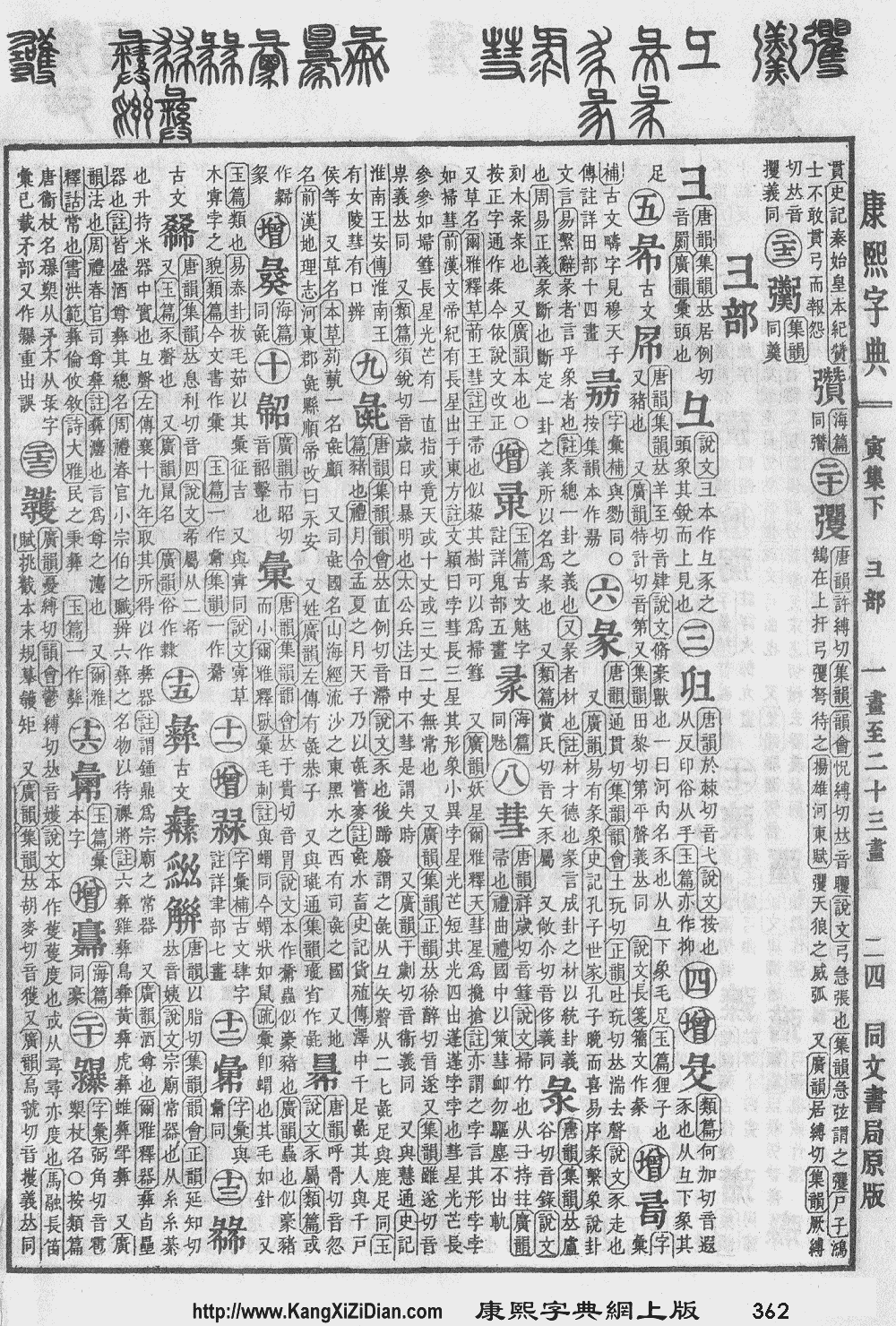
  • Kangxi Dictionary: page 362, character 21
  • Dai Kanwa Jiten: character 9936
  • Dae Jaweon: page 681, character 2
  • Hanyu Da Zidian (first edition): volume 2, page 962, character 4
  • Unihan data for U+5F59

Chinese

trad. 彙
simp. 汇*
alternative forms
 
彚
𢑥
𢑷
𢑭
𢑤
彚
𢑥
𢑷
𢑭
𢑤
𣉰
𢍖
𡻼
蝟/猬

Glyph origin

Historical forms of the character 彙
Shuowen Jiezi (compiled in Han)
Small seal script

Phono-semantic compound (形聲/形声, OC *ɢruds) : semantic 㣇 + abbreviated phonetic 胃 (OC *ɢuds).

Etymology

hedgehog
Its graph is also used to 彙/汇 (huì, “category, class”), which is perhaps a variant of 類/类 (lèi) without the latter's l- initial. Also note 彙/汇 (huì, “hedgehog”)'s Cantonese pronunciation leoi6.(Bodman, 1980; Schuessler, 2007)
Sino-Tibetan; cognate with Mizo kuh (“porcupine's quill, porcupine”) and Mizo sakuh (“porcupine”). In Tibeto-Burman cognates *k- is seemingly a prefix.(Schuessler, 2007)
category, class
If 彙 (OC *wəs) were related to 類 (OC *rus), it may be a form whose initial *r- had been treated as a prefix and dropped.

Pronunciation


Note:
  • wui6 - most common pronunciation;
  • leoi6 - semantic (original character is 類).

  • Dialectal data
Variety Location 彙
Mandarin Beijing /xuei⁵¹/
Harbin /xuei⁵³/
Tianjin /xuei⁵³/
Jinan /xuei²¹/
Qingdao /xue⁴²/
Zhengzhou /xuei³¹²/
Xi'an /xuei⁴⁴/
Xining /xuɨ²¹³/
Yinchuan /xuei¹³/
Lanzhou /xuei¹³/
Ürümqi /xuei²¹³/
Wuhan /xuei³⁵/
Chengdu /xuei¹³/
Guiyang /xuei²¹³/
Kunming /xuei²¹²/
Nanjing /xuəi⁴⁴/
Hefei /xue⁵³/
Jin Taiyuan /xuei⁴⁵/
Pingyao /xuæ³⁵/
Hohhot /xuei⁵⁵/
Wu Shanghai /ɦue²³/
Suzhou /ɦue̞³¹/
Hangzhou /ɦui¹³/
Wenzhou /vai²²/
Hui Shexian /xuɛ²²/
Tunxi /xuə¹¹/
Xiang Changsha /fei⁵⁵/
/fei¹¹/
Xiangtan /ɸəi⁵⁵/
Gan Nanchang /fɨi²¹/
Hakka Meixian /fi⁵³/
Taoyuan
Cantonese Guangzhou /wui²²/
Nanning /wui²²/
Hong Kong /wui²²/
Min Xiamen (Hokkien) /hue²²/
/lue²²/ ~音妙悟
Fuzhou (Eastern Min) /huɔi²⁴²/
Jian'ou (Northern Min) /xo⁴⁴/
Shantou (Teochew) /hue³⁵/
Haikou (Hainanese) /hui³³/

Rime
Character 彙
Reading # 1/1
Initial (聲) 云 (35)
Final (韻) 微 (21)
Tone (調) Departing (H)
Openness (開合) Closed
Division (等) III
Fanqie 于貴切
Baxter hjw+jH
Reconstructions
Zhengzhang
Shangfang
/ɦʉiH/
Pan
Wuyun
/ɦʷɨiH/
Shao
Rongfen
/ɣiuəiH/
Edwin
Pulleyblank
/ɦujH/
Li
Rong
/ɣiuəiH/
Wang
Li
/ɣĭwəiH/
Bernard
Karlgren
/we̯iH/
Expected
Mandarin
Reflex
wèi
Expected
Cantonese
Reflex
wai6
Zhengzhang system (2003)
Character 彙
Reading # 1/1
No. 5491
Phonetic
component
彚
Rime
group
未
Rime
subdivision
2
Corresponding
MC rime
胃
Old
Chinese
/*ɢruds/

Definitions

彙

  1. † Alternative form of 蝟/猬 (wèi, “hedgehog”)
    彙毛刺 [Classical Chinese, trad.]
    汇毛刺 [Classical Chinese, simp.]
    From: Erya, 5th – 2nd century BCE
    Huì máo cì [Pinyin]
    Hedgehogs, their hairs are pointy
  2. to gather; to assemble
  3. collection; class; category

Compounds

Japanese

Shinjitai
(extended)

彚

Kyūjitai

彙

Kanji

彙

(common “Jōyō” kanji, kyūjitai kanji, shinjitai form 彚)

  1. hedgehog
  2. collection, compilation

Readings

Etymology 1

Kanji in this term
彙
い
Grade: S
on’yomi

/wi/ → /i/

From Middle Chinese 彙 (MC hjw+jH).

Affix

彙(い) • (i) ←ゐ (wi)?

  1. to sort and collect; collection, compilation, group
Derived terms

Etymology 2

Kanji in this term
彙
はりねずみ
Grade: S
kun’yomi
For pronunciation and definitions of 彙 – see the following entry.
【針鼠はりねずみ】
[noun] a hedgehog
Alternative spellings
蝟, 猬, ハリネズミ
(This term, 彙, is an alternative spelling of the above term.)

Korean

Etymology

From a corrupted or unorthodox reading.

Historical readings

The original reading is 위 (wi) based on Middle Chinese 彙 (MC hjw+jH).

Historical readings

Pronunciation

Hanja

Wikisource 彙 (eumhun 모을 휘 (mo'eul hwi))

  1. Hanja form? of 휘 (“collection”).

Compounds

References

  • 국제퇴계학회 대구경북지부 (國際退溪學會 大邱慶北支部) (2007). Digital Hanja Dictionary, 전자사전/電子字典.

Vietnamese

Etymology

This character was confused with 暈.

Han character

彙: Hán Nôm readings: vừng, vị, vựng, hối

  1. This term needs a translation to English. Please help out and add a translation, then remove the text {{rfdef}}.
This article is issued from Wiktionary. The text is licensed under Creative Commons - Attribution - Sharealike. Additional terms may apply for the media files.