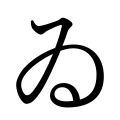
ゐ

See also: ゐ゙

ゐ U+3090, ゐ
HIRAGANA LETTER WI
← わ
[U+308F]
Hiragana ゑ →
[U+3091]

Japanese

Stroke order
1 stroke

Etymology 1

Derived in the Heian period from writing the man'yōgana kanji 為 in the cursive sōsho style.

Pronunciation

    • IPA(key): [ɰᵝi]
      • IPA(key): [i]

      (rare)

      Syllable

      ゐ • (i) 

      1. (archaic) The hiragana syllable ゐ (i). Its equivalent in katakana is ヰ (i). It is the forty-fifth syllable in the gojūon order; its position is わ行い段 (wa-gyō i-dan, “row wa, section i”).
      Usage notes

      This is now a rarely used hiragana. In most cases, it is replaced by い.

      See also

      Etymology 2

      For pronunciation and definitions of ゐ – see the following entries.
      【委い】3
      [affix] entrust; leave to
      [affix] cast aside; abandon
      [affix] detailed
      [affix] Short for 委員会 (iinkai, “committee”).
      【位い】4
      [affix] rank, place
      [counter] rank, place
      [counter] decimal place
      [counter] ghosts
      【囲い】5
      [counter] counter for the amount that can be encircled in one's arms, used as a rough measurement of circumference (roughly 1.5 meters)
      [affix] surround; encircle; enclosure
      [affix] circumference
      【胃い】6
      [noun] stomach
      [proper noun] (Chinese astronomy) Stomach Mansion (one of the Twenty-Eight Mansions)
      [affix] stomach
      【遺い】6
      [noun] something fallen, something lost or left behind
      [affix] be left, remain
      [affix] leave behind after one's death, bequeath
      [affix] leave behind, forget
      [affix] give, present
      [affix] let leak
      【威い】S
      [noun] power; might; strength; authority
      [affix] power; might; strength; authority; dignity; majesty
      【為い】S
      [noun] the twelfth string on a koto (Japanese zither)
      [noun] a fingering method for playing the shakuhachi (Japanese flute)
      [affix] do; perform; carry out
      【畏い】S
      [affix] fear
      [affix] respect
      【唯い】S
      [interjection] polite particle used to respond to elders: yes
      [affix] polite particle used to respond to elders: yes
      【尉い】S
      [affix] a watchman or military officer in the ancient Chinese military
      [affix] A military rank.
      【萎い】S
      [affix] wither; droop
      【偉い】S
      [noun] (literary) greatness
      [adjective] (literary) great
      [affix] great, excellent, magnificent, extraordinary
      【彙い】S
      [affix] to sort and collect; collection, compilation, group
      【違い】S
      [affix] differ; vary
      [affix] go against; run counter to; disobey
      【維い】S
      [affix] hold together; keep; maintain
      [affix] what holds together; net, supportive
      【慰い】S
      [affix] comfort; console
      【緯い】S
      [noun] weft, woof
      [noun] parallels of latitude
      【帷い】H
      [noun] a curtain or hanging that covers all sides
      [affix] hanging; curtain
      【蝟い】H
      [noun] the Chinese name of the 針鼠 (harinezumi, “hedgehog”)
      (This term, ゐ, is a historical kana spelling of the above terms.)
      For a list of all kanji read as ゐ, see Category:Japanese kanji read as ゐ.)

      Etymology 3

      Native readings.

      For pronunciation and definitions of ゐ – see the following entries.
      【井い】4
      [proper noun] a surname
      (This term, ゐ, is the hiragana spelling of the above term.)
      【井い】4
      [noun] well (water source)
      【亥い】J
      [proper noun] the Boar, the twelfth of the twelve Earthly Branches
      【居い】5
      [noun] being (in a place), sitting (in a place); a seat
      【猪い】J
      [noun] a pig or wild boar
      【堰い】J
      [noun] a dike or levee for containing water
      (This term, ゐ, is a historical kana spelling of the above terms.)
      For a list of all kanji read as ゐ, see Category:Japanese kanji read as ゐ.)
      This article is issued from Wiktionary. The text is licensed under Creative Commons - Attribution - Sharealike. Additional terms may apply for the media files.