怵
| ||||||||
Translingual
Han character
怵 (Kangxi radical 61, 心+5, 8 strokes, cangjie input 心戈木 (PID) or 心戈十金 (PIJC), four-corner 93094, composition ⿰忄朮(HTJK) or ⿰忄术(GV))
References
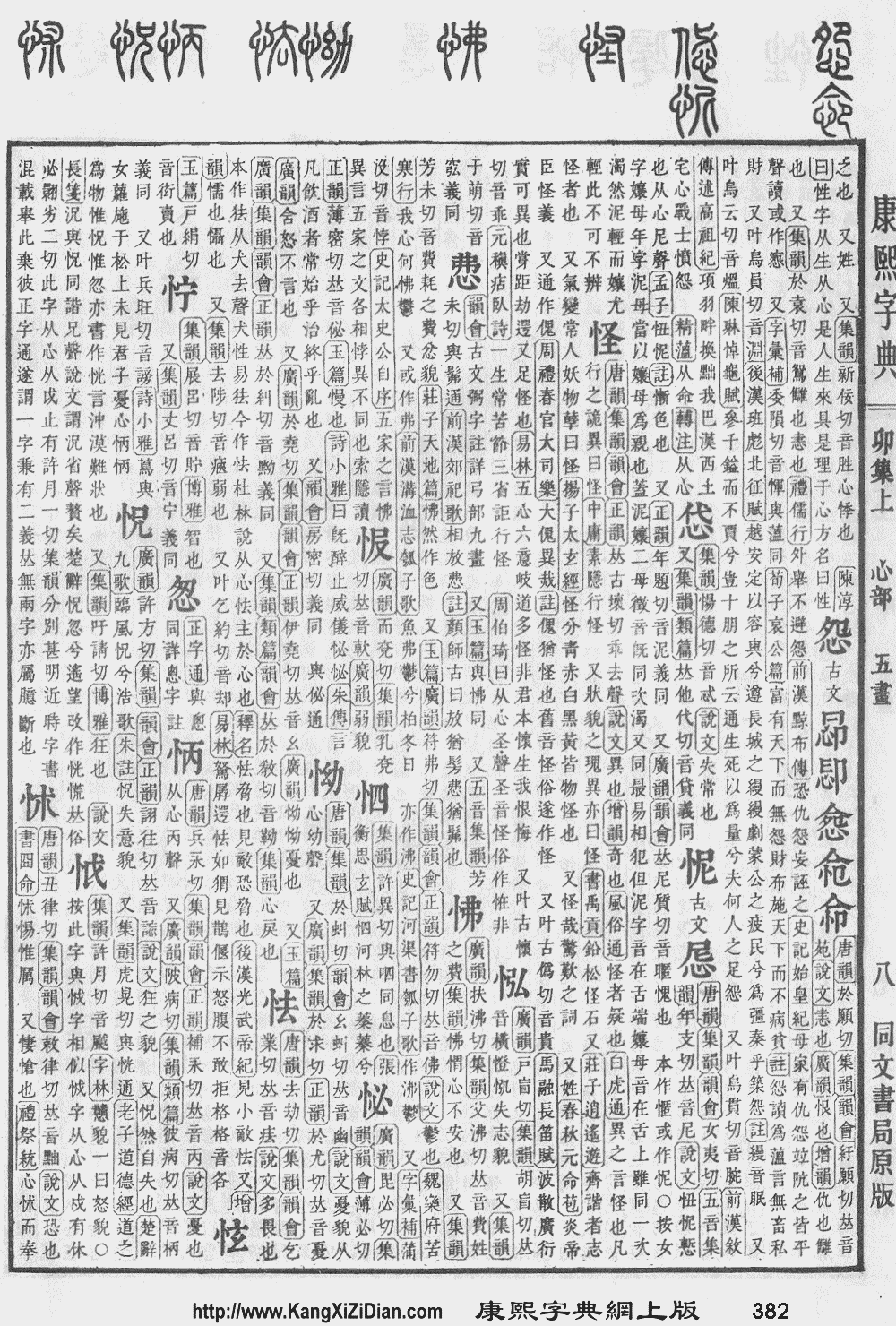
- Kangxi Dictionary: page 382, character 25
- Dai Kanwa Jiten: character 10498
- Dae Jaweon: page 712, character 16
- Hanyu Da Zidian (first edition): volume 4, page 2284, character 1
- Unihan data for U+6035
Chinese
| trad. | 怵 | |
|---|---|---|
| simp. # | 怵 | |
Glyph origin
Characters in the same phonetic series (朮) (Zhengzhang, 2003)
Phono-semantic compound (形聲/形声, OC *l̥ʰud) : semantic 心 (“heart”) + phonetic 朮 (OC *l'ud, *ɦljud).
Pronunciation 1
Compounds
- 動心怵目/动心怵目
- 怵怵忐忐
- 怵惕 (chùtì)
- 怵然
- 怵目驚心/怵目惊心
- 怵魄動心/怵魄动心
- 發怵/发怵
Pronunciation 2
Compounds
- 怵迫
- 誘怵/诱怵
References
- “怵”, in 漢語多功能字庫 (Multi-function Chinese Character Database), 香港中文大學 (the Chinese University of Hong Kong), 2014–
Japanese
Kanji
怵
- This term needs a translation to English. Please help out and add a translation, then remove the text
{{rfdef}}.
Vietnamese
Han character
怵: Hán Nôm readings: truột
- This term needs a translation to English. Please help out and add a translation, then remove the text
{{rfdef}}.
This article is issued from Wiktionary. The text is licensed under Creative Commons - Attribution - Sharealike. Additional terms may apply for the media files.