拑

拑 U+62D1, 拑
CJK UNIFIED IDEOGRAPH-62D1
← 拐
[U+62D0]
CJK Unified Ideographs 拒 →
[U+62D2]

Translingual

Han character

拑 (Kangxi radical 64, 手+5, 8 strokes, cangjie input 手廿一 (QTM), four-corner 54070, composition ⿰扌甘)

  1. to clamp, tie down or pin down

Derived characters

References

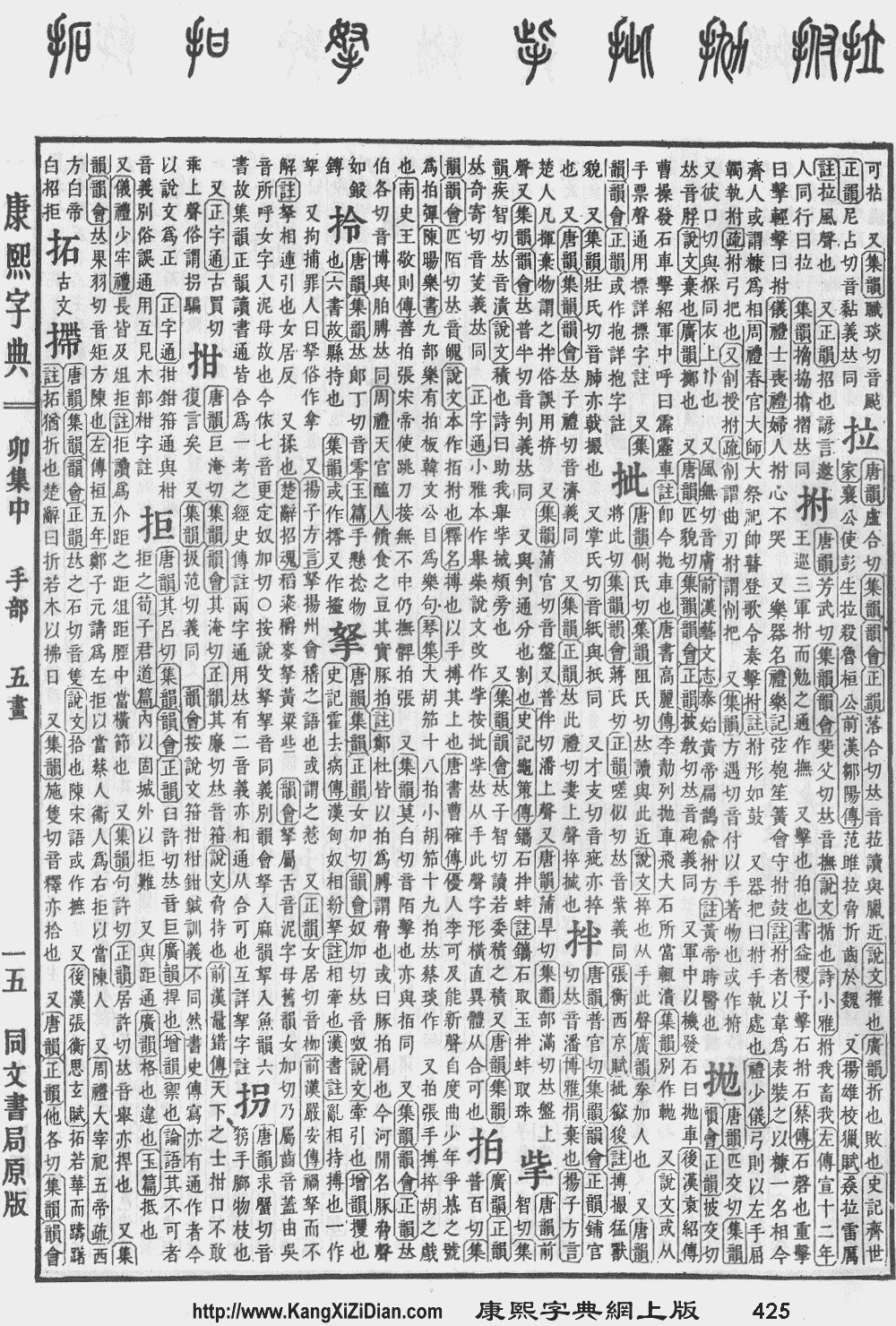
  • Kangxi Dictionary: page 425, character 11
  • Dai Kanwa Jiten: character 11956
  • Dae Jaweon: page 773, character 16
  • Hanyu Da Zidian (first edition): volume 3, page 1848, character 3
  • Unihan data for U+62D1

Chinese

simp. and trad.
拑
alternative forms 鉗/钳

Glyph origin

Historical forms of the character 拑
Shuowen Jiezi (compiled in Han)
Small seal script

Pronunciation


Rime
Character 拑
Reading # 1/1
Initial (聲) 群 (30)
Final (韻) 鹽 (154)
Tone (調) Level (Ø)
Openness (開合) Open
Division (等) III
Fanqie 巨淹切
Baxter gjem
Reconstructions
Zhengzhang
Shangfang
/ɡˠiᴇm/
Pan
Wuyun
/ɡᵚiɛm/
Shao
Rongfen
/ɡiæm/
Edwin
Pulleyblank
/gjiam/
Li
Rong
/ɡjɛm/
Wang
Li
/ɡĭɛm/
Bernard
Karlgren
/gi̯ɛm/
Expected
Mandarin
Reflex
qián
Expected
Cantonese
Reflex
kim4
Zhengzhang system (2003)
Character 拑
Reading # 1/1
No. 3668
Phonetic
component
甘
Rime
group
談
Rime
subdivision
1
Corresponding
MC rime
箝
Old
Chinese
/*ɡram/

Definitions

拑

  1. (Hokkien) to grab; to pinch; to cling; to grip tightly
    拑牆𬦰壁/拑墙𬦰壁 [Taiwanese Hokkien]  ―  khîⁿ chhiûⁿ peh piah [Pe̍h-ōe-jī]  ―  (please add an English translation of this usage example)
    拑牢牢 [Taiwanese Hokkien]  ―  khîⁿ-tiâu-tiâu [Pe̍h-ōe-jī]  ―  to grab on for dear life, have a firm hold on

Japanese

Kanji

拑

(uncommon “Hyōgai” kanji)

  1. shut one's mouth

Readings

Korean

Hanja

拑 (eum 겸 (gyeom))

  1. to clamp
  2. tie down or pin down

Vietnamese

Han character

拑: Hán Nôm readings: kiềm, cùm

  1. This term needs a translation to English. Please help out and add a translation, then remove the text {{rfdef}}.
This article is issued from Wiktionary. The text is licensed under Creative Commons - Attribution - Sharealike. Additional terms may apply for the media files.