拐
| ||||||||
Translingual
| Japanese | 拐 |
|---|---|
| Simplified | 拐 |
| Traditional | 拐 |
Han character
拐 (Kangxi radical 64, 手+5, 8 strokes, cangjie input 手口大尸 (QRKS) or 手口尸竹 (QRSH), four-corner 56027, composition ⿰扌另 or ⿰扌叧)
Related characters
Derived characters
- 𮛠, 箉
References
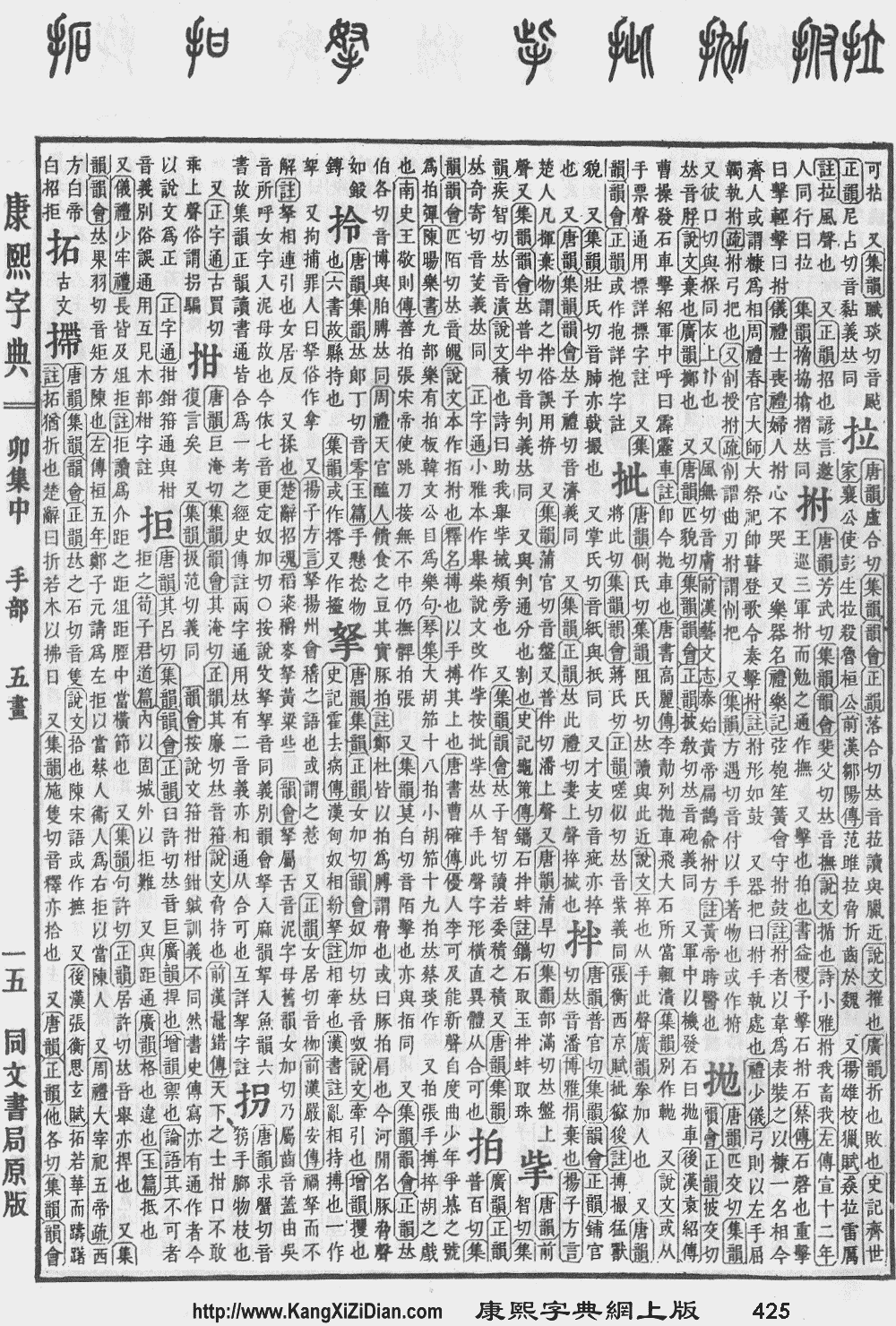
- Kangxi Dictionary: page 425, character 10
- Dai Kanwa Jiten: character 11955
- Dae Jaweon: page 773, character 15
- Hanyu Da Zidian (first edition): volume 3, page 1853, character 3
- Unihan data for U+62D0
Chinese
| trad. | 拐 | |
|---|---|---|
| simp. # | 拐 | |
Glyph origin
Characters in the same phonetic series (枴) (Zhengzhang, 2003)
Phono-semantic compound (形聲/形声, OC *ɡʷroːlʔ) : semantic 扌 (“hand”) + phonetic 冎 (OC *kroːlʔ).
Pronunciation
Definitions
拐
- to turn
- to kidnap; to abduct
- to misappropriate
- walking stick; cane
- 拄拐 ― zhǔguǎi ― to walk with a cane
- the numeral seven (used in radio communications in aviation and by the military)
- (Sichuanese) wrong; incorrect
Synonyms
- (to turn):
Dialectal synonyms of 轉 (“to turn; to make a turn; to change direction”) [map]
| Variety | Location | Words |
|---|---|---|
| Formal (Written Standard Chinese) | 轉, 拐 | |
| Mandarin | Beijing | 拐 |
| Taiwan | 轉 | |
| Malaysia | 轉 | |
| Singapore | 轉 | |
| Cantonese | Guangzhou | 轉 |
| Hong Kong | 轉 | |
| Macau | 轉 | |
| Kuala Lumpur (Guangfu) | 轉 | |
| Penang (Guangfu) | 轉 | |
| Singapore (Guangfu) | 轉 | |
| Hakka | Miaoli (N. Sixian) | 斡 |
| Pingtung (Neipu; S. Sixian) | 斡 | |
| Hsinchu County (Zhudong; Hailu) | 斡 | |
| Taichung (Dongshi; Dabu) | 斡 | |
| Hsinchu County (Qionglin; Raoping) | 斡 | |
| Yunlin (Lunbei; Zhao'an) | 斡 | |
| Southern Min | Xiamen | 斡 |
| Quanzhou | 斡 | |
| Zhangzhou | 斡 | |
| Tainan | 斡 | |
| Penang (Hokkien) | 彎 | |
| Singapore (Hokkien) | 斡 | |
| Manila (Hokkien) | 斡 | |
| Chaozhou | 斡 | |
| Shantou | 斡 | |
- (walking stick):
- (seven): 七 (qī)
- (wrong):
Dialectal synonyms of 錯 (“wrong”) [map]
Compounds
- 一拐一拐
- 一瘸一拐 (yīquéyīguǎi)
- 七拐八彎/七拐八弯
- 七繞八拐/七绕八拐
- 三拐兒/三拐儿
- 丟拐/丢拐
- 刁拐
- 刁風拐月/刁风拐月
- 匿拐
- 右拐 (yòuguǎi)
- 坑蒙拐騙/坑蒙拐骗
- 大拐
- 孤拐
- 孤拐臉/孤拐脸
- 孤拐面
- 小拐
- 左拐 (zuǒguǎi)
- 性誘拐/性诱拐 (xìngyòuguǎi)
- 拐兒/拐儿
- 拐子 (guǎizi)
- 拐子臉/拐子脸
- 拐子頭/拐子头
- 拐子馬/拐子马
- 拐孤
- 拐帶/拐带 (guǎidài)
- 拐帶人口/拐带人口
- 拐彎/拐弯 (guǎiwān)
- 拐彎兒/拐弯儿 (guǎiwānr)
- 拐彎抹角/拐弯抹角 (guǎiwānmòjiǎo)
- 拐抓
- 拄拐 (zhǔguǎi)
- 拐杖 (guǎizhàng)
- 拐枕
- 拐棍 (guǎigùn)
- 拐棍兒/拐棍儿
- 拐步
- 拐盜/拐盗
- 拐肘 (guǎizhǒu)
- 拐著彎/拐著弯
- 拐裨子
- 拐角 (guǎijiǎo)
- 拐角處/拐角处
- 拐角處遇見幸福/拐角处遇见幸福
- 拐誘/拐诱
- 拐賣/拐卖 (guǎimài)
- 拐走
- 拐跑
- 拐進/拐进
- 拐門/拐门
- 拐騙/拐骗 (guǎipiàn)
- 拐點/拐点 (guǎidiǎn)
- 拿拐
- 曲裡拐彎/曲里拐弯
- 曲里拐彎
- 木拐梯子
- 架拐
- 柳拐子病 (liǔguǎizibìng)
- 繞拐/绕拐
- 羊拐
- 胳膊肘往外拐
- 腳骨拐/脚骨拐
- 誘拐/诱拐 (yòuguǎi)
- 誘拐者/诱拐者
- 豬拐子/猪拐子
- 辣拐子 (làguǎizi)
- 鐵拐李/铁拐李
- 雙拐/双拐
- 龍頭拐杖/龙头拐杖
Japanese
Pronunciation
- IPA(key): [ka̠i]
Korean
Etymology
From Middle Chinese 拐 (MC geaX). Recorded as Middle Korean 괘〮 (kwáy) (Yale: kway) in Hunmong Jahoe (訓蒙字會 / 훈몽자회), 1527.
Vietnamese
This article is issued from Wiktionary. The text is licensed under Creative Commons - Attribution - Sharealike. Additional terms may apply for the media files.