拳
See also: 挙
| ||||||||
Translingual
Han character
拳 (Kangxi radical 64, 手+6, 10 strokes, cangjie input 火手手 (FQQ), four-corner 90502, composition ⿱龹手)
Related characters
References
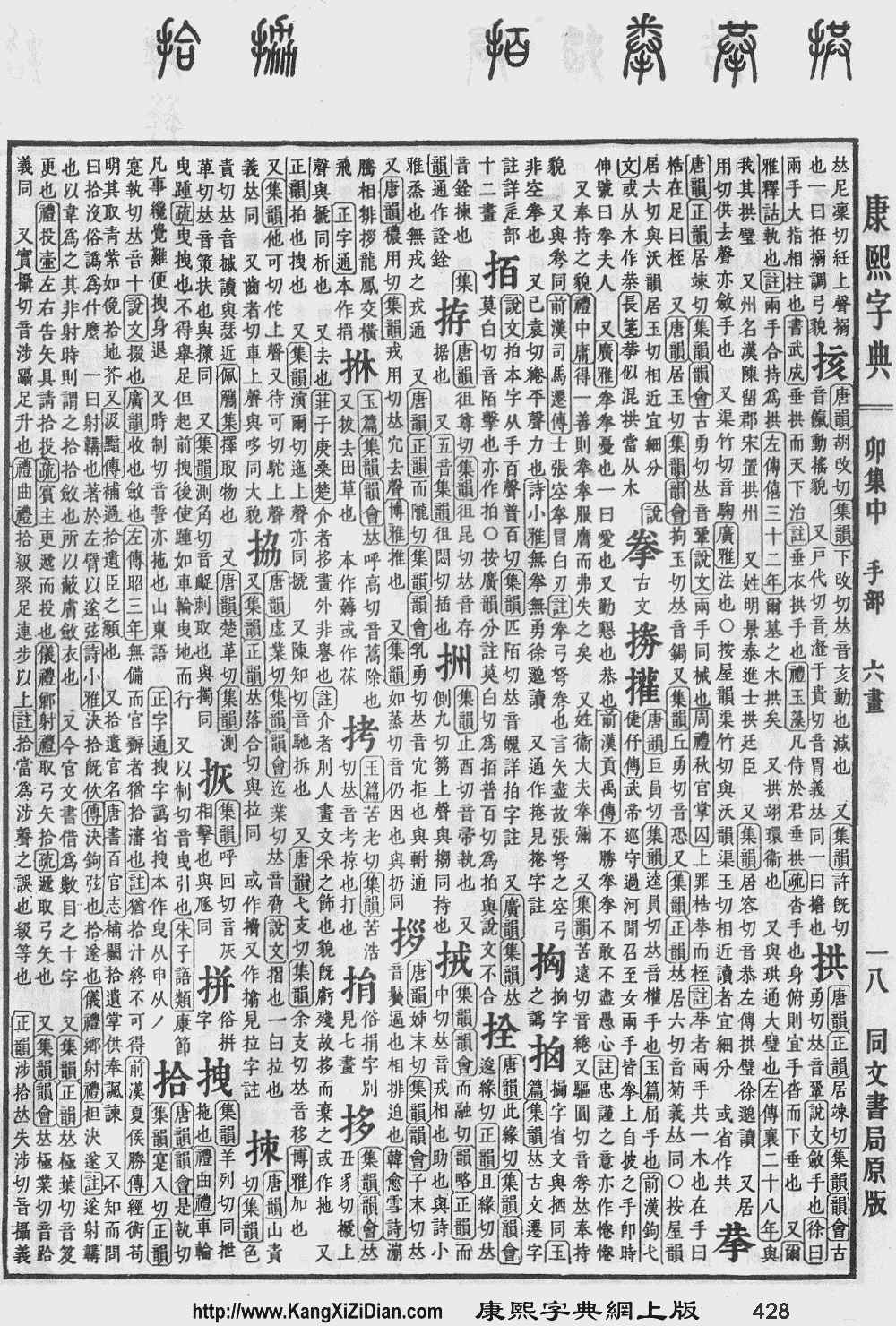
- Kangxi Dictionary: page 428, character 4
- Dai Kanwa Jiten: character 11996
- Dae Jaweon: page 777, character 2
- Hanyu Da Zidian (first edition): volume 3, page 1864, character 8
- Unihan data for U+62F3
Chinese
| simp. and trad. |
拳 | |
|---|---|---|
| alternative forms | 搼 | |
Glyph origin
Characters in the same phonetic series (龹) (Zhengzhang, 2003)
Phono-semantic compound (形聲/形声, OC *ɡron) : phonetic 龹 () + semantic 手 (“hand”) – a fist is a form of a hand.
Etymology
From 卷 (OC *ɡron, “to bent; to curve”) (Schuessler, 2007; also cf. Baxter and Sagart, 2014).
Pronunciation
Definitions
拳
Synonyms
Dialectal synonyms of 拳頭 (“fist”) [map]
Descendants
Others:
Compounds
- 一拳
- 一拳柱定
- 仙人拳
- 內家拳法/内家拳法
- 八卦拳
- 八極拳/八极拳 (bājíquán)
- 六合拳譜/六合拳谱
- 划拳 (huáquán)
- 北拳 (běiquán)
- 南拳 (nánquán)
- 太極拳/太极拳 (tàijíquán)
- 少林拳 (Shàolínquán)
- 巴子拳
- 庚子拳亂/庚子拳乱
- 形意拳
- 截短拳
- 戳短拳
- 打太平拳
- 打太極拳/打太极拳 (dǎ tàijíquán)
- 打拳 (dǎquán)
- 抱拳 (bàoquán)
- 拳不離手,曲不離口/拳不离手,曲不离口 (quánbùlíshǒu, qūbùlíkǒu)
- 拳勇
- 拳匪
- 拳壇/拳坛
- 拽大拳
- 拳套
- 拳師/拳师 (quánshī)
- 拳打 (quándǎ)
- 拳打腳踢/拳打脚踢 (quándǎjiǎotī)
- 拳拳 (quánquán)
- 拳拳服膺
- 拳擊/拳击 (quánjī)
- 拳攣/拳挛
- 拳曲 (quánqū)
- 拳棒
- 拳民
- 拳法 (quánfǎ)
- 拳派
- 拳王 (quánwáng)
- 拳腳/拳脚 (quánjiǎo)
- 拳腳交加/拳脚交加
- 拳術/拳术 (quánshù)
- 拳譜/拳谱
- 拳賽/拳赛 (quánsài)
- 拳跼
- 拳銃/拳铳
- 拳頭/拳头
- 拳頭產品/拳头产品
- 捋臂將拳/捋臂将拳
- 捋臂揎拳
- 捋袖揎拳
- 掄拳/抡拳
- 握拳
- 揮拳/挥拳
- 揎拳捋袖
- 揎拳擄袖/揎拳掳袖
- 揎拳攞袖/揎拳𫽋袖
- 握拳透掌
- 握拳透爪
- 搳拳 (huáquán)
- 摩拳擦掌 (móquáncāzhǎng)
- 撞心拳
- 擎拳合掌
- 擄袖揎拳/掳袖揎拳
- 擦拳抹掌
- 擦拳磨掌
- 擦掌摩拳
- 擦掌磨拳
- 攛拳攏袖/撺拳拢袖
- 查拳
- 毒手尊拳
- 比箭掄拳/比箭抡拳
- 泰國拳/泰国拳
- 洶洶拳拳/汹汹拳拳
- 無拳無勇/无拳无勇
- 猜拳 (cāiquán)
- 直拳
- 磨拳擦掌 (móquáncāzhǎng)
- 美人拳
- 義和拳/义和拳 (Yìhéquán)
- 老拳 (lǎoquán)
- 花拳
- 花拳繡腿/花拳绣腿 (huāquánxiùtuǐ)
- 莒拳
- 虎爪拳
- 蛇拳
- 螳螂拳
- 裸袖揎拳
- 話拳/话拳
- 豁拳 (huáquán)
- 赤手空拳 (chìshǒukōngquán)
- 跆拳道 (táiquándào)
- 蹬心拳
- 通臂拳
- 醉拳 (zuìquán)
- 鈀子拳/钯子拳
- 鐵拳/铁拳 (tiěquán)
- 長拳/长拳
- 隻手單拳/只手单拳
- 隻手空拳/只手空拳
- 雞肋尊拳/鸡肋尊拳
- 飽以老拳/饱以老拳 (bǎoyǐlǎoquán)
Japanese
| Shinjitai | 拳 |  |
| Kyūjitai [1][2][3][4] |
拳󠄁 拳+ 󠄁?(Adobe-Japan1) |
 |
| 拳󠄃 拳+ 󠄃?(Hanyo-Denshi) (Moji_Joho) | ||
| The displayed kanji may be different from the image due to your environment. See here for details. | ||
Kanji
拳
- ken, a game played with the hands; a game of hands; in Italian, mor(r)a, a game in which two (or more) players each suddenly display a hand showing zero to five fingers and call out what they think will be the sum of all fingers shown.
- fist, usually as a suffix in the names of martial art moves
Readings
Compounds
- 拳拳 (kenken)
- 拳固 (genko)
- 拳骨 (genkotsu)
- 拳酒 (genzake)
- 拳銃 (kenjū)
- 拳打 (kenda)
- 拳玉 (kendama)
- 拳闘 (kentō, “boxing”)
- 拳匪 (kenpi)
- 拳法 (kenpō)
- 拳万 (genman)
- 合拳 (aiken)
- 石拳 (ishiken)
- 狐拳 (kitsuneken)
- 軍師拳 (gunshiken)
- 薩摩拳 (satsumaken)
- じゃん拳 (janken)
- 手拳 (shuken)
- 庄屋拳 (shōyaken)
- 少林拳 (shōrinken)
- 太極拳 (taikyokuken)
- 鉄拳 (tekken)
- 闘拳 (tōken)
- 藤八拳 (tōhachiken)
- 徒手空拳 (toshukūken)
- 虎拳 (toraken)
- 本拳 (honken)
- 交ぜ拳, 雑ぜ拳 (mazeken)
- 虫拳 (mushiken)
- 野球拳 (yakyūken)
Etymology 1
| Kanji in this term |
|---|
| 拳 |
| こぶし Grade: S |
| kun’yomi |
| For pronunciation and definitions of 拳 – see the following entry. | ||||
| ||||
| (This term, 拳, is an alternative spelling of the above term.) |
Etymology 2
| Kanji in this term |
|---|
| 拳 |
| けん Grade: S |
| kan’on |
From Middle Chinese 拳 (MC gjwen).
The standalone noun senses are first cited to texts from the 1500s.[5]
Noun
拳 • (ken)
Suffix
拳 • (-ken)
- (martial arts) used in the names of styles, or moves that involve punching
- Antonym: 脚 (-kyaku)
- 蟷螂拳
- tōrōken
- mantis style
- 太極拳
- taikyokuken
- tai chi
- 波動拳
- Hadōken
- Surge Fist
- 1999 February 20 [1994 April 15], Rumiko Takahashi, “PART.2 [海](うみ)[千](せん)[拳](けん)と[山](やま)[千](せん)[拳](けん) ([海](うみ)[千](せん)[拳](けん)と[山](やま)[千](せん)[拳](けん)) [PART.2 Umisenken and Yamasenken]”, in らんま½ (らんま½) [Ranma ½], 10th edition, volume 28 (fiction), Tokyo: Shogakukan, →ISBN:
- やつの目的はおそらく、山千拳と対をなす海千拳の秘伝書。
- Yatsu no mokuteki wa osoraku, Yamasenken to tsui o nasu Umisenken no hidensho.
- He must be looking for the scroll for Umisenken, the antithesis of Yamasenken.
- Umisenken?
- Umisenken?
- やつの目的はおそらく、山千拳と対をなす海千拳の秘伝書。
- 2000 December 20 [1999 May 17], Maekawa, Takeshi, “水面の戦いの巻 [Water Struggle]”, in 新鉄拳チンミ (新鉄拳チンミ) [New Ironfist Chinmi], 2nd edition, volume 6 (fiction), Tokyo: Kodansha, →ISBN, pages 158–161:
- 今度はこっちの番だソウビ‼
- Kondo wa kotchi no ban da Sōbi‼
- It’s my turn now, Sōbi‼
- Mu
- Mm?
- Tsū‥‥hai‥‥ken‼‼
- Tong‥‥bei‥‥quan‼‼
- Tsūhaiken⁉ Tsurihashi de miseta ano waza de Mizu o‥‥‼
- Tongbeiquan⁉ I saw him use this move at the suspension bridge, but now on water‥‥⁉
- 今度はこっちの番だソウビ‼
- 2001 January 23, Masami Kurumada, “女神の聖闘士の巻 [Athena’s Saints]”, in Saint星矢 (Saint星矢) [Saint Seiya], volume 1 (fiction), Tokyo: Shueisha, →ISBN, page 60:
- ペガサス流星拳‼
- Pegasasu Ryūseiken‼
- Pegasus Meteor Fists‼
- ペガサス流星拳‼
- 2004 September 8, Nobuhiro Watsuki, “第36話 カーニバル[祭] [Chapter 36: Carnival]”, in 武装錬金 (武装錬金) [Armed Alchemy], volume 4, Tokyo: Shueisha, →ISBN:
- 直撃!ブラボー拳‼
- Chokugeki! Burabō-ken‼
- Direct! Bravo Punch‼
- 直撃!ブラボー拳‼
References
- “拳”, in 漢字ぺディア (Kanjipedia) (in Japanese), 日本漢字能力検定協会, 2015–2024
- 白川静 (Shirakawa Shizuka) (2014) “拳”, in 字通 (Jitsū) (in Japanese), popular edition, Tōkyō: Heibonsha, →ISBN
- Haga, Gōtarō (1914) 漢和大辞書 [The Great Kanji-Japanese Dictionary] (in Japanese), Fourth edition, Tōkyō: Kōbunsha, , page 945 (paper), page 522 (digital)
- Shōundō Henshūjo, editor (1927), 新漢和辞典 [The New Kanji-Japanese Dictionary] (in Japanese), Ōsaka: Shōundō, , page 579 (paper), page 302 (digital)
- Shōgaku Tosho (1988) 国語大辞典(新装版) [Unabridged Dictionary of Japanese (Revised Edition)] (in Japanese), Tōkyō: Shogakukan, →ISBN
- Matsumura, Akira, editor (2006), 大辞林 [Daijirin] (in Japanese), Third edition, Tōkyō: Sanseidō, →ISBN
- Yamada, Tadao et al., editors (2011), 新明解国語辞典 [Shin Meikai Kokugo Jiten] (in Japanese), Seventh edition, Tōkyō: Sanseidō, →ISBN
Korean
Etymology
From Middle Chinese 拳 (MC gjwen).
Recorded as Middle Korean 꿘 (Yale: kkwen) in Dongguk Jeongun (東國正韻 / 동국정운), 1448.
Recorded as Middle Korean 권 (kwen) (Yale: kwen) in Hunmong Jahoe (訓蒙字會 / 훈몽자회), 1527.
Compounds
Vietnamese
This article is issued from Wiktionary. The text is licensed under Creative Commons - Attribution - Sharealike. Additional terms may apply for the media files.