擢
| ||||||||
Translingual
Han character
擢 (Kangxi radical 64, 手+14, 17 strokes, cangjie input 手尸一土 (QSMG) or 難手尸一土 (XQSMG), four-corner 57014, composition ⿰扌翟)
Derived characters
- 𧃔, 𥷘
References
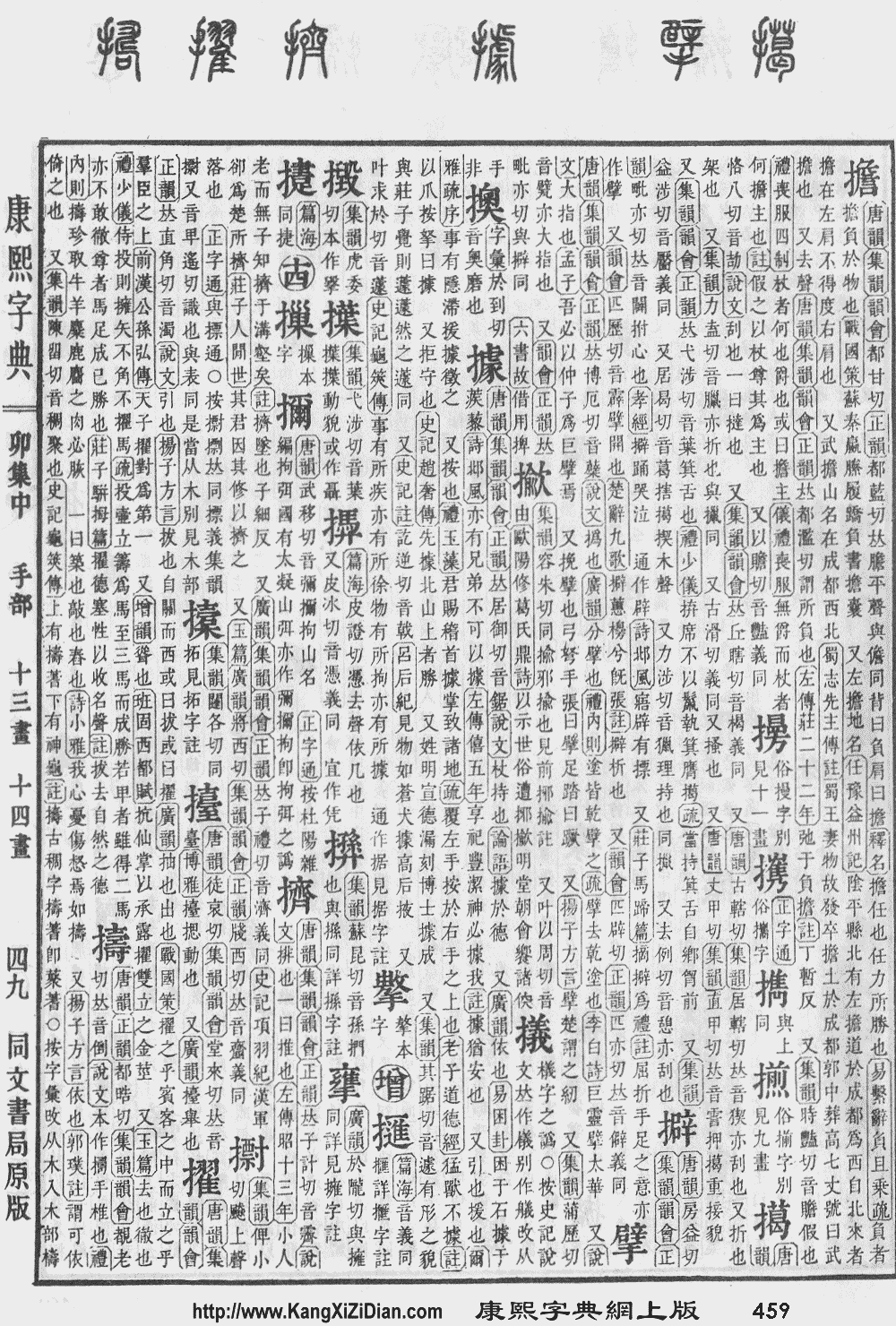
- Kangxi Dictionary: page 459, character 27
- Dai Kanwa Jiten: character 12852
- Dae Jaweon: page 808, character 20
- Hanyu Da Zidian (first edition): volume 3, page 1977, character 7
- Unihan data for U+64E2
Chinese
Glyph origin
| Historical forms of the character 擢 |
|---|
| Shuowen Jiezi (compiled in Han) |
| Small seal script |
 |
Characters in the same phonetic series (翟) (Zhengzhang, 2003)
Pronunciation
Definitions
擢
- (literary) to pull out
- (literary) to select; to promote
- (Hokkien) to pull; to tug
- (Mainland China Hokkien, figurative) to guide and support; to lead
- (Mainland China Hokkien) to coax out of somebody; to trick somebody into telling (of a secret, information, the truth, etc.)
- (Xiamen and Zhangzhou Hokkien) to roughly sew and mend
- (Taiwanese Hokkien) to flatten out (especially clothes)
Synonyms
Dialectal synonyms of 拉 (“to pull; to tug”) [map]
| Variety | Location | Words |
|---|---|---|
| Formal (Written Standard Chinese) | 拉, 挽 | |
| Mandarin | Beijing | 抻, 扽 |
| Taiwan | 拉 | |
| Jinan | 抻, 拉 | |
| Xi'an | 拉, 抻, 扯 | |
| Wuhan | 拉, 扯, 𠡒 | |
| Chengdu | 扯, 拉 | |
| Guilin | 扯 | |
| Yangzhou | 拽, 扽, 拉 | |
| Hefei | 拉, 拽 | |
| Singapore | 拉 | |
| Cantonese | Guangzhou | 拉, 掹 |
| Hong Kong | 拉, 掹 | |
| Yangjiang | 掹, 拉 | |
| Singapore (Guangfu) | 拉 | |
| Gan | Nanchang | 扯, 𠡒 |
| Hakka | Meixian | 挷 |
| Jin | Taiyuan | 扯 |
| Northern Min | Jian'ou | 拔, 揄 |
| Eastern Min | Fuzhou | 拔 |
| Southern Min | Xiamen | 搝, 擢 |
| Quanzhou | 搝, 擢 | |
| Zhangzhou | 搝, 擢 | |
| Taipei | 搝 | |
| New Taipei (Sanxia) | 搝 | |
| Kaohsiung | 搝 | |
| Yilan | 搝 | |
| Changhua (Lukang) | 搝 | |
| Taichung | 搝 | |
| Tainan | 搝, 擢 | |
| Hsinchu | 搝 | |
| Kinmen | 搝 | |
| Penghu (Magong) | 搝 | |
| Penang (Hokkien) | 搝, 擢 | |
| Singapore (Hokkien) | 搝 | |
| Manila (Hokkien) | 拔 | |
| Chaozhou | 𠡒 | |
| Wu | Shanghai | 拉 |
| Suzhou | 拉 | |
| Ningbo | 拉, 𠡒 | |
| Wenzhou | 拉, 𢱋, 𠡒 | |
| Xiang | Changsha | 扯, 悶 |
| Shuangfeng | 扯 | |
Compounds
Pronunciation
Definitions
擢
- This term needs a translation to English. Please help out and add a translation, then remove the text
{{rfdef}}.
Japanese
| Shinjitai (extended) |
Shinjitai (extended) |
擢󠄀 擢+ 󠄀?(Adobe-Japan1) |
 |
|
| 擢󠄂 擢+ 󠄂?(Hanyo-Denshi) (Moji_Joho) | ||||
| Kyūjitai | 擢 |  | ||
| The displayed kanji may be different from the image due to your environment. See here for details. | ||||
Kanji
擢
(“Jinmeiyō” kanji used for names)
- This term needs a translation to English. Please help out and add a translation, then remove the text
{{rfdef}}.
Readings
Compounds
- 抜擢 (batteki)
Korean
Hanja
擢 (eum 탁 (tak))
- This term needs a translation to English. Please help out and add a translation, then remove the text
{{rfdef}}.
Vietnamese
Han character
- This term needs a translation to English. Please help out and add a translation, then remove the text
{{rfdef}}.
References
This article is issued from Wiktionary. The text is licensed under Creative Commons - Attribution - Sharealike. Additional terms may apply for the media files.