敬
| ||||||||
| ||||||||
Translingual
Han character
敬 (Kangxi radical 66, 攴+9 in traditional Chinese and Korean, 攴+8 in mainland China and Japanese, 13 strokes in traditional Chinese and Korean, 12 strokes in mainland China and Japanese, cangjie input 廿口人大 (TROK), four-corner 48640, composition ⿰苟攵(GJKV) or ⿰茍攵(HT))
References
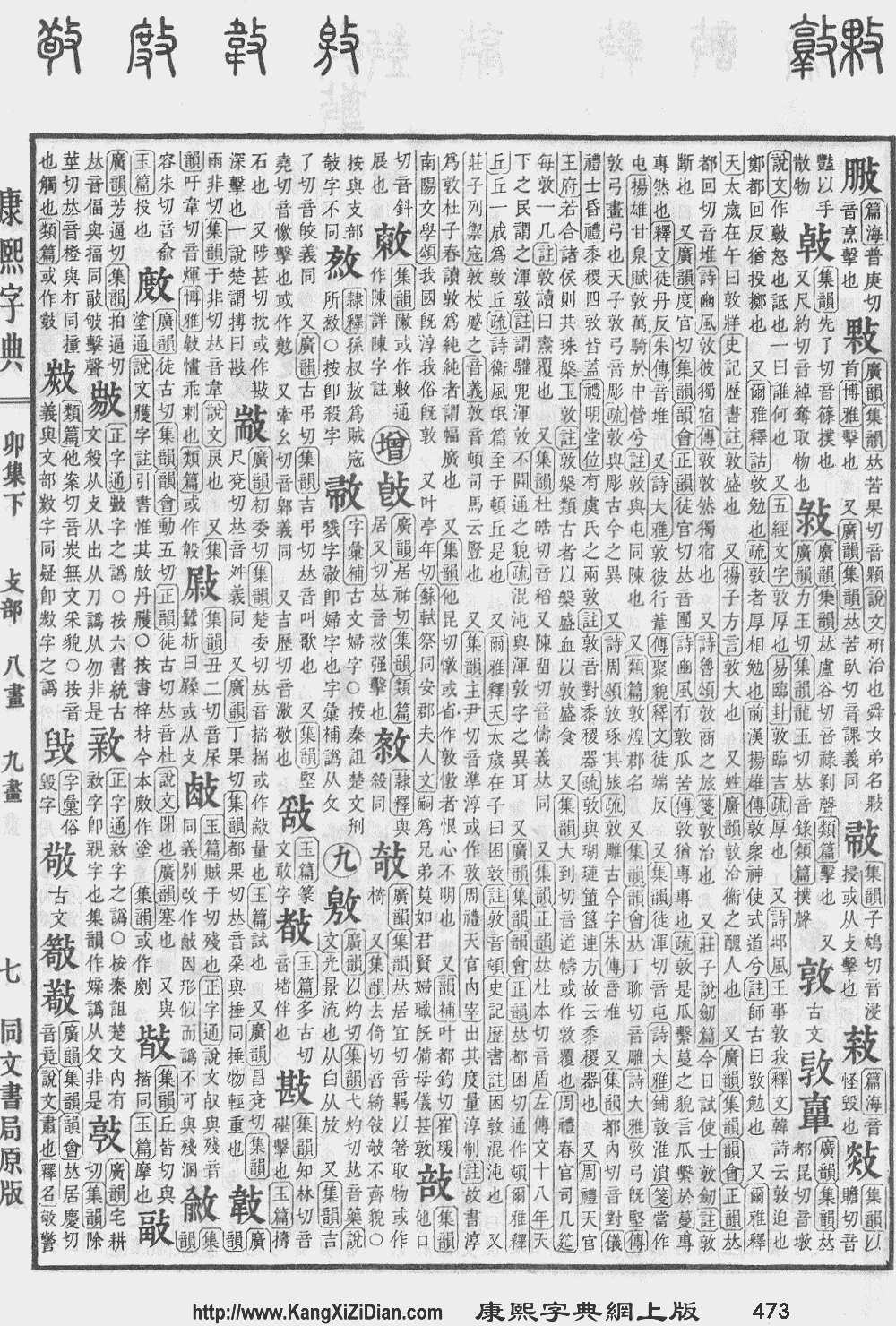
- Kangxi Dictionary: page 473, character 35
- Dai Kanwa Jiten: character 13285
- Dae Jaweon: page 826, character 17
- Hanyu Da Zidian (first edition): volume 2, page 1466, character 2
- Unihan data for U+656C
- Unihan data for U+2F8C9
Chinese
| trad. | 敬 | |
|---|---|---|
| simp. # | 敬 | |
Glyph origin
| Historical forms of the character 敬 | |||
|---|---|---|---|
| Western Zhou | Warring States | Shuowen Jiezi (compiled in Han) | Liushutong (compiled in Ming) |
| Bronze inscriptions | Chu slip and silk script | Small seal script | Transcribed ancient scripts |
 |
 |
 |
 |
Ideogrammic compound (會意/会意) : 茍 + 攵, the left component represents a sitting dog, the right component represents authority.
Etymology
Cognate with 驚 (OC *kreŋ, “to be afraid; to scare”) (Schuessler, 2007). See there for more.
Pronunciation
Definitions
敬
- to respect; to honor
- to present; to offer (alcohol, food, cigarettes, tea, etc.)
- (literary, or in compounds) to concentrate completely on; to devote oneself to; to focus all of one's attention on
- (literary, or in compounds) respectful; deferential (Can we add an example for this sense?)
- a surname
Synonyms
- (to respect):
- (to concentrate completely on):
- (respectful):
Antonyms
- (antonym(s) of “to respect”): 鄙 (bǐ)
Compounds
- 不敬 (bùjìng)
- 主敬存誠/主敬存诚
- 最敬禮/最敬礼 (zuìjìnglǐ)
- 可敬 (kějìng)
- 回敬 (huíjìng)
- 大不敬 (dàbùjìng)
- 失敬 (shījìng)
- 奠敬
- 奩敬/奁敬
- 孝敬 (xiàojìng)
- 尊敬 (zūnjìng)
- 屈尊敬賢/屈尊敬贤
- 崇敬 (chóngjìng)
- 廝抬廝敬/厮抬厮敬
- 廝敬廝愛/厮敬厮爱
- 彌敬/弥敬
- 忒敬思
- 忠敬
- 恭恭敬敬 (gōnggōngjìngjìng)
- 恭敬 (gōngjìng)
- 慎始敬終/慎始敬终 (shènshǐjìngzhōng)
- 憐貧敬老/怜贫敬老
- 敬上
- 敬上愛下/敬上爱下
- 敬之
- 敬事
- 敬事不暇
- 敬事房
- 敬亭山
- 敬仰 (jìngyǎng)
- 敬佩 (jìngpèi)
- 敬信 (Jìngxìn, “Jingxin”)
- 敬同
- 敬天愛民/敬天爱民
- 敬奉 (jìngfèng)
- 敬姜猶績/敬姜犹绩
- 敬小慎微
- 敬心
- 敬思
- 敬悉
- 敬意 (jìngyì)
- 敬愛/敬爱 (jìng'ài)
- 敬慎
- 敬慕 (jìngmù)
- 敬懇者/敬恳者
- 敬懼/敬惧
- 敬授人時/敬授人时
- 敬啟者/敬启者 (jìngqǐzhě)
- 敬時愛日/敬时爱日
- 敬服 (jìngfú)
- 敬業/敬业 (jìngyè)
- 敬業樂群/敬业乐群
- 敬業精神/敬业精神
- 敬畏 (jìngwèi)
- 敬祝 (jìngzhù)
- 敬神
- 敬禮/敬礼 (jìnglǐ)
- 敬稟者/敬禀者
- 敬稱/敬称 (jìngchēng)
- 敬老尊賢/敬老尊贤
- 敬老恤貧/敬老恤贫
- 敬老慈幼
- 敬老憐貧/敬老怜贫
- 敬老節/敬老节
- 敬老院 (jìnglǎoyuàn)
- 敬而遠之/敬而远之 (jìng'éryuǎnzhī)
- 敬肅者/敬肃者
- 敬若神明
- 敬虔主義/敬虔主义 (jìngqiánzhǔyì)
- 敬詞/敬词 (jìngcí)
- 敬請/敬请 (jìngqǐng)
- 敬諾/敬诺
- 敬謝/敬谢
- 敬謝不敏/敬谢不敏
- 敬謹/敬谨
- 敬賢/敬贤 (jìngxián)
- 敬賢禮士/敬贤礼士 (jìngxiánlǐshì)
- 敬身
- 敬辭/敬辞 (jìngcí)
- 敬酒 (jìngjiǔ)
- 敬重 (jìngzhòng)
- 敬陪末坐
- 敬陪末座
- 敬頌/敬颂
- 梁敬帝
- 楮敬
- 欽敬/钦敬 (qīnjìng)
- 潔敬/洁敬
- 炭敬
- 無以為敬/无以为敬
- 用代楮敬
- 畢恭畢敬/毕恭毕敬 (bìgōngbìjìng)
- 相敬如賓/相敬如宾
- 程敬
- 節敬/节敬
- 肅然起敬/肃然起敬 (sùránqǐjìng)
- 脩敬
- 至敬無文/至敬无文
- 致敬 (zhìjìng)
- 茶敬
- 莊敬/庄敬 (zhuāngjìng)
- 莊敬自強/庄敬自强
- 菲敬
- 虔敬 (qiánjìng)
- 誠心敬意/诚心敬意
- 誠敬/诚敬
- 贄敬/贽敬
- 起敬 (qǐjìng)
- 輕財敬士/轻财敬士
References
- “敬”, in 漢語多功能字庫 (Multi-function Chinese Character Database), 香港中文大學 (the Chinese University of Hong Kong), 2014–
- “Entry #9524”, in 臺灣閩南語常用詞辭典 [Dictionary of Frequently-Used Taiwan Minnan] (overall work in Mandarin and Hokkien), Ministry of Education, R.O.C., 2023.
Japanese
Readings
Compounds
- 敬愛 (keiai): respect and affection
- 敬畏 (keī): reverence, holding in awe, fear
- 敬意 (keī): respect
- 敬遠 (keien): keeping at a distance
- 敬具 (keigu): a respectful closing statement
- 敬虔 (keiken): pious
- 敬語 (keigo): honorifics
- 敬神 (keishin): piety
- 敬称 (keishō): title of honor
- 敬体 (keitai): distal style
- 敬白 (keihaku): Yours Sincerely
- 敬服 (keifuku): admiration
- 敬慕 (keibo): love and respect
- 敬礼 (keirei): salute, bow
- 敬老 (keirō): respect for elders
- 敬譲語 (keijōgo): polite speech
- 敬天愛人 (keiten aijin): "Revere heaven, love people."
- 失敬 (shikkei): rude
- 尊敬 (sonkei): respect
Archaic
Pronunciation
- IPA(key): [ke̞ː]
Etymology 2
| Kanji in this term |
|---|
| 敬 |
| うやまい Grade: 6 |
| kun’yomi |
The 連用形 (ren'yōkei, “continuative or stem form”) of verb 敬う (uyamau, “to respect, to esteem”).[1][2]
Alternative forms
- 敬い (uyamai)
Pronunciation
- IPA(key): [ɯ̟ᵝja̠ma̠i]
Usage notes
More commonly spelled as 敬い with the okurigana.
Etymology 3
Used as ateji in various names.
References
- Shōgaku Tosho (1988) 国語大辞典(新装版) [Unabridged Dictionary of Japanese (Revised Edition)] (in Japanese), Tōkyō: Shogakukan, →ISBN
- Matsumura, Akira, editor (2006), 大辞林 [Daijirin] (in Japanese), Third edition, Tōkyō: Sanseidō, →ISBN
Korean
Vietnamese
Han character
敬: Hán Việt readings: kính (
敬: Nôm readings: kính[1][2][4][5], kỉnh[2], kinh[6]
Compounds
- 恭敬 (cung kính)
- 敬重 (kính trọng)
References
- Nguyễn (2014).
- Nguyễn et al. (2009).
- Trần (2004).
- Bonet (1899).
- Génibrel (1898).
- Taberd & Pigneau de Béhaine (1838).