棘

棘 U+68D8, 棘
CJK UNIFIED IDEOGRAPH-68D8
← 棗
[U+68D7]
CJK Unified Ideographs 棙 →
[U+68D9]

Translingual

Han character

棘 (Kangxi radical 75, 木+8, 12 strokes, cangjie input 木月木月 (DBDB), four-corner 55992, composition ⿰朿朿)

Derived characters

References

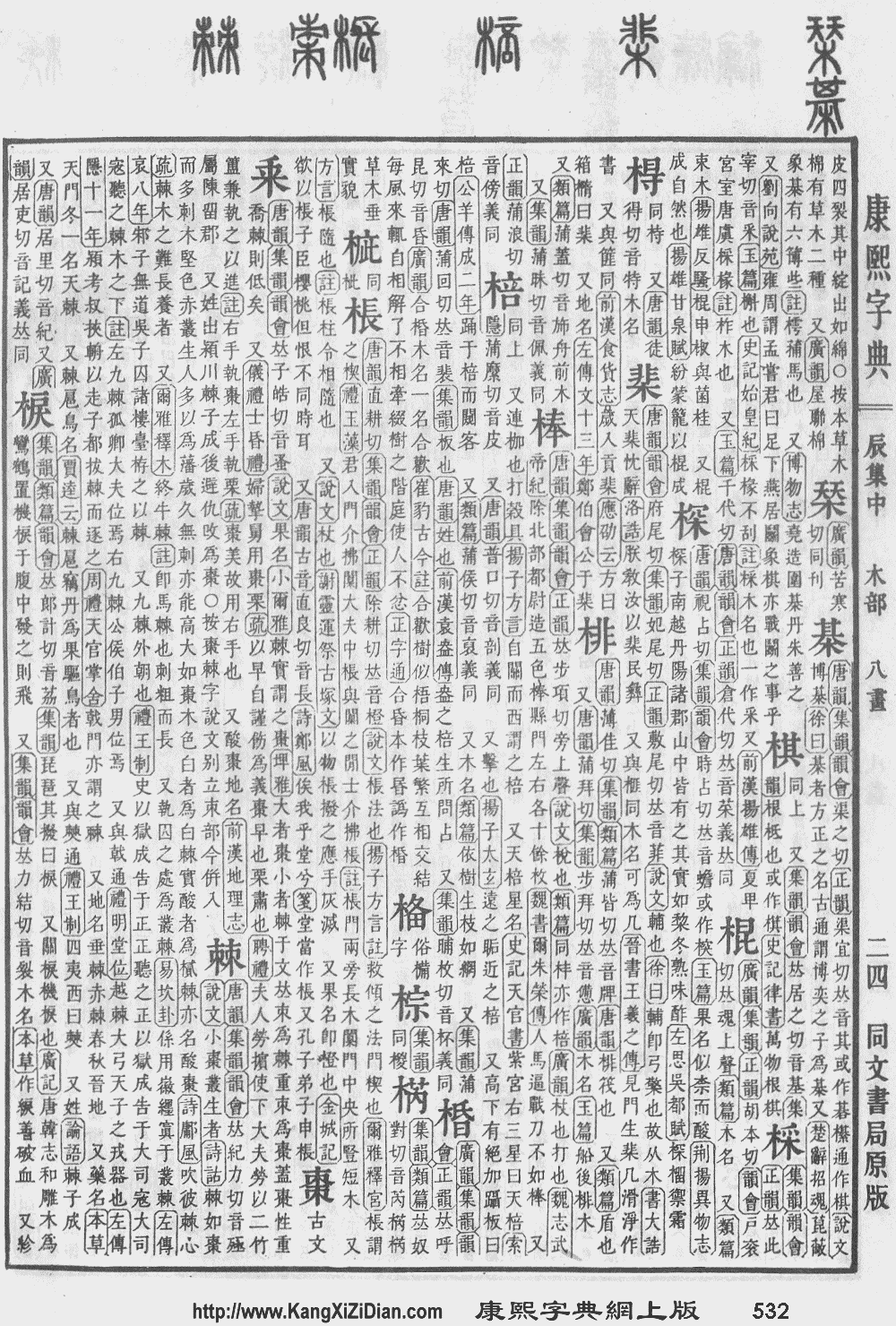
  • Kangxi Dictionary: page 532, character 20
  • Dai Kanwa Jiten: character 14938
  • Dae Jaweon: page 921, character 1
  • Hanyu Da Zidian (first edition): volume 2, page 1227, character 9
  • Unihan data for U+68D8

Chinese

simp. and trad.
棘
alternative forms 撠 to prick
𣡍
𭫼

Glyph origin

Historical forms of the character 棘
Shang Western Zhou Shuowen Jiezi (compiled in Han) Liushutong (compiled in Ming)
Oracle bone script Bronze inscriptions Small seal script Transcribed ancient scripts

Pronunciation


Rime
Character 棘
Reading # 1/1
Initial (聲) 見 (28)
Final (韻) 職 (134)
Tone (調) Checked (Ø)
Openness (開合) Open
Division (等) III
Fanqie 紀力切
Baxter kik
Reconstructions
Zhengzhang
Shangfang
/kɨk̚/
Pan
Wuyun
/kɨk̚/
Shao
Rongfen
/kiek̚/
Edwin
Pulleyblank
/kik̚/
Li
Rong
/kiək̚/
Wang
Li
/kĭək̚/
Bernard
Karlgren
/ki̯ək̚/
Expected
Mandarin
Reflex
ji
Expected
Cantonese
Reflex
gik1
Baxter–Sagart system 1.1 (2014)
Character 棘
Reading # 1/1
Modern
Beijing
(Pinyin)
jí
Middle
Chinese
‹ kik ›
Old
Chinese
/*krək/
English thorns

Notes for Old Chinese notations in the Baxter–Sagart system:

* Parentheses "()" indicate uncertain presence;
* Square brackets "[]" indicate uncertain identity, e.g. *[t] as coda may in fact be *-t or *-p;
* Angle brackets "<>" indicate infix;
* Hyphen "-" indicates morpheme boundary;

* Period "." indicates syllable boundary.
Zhengzhang system (2003)
Character 棘
Reading # 1/1
No. 5745
Phonetic
component
棘
Rime
group
職
Rime
subdivision
0
Corresponding
MC rime
殛
Old
Chinese
/*krɯɡ/

Definitions

棘

  1. jujube tree
  2. thorny bush; bramble
  3. thorns
  4. thorny
  5. to prick
  6. Synonym of 戟 (jǐ, “halberd”)

Compounds

Pronunciation

Definitions

棘

  1. (Cantonese) Alternative form of 撠 (kik1, “to be stuck”)

Japanese

Kanji

棘

(uncommon “Hyōgai” kanji)

  1. This term needs a translation to English. Please help out and add a translation, then remove the text {{rfdef}}.

Readings

Compounds

Etymology 1

Kanji in this term
棘
とげ
Hyōgaiji
kun’yomi

Alternative forms

Pronunciation

Noun

棘(とげ) • (toge) 

  1. thorn

Etymology 2

Kanji in this term
棘
いばら
Hyōgaiji
kun’yomi

umara → ubara → ibara.

Alternative forms

Pronunciation

Noun

棘(いばら) or 棘(イバラ) • (ibara) 

  1. a shrub with thorns: a bramble, a briar
  2. thorn
  3. a thorny flower of the genus Rosa: a rose
Derived terms

References

  1. Matsumura, Akira, editor (2006), 大辞林 [Daijirin] (in Japanese), Third edition, Tōkyō: Sanseidō, →ISBN
  2. NHK Broadcasting Culture Research Institute, editor (1998), NHK日本語発音アクセント辞典 [NHK Japanese Pronunciation Accent Dictionary] (in Japanese), Tōkyō: NHK Publishing, →ISBN

Korean

Hanja

棘 • (geuk) (hangeul 극, revised geuk, McCune–Reischauer kŭk, Yale kuk)

  1. This term needs a translation to English. Please help out and add a translation, then remove the text {{rfdef}}.

Vietnamese

Han character

棘: Hán Nôm readings: gấc, cức

  1. This term needs a translation to English. Please help out and add a translation, then remove the text {{rfdef}}.
This article is issued from Wiktionary. The text is licensed under Creative Commons - Attribution - Sharealike. Additional terms may apply for the media files.