殸

殸 U+6BB8, 殸
CJK UNIFIED IDEOGRAPH-6BB8
← 殷
[U+6BB7]
CJK Unified Ideographs 殹 →
[U+6BB9]

Translingual

Han character

殸 (Kangxi radical 79, 殳+7, 11 strokes, cangjie input 土竹竹弓水 (GHHNE), composition ⿰声殳)

Descendants

References

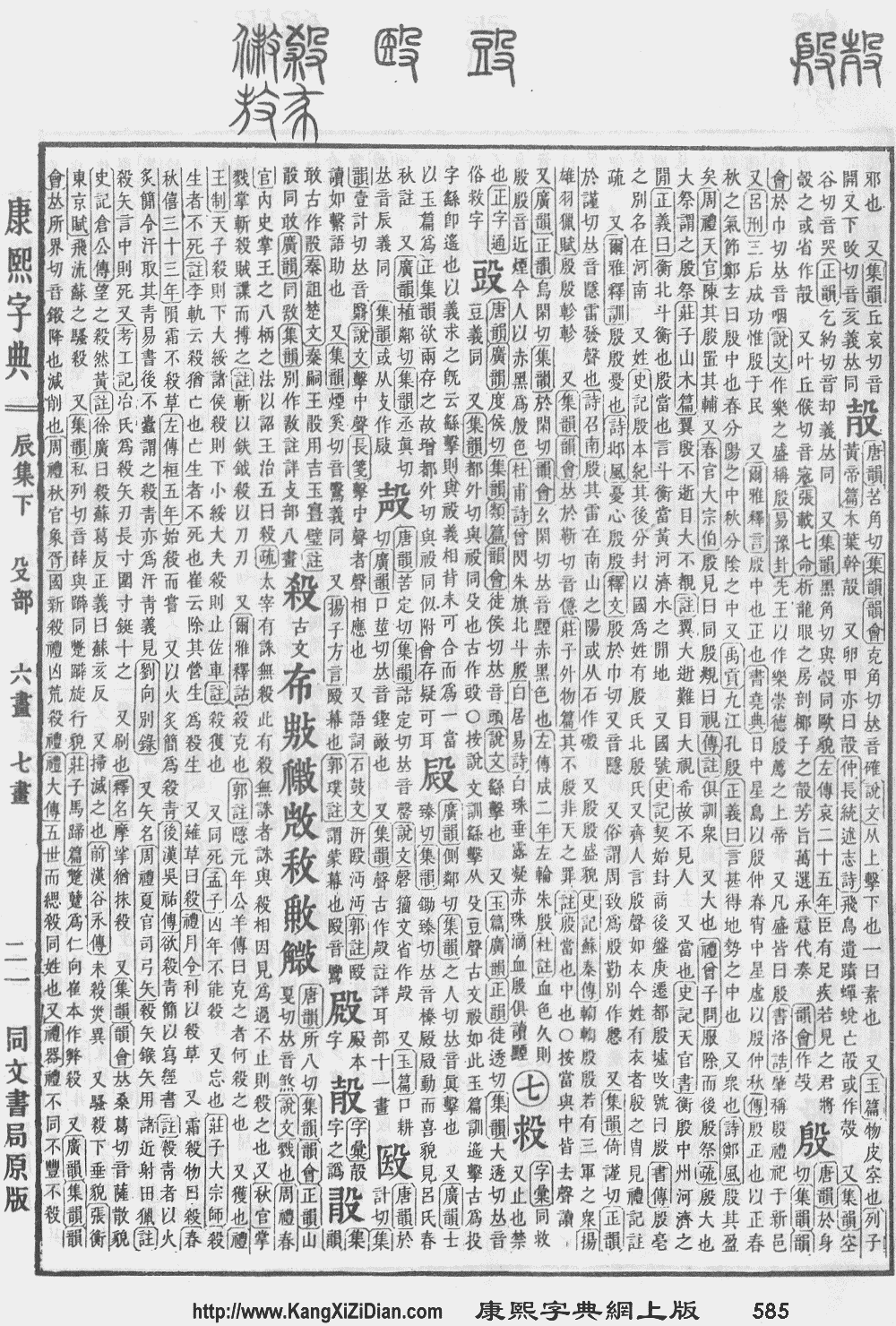
  • Kangxi Dictionary: page 585, character 6
  • Dai Kanwa Jiten: character 16633
  • Dae Jaweon: page 977, character 25
  • Hanyu Da Zidian (first edition): volume 3, page 2159, character 6
  • Unihan data for U+6BB8

Chinese

Glyph origin

Historical forms of the character 殸
Shang Shuowen Jiezi (compiled in Han) Liushutong (compiled in Ming)
Oracle bone script Small seal script Transcribed ancient scripts

Etymology 1

simp. and trad.
殸

Pronunciation


Rime
Character 殸 殸
Reading # 1/2 2/2
Initial (聲) 溪 (29) 溪 (29)
Final (韻) 耕 (117) 青 (125)
Tone (調) Level (Ø) Departing (H)
Openness (開合) Open Open
Division (等) II IV
Fanqie 口莖切 苦定切
Baxter kheang khengH
Reconstructions
Zhengzhang
Shangfang
/kʰˠɛŋ/ /kʰeŋH/
Pan
Wuyun
/kʰᵚæŋ/ /kʰeŋH/
Shao
Rongfen
/kʰɐŋ/ /kʰɛŋH/
Edwin
Pulleyblank
/kʰəɨjŋ/ /kʰɛjŋH/
Li
Rong
/kʰɛŋ/ /kʰeŋH/
Wang
Li
/kʰæŋ/ /kʰieŋH/
Bernard
Karlgren
/kʰæŋ/ /kʰieŋH/
Expected
Mandarin
Reflex
kēng qìng
Expected
Cantonese
Reflex
hang1 hing3
Baxter–Sagart system 1.1 (2014)
Character 殸
Reading # 1/1
Modern
Beijing
(Pinyin)
qìng
Middle
Chinese
‹ khengH ›
Old
Chinese
/*[C.qʰ]ˁeŋ-s/
English hanging musical stone

Notes for Old Chinese notations in the Baxter–Sagart system:

* Parentheses "()" indicate uncertain presence;
* Square brackets "[]" indicate uncertain identity, e.g. *[t] as coda may in fact be *-t or *-p;
* Angle brackets "<>" indicate infix;
* Hyphen "-" indicates morpheme boundary;

* Period "." indicates syllable boundary.
Zhengzhang system (2003)
Character 殸 殸
Reading # 1/2 2/2
No. 10513 10516
Phonetic
component
殸 殸
Rime
group
耕 耕
Rime
subdivision
0 0
Corresponding
MC rime
鏗 罄
Old
Chinese
/*kʰreːŋ/ /*kʰeːŋs/
Notes 籀文磬

Definitions

殸

  1. † enemy

Etymology 2

For pronunciation and definitions of 殸 – see 磬 (“stone chimes; sounding stone; qing; inverted bell”).
(This character is a variant form of 磬).

Etymology 3

For pronunciation and definitions of 殸 – see 聲 (“sound; noise; voice; music; etc.”).
(This character is a variant form of 聲).

References

Japanese

Kanji

殸

(uncommon “Hyōgai” kanji)

  1. voice

Readings

Korean

Hanja

殸 • (seong) (hangeul 성, revised seong, McCune–Reischauer sŏng, Yale seng)

  1. voice
  2. elegance
  3. song
  4. honor
This article is issued from Wiktionary. The text is licensed under Creative Commons - Attribution - Sharealike. Additional terms may apply for the media files.