灌

See also: 潅
灌 U+704C, 灌
CJK UNIFIED IDEOGRAPH-704C
← 灋
[U+704B]
CJK Unified Ideographs 灍 →
[U+704D]

Translingual

Han character

灌 (Kangxi radical 85, 水+18 in traditional Chinese and Korean, 水+17 in mainland China and Japanese, 21 strokes in traditional Chinese and Korean, 20 strokes in mainland China and Japanese, cangjie input 水廿口土 (ETRG), four-corner 34114, composition ⿰氵雚)

Derived characters

References

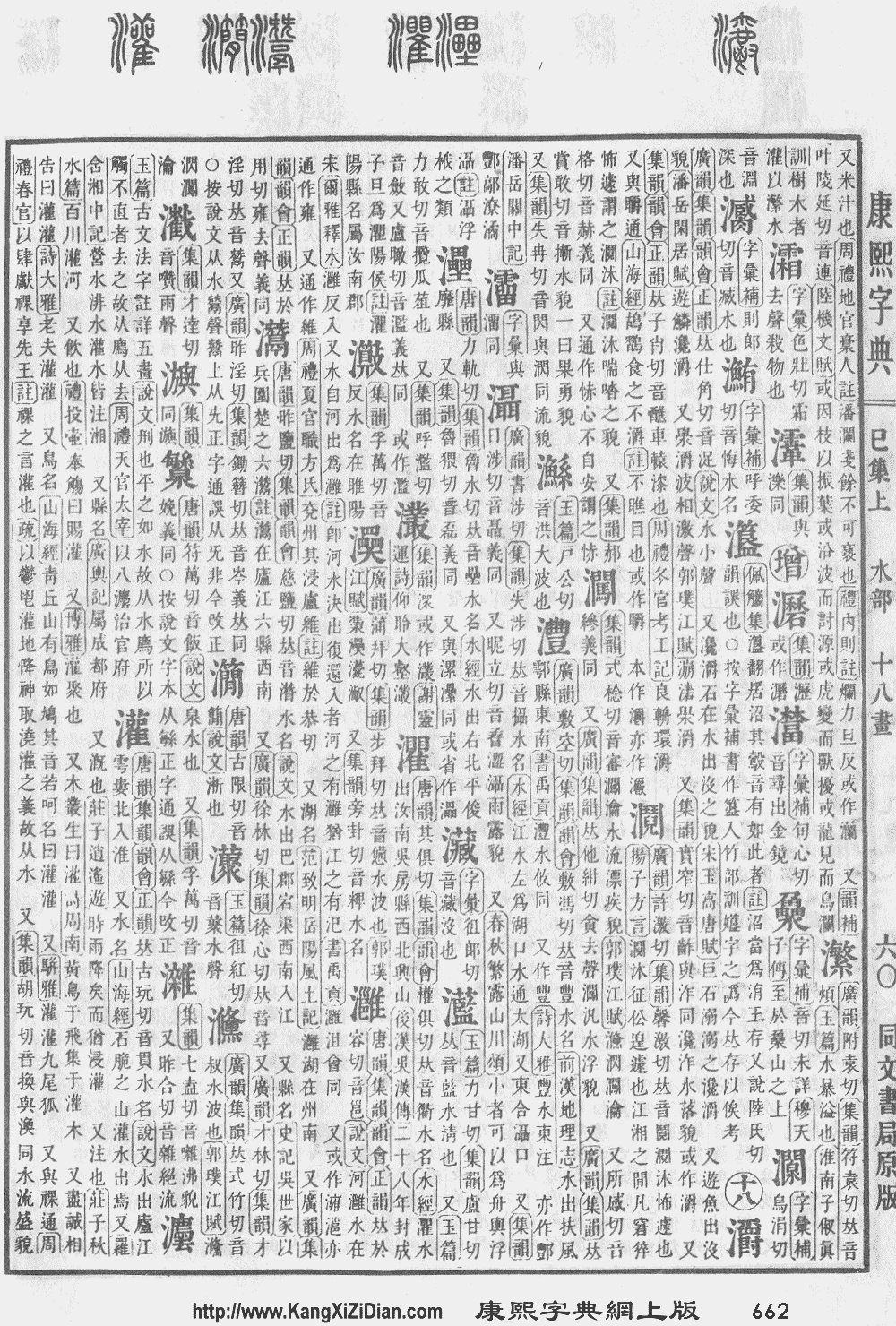
  • Kangxi Dictionary: page 662, character 35
  • Dai Kanwa Jiten: character 18759
  • Dae Jaweon: page 1071, character 30
  • Hanyu Da Zidian (first edition): volume 3, page 1786, character 13
  • Unihan data for U+704C

Chinese

trad. 灌
simp. # 灌
2nd round simp. 浂

Glyph origin

Phono-semantic compound (形聲/形声, OC *koːns) : semantic 水 (“water”) + phonetic 雚 (OC *koːns).

Pronunciation


Note:
  • guang3 - Shantou;
  • guêng3 - Chaozhou.

    Rime
    Character 灌
    Reading # 1/1
    Initial (聲) 見 (28)
    Final (韻) 桓 (62)
    Tone (調) Departing (H)
    Openness (開合) Closed
    Division (等) I
    Fanqie 古玩切
    Baxter kwanH
    Reconstructions
    Zhengzhang
    Shangfang
    /kuɑnH/
    Pan
    Wuyun
    /kʷɑnH/
    Shao
    Rongfen
    /kuɑnH/
    Edwin
    Pulleyblank
    /kwanH/
    Li
    Rong
    /kuɑnH/
    Wang
    Li
    /kuɑnH/
    Bernard
    Karlgren
    /kuɑnH/
    Expected
    Mandarin
    Reflex
    guàn
    Expected
    Cantonese
    Reflex
    gun3
    Baxter–Sagart system 1.1 (2014)
    Character 灌
    Reading # 1/1
    Modern
    Beijing
    (Pinyin)
    guàn
    Middle
    Chinese
    ‹ kwanH ›
    Old
    Chinese
    /*[C.qʷ]ˁar-s/
    English pour, drip

    Notes for Old Chinese notations in the Baxter–Sagart system:

    * Parentheses "()" indicate uncertain presence;
    * Square brackets "[]" indicate uncertain identity, e.g. *[t] as coda may in fact be *-t or *-p;
    * Angle brackets "<>" indicate infix;
    * Hyphen "-" indicates morpheme boundary;

    * Period "." indicates syllable boundary.
    Zhengzhang system (2003)
    Character 灌
    Reading # 1/1
    No. 4478
    Phonetic
    component
    雚
    Rime
    group
    元
    Rime
    subdivision
    3
    Corresponding
    MC rime
    貫
    Old
    Chinese
    /*koːns/

    Definitions

    灌

    1. to fill (with liquid); to pour
    2. to irrigate; to water
    3. to record (music)
      灌唱片  ―  guàn chàngpiàn  ―  to make a record
    4. (Taiwan) to install (software)

    Synonyms

    • (to irrigate):

    Compounds

    • 倒灌 (dàoguàn)
    • 冬灌
    • 半灌木
    • 叢灌/丛灌
    • 噴灑灌溉/喷洒灌溉
    • 如湯灌雪/如汤灌雪
    • 如雷灌耳 (rúléiguàněr)
    • 抱甕灌圃/抱瓮灌圃
    • 排灌
    • 提灌
    • 春灌
    • 海水倒灌
    • 淹灌
    • 溝灌/沟灌 (gōuguàn)
    • 漫灌
    • 潛灌/潜灌
    • 澆灌/浇灌 (jiāoguàn)
    • 灌區/灌区
    • 灌口二郎
    • 灌唱片
    • 灌園食力/灌园食力
    • 灌夫罵坐/灌夫骂坐
    • 灌救
    • 灌木 (guànmù)
    • 灌水 (guànshuǐ)
    • 灌注 (guànzhù)
    • 灌注器 (guànzhùqì)
    • 灌溉 (guàngài)
    • 灌溉工程
    • 灌溉渠
    • 灌滌/灌涤
    • 灌漿/灌浆
    • 灌灌
    • 灌瓜之義/灌瓜之义
    • 灌籃/灌篮 (guànlán)
    • 灌精兒/灌精儿
    • 灌腸/灌肠
    • 灌膿/灌脓
    • 灌輸/灌输 (guànshū)
    • 灌迷湯/灌迷汤
    • 灌酒
    • 灌醉 (guànzuì)
    • 灌錄/灌录 (guànlù)
    • 灌音
    • 灌頂/灌顶 (guàndǐng)
    • 灌香腸/灌香肠
    • 灌黃湯/灌黄汤
    • 畦溝灌溉/畦沟灌溉
    • 盤灌法/盘灌法
    • 絳灌/绛灌
    • 罵坐灌夫/骂坐灌夫
    • 自流灌溉
    • 莽灌夫
    • 負壺灌區/负壶灌区
    • 輪流灌溉/轮流灌溉
    • 醍醐灌頂/醍醐灌顶 (tíhúguàndǐng)
    • 錄灌/录灌

    Japanese

    Shinjitai
    (extended)

    潅

    Kyūjitai

    灌

    Kanji

    灌

    (uncommon “Hyōgai” kanji, kyūjitai kanji, shinjitai form 潅)

    1. to pour

    Readings

    Compounds

    Korean

    Hanja

    灌 • (gwan) (hangeul 관)

    1. pour
    2. water
    3. irrigate, flood

    Vietnamese

    Han character

    灌: Hán Nôm readings: quán

    1. This term needs a translation to English. Please help out and add a translation, then remove the text {{rfdef}}.
    This article is issued from Wiktionary. The text is licensed under Creative Commons - Attribution - Sharealike. Additional terms may apply for the media files.