甾
| ||||||||
| ||||||||
Translingual
Han character
甾 (Kangxi radical 102, 田+3, 8 strokes, cangjie input 女女田 (VVW), four-corner 22600, composition ⿱巛田)
Derived characters
References
- Kangxi Dictionary: page 759, character 11
- Dai Kanwa Jiten: character 21742
- Dae Jaweon: page 1169, character 11
- Hanyu Da Zidian (first edition): volume 4, page 2531, character 5
- Unihan data for U+753E
- Unihan data for U+2F936

Chinese
| simp. and trad. |
甾 | |
|---|---|---|
Glyph origin
Phono-semantic compound (形聲/形声, OC *ʔsrɯ) : phonetic 𠙹 + semantic 田 (“cropfield”), attested since Qin State of Warring States period. Evolved later into various different shapes – ⿱𠀐田, 𱰭, and 甾 (Chen, 2021).
The "container" sense was of a different character – 𠙹 – attested since oracle bones script. This sense was conflated with 甾 later, as in Middle Chinese rime books (ibid.) See the entry 𠙹 for more.
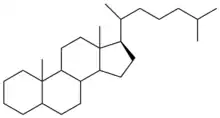
This character was practically obsolete before it was revived as a modern translation for steroid. It is also a pictogram (象形) in this sense; the upper part represents the three side chains on the ring system, and the 田 component represents the tetracyclic core of steroids. See the image on right.
Smith (2011) interprets the oracle bone glyph as depicting the new moon and proposes that it originally wrote a word *ts[r]əʔ "darkened phase" i.e. "new moon", related to 緇 (OC *tsrə) "blackened", 菑 (OC *tsrə) "field cleared by slash and burn", 淄 (OC *tsrə) "murky (water)". Lunar meaning is also present in 臘/腊 (là) of which this character is the upper-right component.
(This etymology is missing or incomplete. Please add to it, or discuss it at the Etymology scriptorium. Particularly: “Who and when repurposed this character as steroid though?”)
Pronunciation 1
Definitions
甾
Compounds
- 甾丘
- 甾川
- 甾縣/甾县
- 臨甾/临甾
Pronunciation 2
Japanese
Kanji
- This term needs a translation to English. Please help out and add a translation, then remove the text
{{rfdef}}.