碍
See also: 礙
| ||||||||
Translingual
Han character
碍 (Kangxi radical 112, 石+8, 13 strokes, cangjie input 一口日一戈 (MRAMI), four-corner 16641, composition ⿰石㝵)
Derived characters
- 𠿴, 𢣀, 𦡡, 𫣣
Related characters
- 礙 (Orthodox form in Traditional Chinese)
Further reading
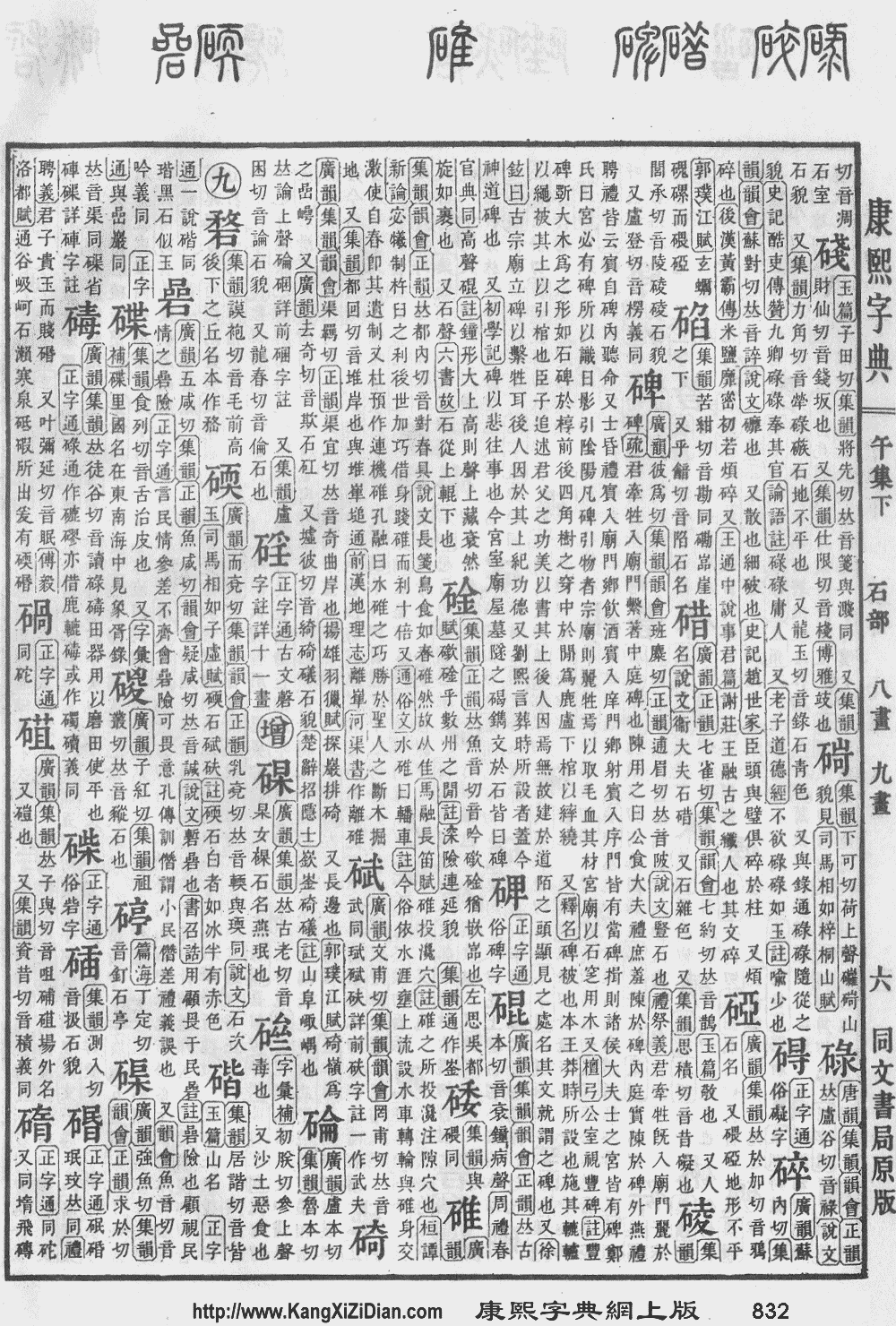
- Kangxi Dictionary: page 832, character 4
- Dai Kanwa Jiten: character 24283
- Dae Jaweon: page 1248, character 22
- Hanyu Da Zidian (first edition): volume 4, page 2437, character 5
- Unihan data for U+788D
Chinese
| For pronunciation and definitions of 碍 – see 礙 (“to obstruct; to hinder; to block; to deter; obstruction; hindrance”). (This character is the simplified and variant form of 礙). |
Notes:
|
Japanese
Compounds
- 無碍 (muge)
Etymology
| Kanji in this term |
|---|
| 碍 |
| がい Hyōgaiji |
| kan’on |
| Alternative spelling |
|---|
| 礙 |
From Middle Chinese 礙 (MC ngojH).
Pronunciation
- IPA(key): [ɡa̠i]
Usage notes
In modern Japanese, 碍 is mostly replaced by 害, due to the deprecation of non-tōyō kanji caused by the Japanese script reform.
Korean
Hanja
Vietnamese
Han character
碍: Hán Việt readings: ngại (
碍: Nôm readings: ngại[2][3][4][1][6], ngáy[7][1], ngái[4]
References
- Bonet (1899).
- Nguyễn (2014).
- Nguyễn et al. (2009).
- Trần (2004).
- Génibrel (1898).
- Taberd & Pigneau de Béhaine (1838).
- Hồ (1976).
This article is issued from Wiktionary. The text is licensed under Creative Commons - Attribution - Sharealike. Additional terms may apply for the media files.