害
| ||||||||
Translingual
| Stroke order | |||
|---|---|---|---|
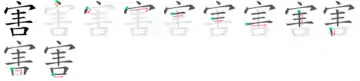 | |||
| Stroke order (Taiwan) | |||
|---|---|---|---|
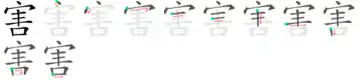 | |||
| Stroke order (Japan) | |||
|---|---|---|---|
 | |||
Han character
害 (Kangxi radical 40, 宀+7, 10 strokes, cangjie input 十手十口 (JQJR) or 十手一口 (JQMR), four-corner 30601, composition ⿳宀丰口)
Derived characters
References
- Kangxi Dictionary: page 286, character 12
- Dai Kanwa Jiten: character 7165
- Dae Jaweon: page 565, character 9
- Hanyu Da Zidian (first edition): volume 2, page 929, character 5
- Unihan data for U+5BB3
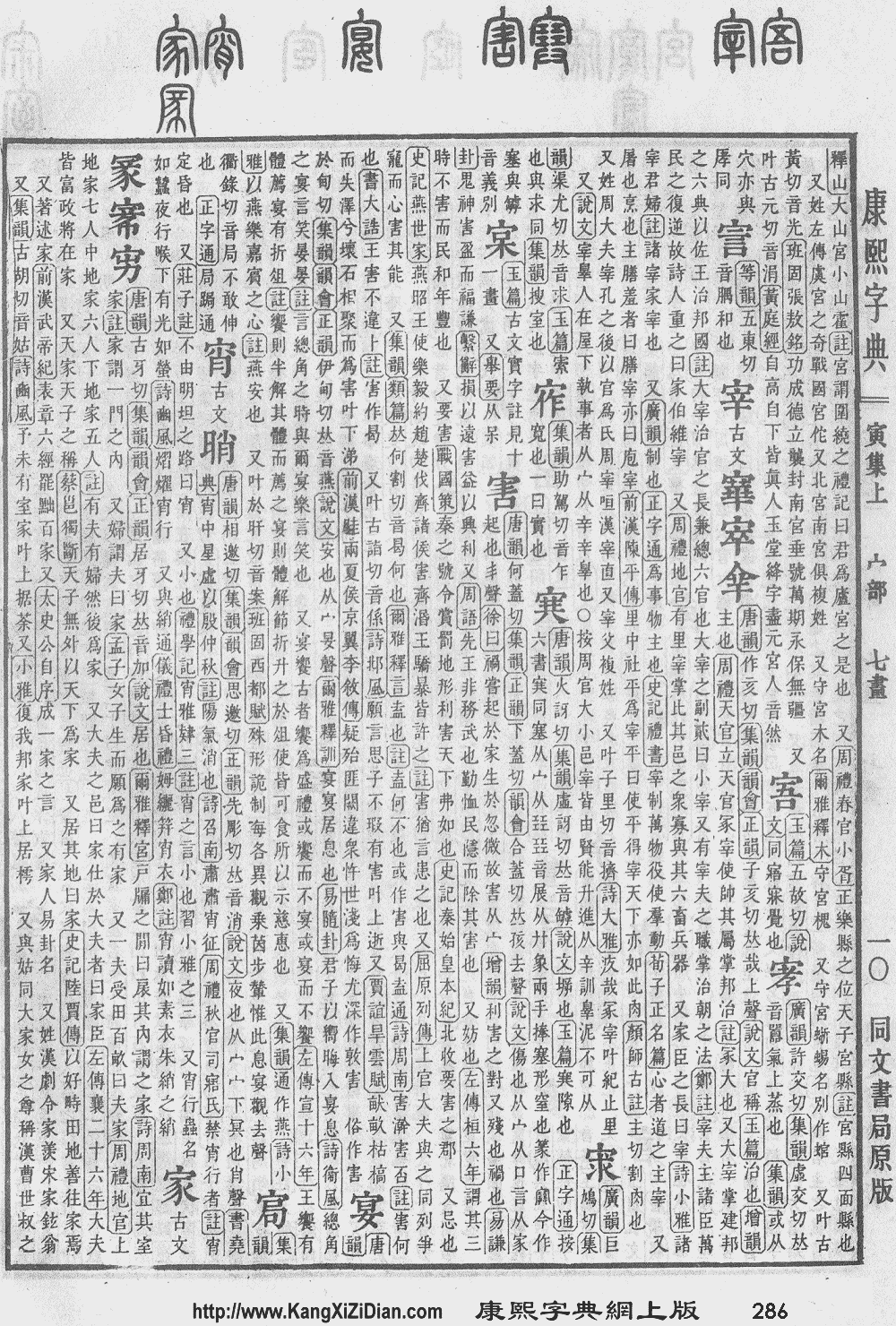
Chinese
| trad. | 害 | |
|---|---|---|
| simp. # | 害 | |
| alternative forms | 𡧱 𰀘 | |
Glyph origin
| Historical forms of the character 害 |
|---|
| Western Zhou |
| Bronze inscriptions |
 |
Characters in the same phonetic series (害) (Zhengzhang, 2003)
Multiple theories:
- He Linyi (何琳儀): Ideogram (指事) : a spear 𫲸 (now 𥎆) + a distinguishing mark 口.[1][2]
- Li Xueqin (2012): Phono-semantic compound (形聲/形声) . The phonetic component is 𡩜 (xiàn).[3]
- Guo Moruo (郭沫若),[1] Dai Jiaxiang (戴家祥)[2]: Pictogram (象形) , ancient form of 蓋 ("lid; cover").
- Gao Hongying (高鴻纓): Jiajie (假借) , original character of 桷, borrowed for sound, which was a pictogram (象形) of a house's rafters (see 舍).[1]
- Chen Bingxin (陳秉新): Original form of 𠤳, written as ⿷𠥓⿴害五 in bronze inscriptions, which itself is an ancient way of writing the 胡 in 胡簋.[1][2]
- Shuowen Jiezi: Phono-semantic compound (形聲/形声, OC *ɡaːds) : semantic 宀 + semantic 口 + phonetic 丯 (OC *kreːds).
- 季旭昇,2004《說文新證》,台北:藝文印書館印行,2014年9月第二版。p.601-602
- 漢語多功能字庫 - 字頭 「害」
- 李學勤,2012《字源》,天津:天津古籍出版社,2013年7月2次印刷。p.662
Etymology
Cognate with 割 (OC *kaːd, “to cut”). See there for more.
Pronunciation 1
Definitions
害
- to harm; to maim; to injure
- 銅生鉎,害自身。 [Eastern Min, trad.]
- Dè̤ng săng cĭng, hâi cê̤ṳ-sĭng. / [tøyŋ⁵³ saŋ⁵⁵ t͡siŋ⁵⁵ hɑi²⁴² t͡sy²⁴²⁻⁵⁵ (s-)liŋ⁵⁵] [Bàng-uâ-cê / IPA]
- Harm oneself (just like copper rusting).
铜生𰽫,害自身。 [Eastern Min, simp.]
- to cause to do; to result in (something unfavourable)
- to kill; to murder
- to suffer from
- to feel (an adverse sentiment)
- harm; disaster; calamity
- crucial point; vital point
- harmful; injurious
- (Southern Min) broken
Compounds
- 三害
- 不害 (bùhài)
- 不害事
- 不知利害
- 不計利害/不计利害
- 以文害辭/以文害辞
- 侵害 (qīnhài)
- 傷天害理/伤天害理 (shāngtiānhàilǐ)
- 傷害/伤害 (shānghài)
- 傷害保險/伤害保险
- 傷害罪/伤害罪
- 光害 (guānghài)
- 全身遠害/全身远害
- 公害 (gōnghài)
- 公害病
- 冷害 (lěnghài)
- 凍害/冻害 (dònghài)
- 利害得失
- 利害關係/利害关系
- 加害 (jiāhài)
- 加害人
- 危害 (wēihài)
- 厲害/厉害 (lìhài)
- 受害 (shòuhài)
- 喪天害理/丧天害理
- 噤害
- 圖害/图害 (túhài)
- 圖財害命/图财害命
- 坑害 (kēnghài)
- 墊害/垫害
- 大害
- 天然災害/天然灾害
- 妨功害能
- 妨害 (fánghài)
- 妨害治安
- 妨害自由
- 妨害風化/妨害风化
- 妒能害賢/妒能害贤
- 定害
- 害乏
- 害事
- 害人不淺/害人不浅 (hàirénbùqiǎn)
- 害人利己
- 害人害己 (hàirénhàijǐ)
- 害人精
- 害人蟲/害人虫
- 害冷
- 害口
- 害命
- 害喜 (hàixǐ)
- 害夏
- 害天災/害天灾
- 害心 (hàixīn)
- 害怕 (hàipà)
- 害慌
- 害死 (hàisǐ)
- 害死人
- 害民 (hàimín)
- 害熱/害热
- 害獸/害兽 (hàishòu)
- 害病 (hàibìng)
- 害發/害发
- 害眼
- 害羞 (hàixiū)
- 害群之馬/害群之马 (hàiqúnzhīmǎ)
- 害肚子
- 害臊 (hàisào)
- 害苦
- 害處/害处 (hàichù)
- 害蟲/害虫 (hàichóng)
- 害酒
- 害頭疼/害头疼
- 害馬/害马
- 害鳥/害鸟 (hàiniǎo)
- 寒害
- 弊害 (bìhài)
- 患害
- 戕害 (qiānghài)
- 戕害不辜 (qiānghàibùgū)
- 扳害
- 排害
- 損害/损害 (sǔnhài)
- 損害賠償/损害赔偿
- 暗害 (ànhài)
- 有害 (yǒuhài)
- 有害無利/有害无利
- 殘害/残害 (cánhài)
- 殘民害物/残民害物
- 殘賢害善/残贤害善
- 殺害/杀害 (shāhài)
- 毒害 (dúhài)
- 民害
- 求生害義/求生害义
- 災害/灾害 (zāihài)
- 災害救濟/灾害救济
- 為害/为害 (wéihài)
- 為民除害/为民除害
- 無害/无害 (wúhài)
- 病害 (bìnghài)
- 病蟲害/病虫害 (bìngchónghài)
- 盛衰利害
- 禁害
- 禍害/祸害 (huòhài)
- 種族迫害/种族迫害
- 自然災害/自然灾害 (zìrán zāihài)
- 自相殘害/自相残害 (zìxiāngcánhài)
- 興利除害/兴利除害
- 藥害/药害
- 螟害
- 蟲害/虫害 (chónghài)
- 蠹國害民/蠹国害民
- 蠹害
- 被害人 (bèihàirén)
- 要害 (yàohài)
- 誤國害民/误国害民
- 誣害/诬害 (wūhài)
- 謀害/谋害 (móuhài)
- 謀財害命/谋财害命 (móucáihàimìng)
- 譖害/谮害
- 讒害/谗害 (chánhài)
- 貪生害義/贪生害义
- 貽害/贻害 (yíhài)
- 賊害/贼害
- 趨利避害/趋利避害 (qūlìbìhài)
- 迫害 (pòhài)
- 運動傷害/运动伤害
- 違天害理/违天害理
- 過失傷害/过失伤害
- 遇害 (yùhài)
- 違害就利/违害就利
- 遠害全身/远害全身
- 遺害/遗害 (yíhài)
- 防弊除害
- 除凶去害
- 除害 (chúhài)
- 陰害/阴害
- 陷害 (xiànhài)
- 陰柔害物/阴柔害物
- 隘害
- 雷害
- 霜害 (shuānghài)
- 風害/风害 (fēnghài)
- 養癰貽害/养痈贻害
- 鴆害/鸩害
- 鹽害/盐害
Pronunciation 2
Japanese
| Shinjitai | 害 |  |
| Kyūjitai [1] |
害󠄂 害+ 󠄂?(Adobe-Japan1) |
 |
| 害󠄆 害+ 󠄆?(Hanyo-Denshi) (Moji_Joho) | ||
| The displayed kanji may be different from the image due to your environment. See here for details. | ||
Readings
Derived terms
References
- “害”, in 漢字ぺディア (Kanjipedia) (in Japanese), 日本漢字能力検定協会, 2015–2024
- Matsumura, Akira, editor (2006), 大辞林 [Daijirin] (in Japanese), Third edition, Tōkyō: Sanseidō, →ISBN
- NHK Broadcasting Culture Research Institute, editor (1998), NHK日本語発音アクセント辞典 [NHK Japanese Pronunciation Accent Dictionary] (in Japanese), Tōkyō: NHK Publishing, →ISBN
Korean
Vietnamese
This article is issued from Wiktionary. The text is licensed under Creative Commons - Attribution - Sharealike. Additional terms may apply for the media files.