簫
See also: 箫
| ||||||||
Translingual
| Traditional | 簫 |
|---|---|
| Shinjitai (extended) |
簘 |
| Simplified | 箫 |
Han character
簫 (Kangxi radical 118, 竹+12, 18 strokes, cangjie input 竹中難 (HLX), four-corner 88227, composition ⿱𥫗肅)
References
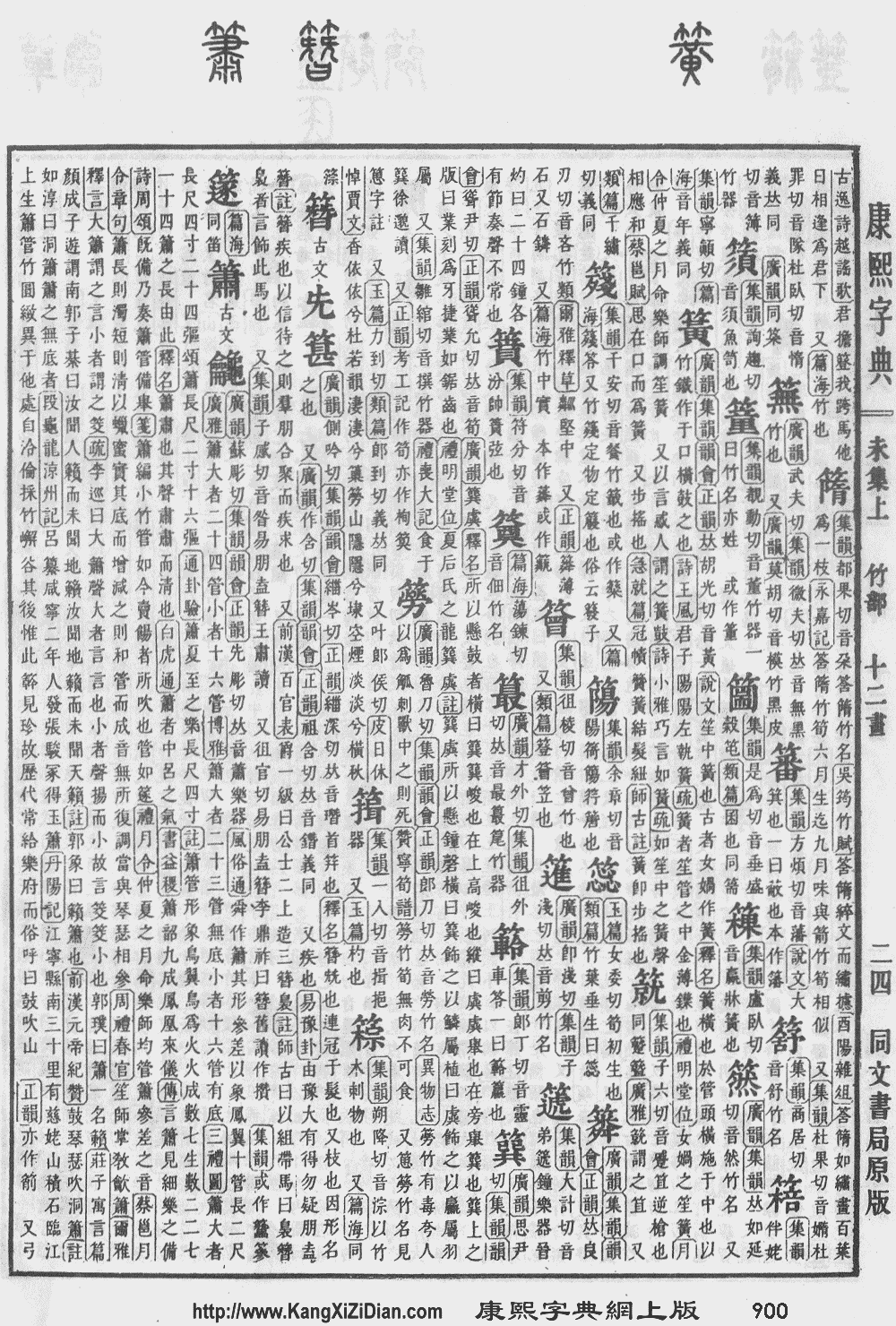
- Kangxi Dictionary: page 900, character 32
- Dai Kanwa Jiten: character 26560
- Dae Jaweon: page 1326, character 16
- Hanyu Da Zidian (first edition): volume 5, page 3023, character 10
- Unihan data for U+7C2B
Chinese
| trad. | 簫 | |
|---|---|---|
| simp. | 箫 | |
| alternative forms | 簘 箾 𪛕 𱍉 𪛖 | |
Glyph origin
Characters in the same phonetic series (肅) (Zhengzhang, 2003)
Phono-semantic compound (形聲/形声, OC *sɯːw) : semantic 竹 (“bamboo”) + phonetic 肅 (OC *sɯwɢ).
Pronunciation
Definitions
簫
- (music) xiao, a vertical, notched, end-blown bamboo flute used since ancient times in Chinese traditional and classical music
- (music, historical) paixiao; panpipes
- (Cantonese, Northern Min, Eastern Min) transverse flute
- a surname: Xiao
Synonyms
Dialectal synonyms of 簫 (“vertical flute”) [map]
| Variety | Location | Words |
|---|---|---|
| Formal (Written Standard Chinese) | 簫, 洞簫 | |
| Mandarin | Beijing | 簫 |
| Taiwan | 簫 | |
| Jinan | 簫 | |
| Xi'an | 簫 | |
| Wuhan | 簫 | |
| Chengdu | 簫 | |
| Yangzhou | 簫 | |
| Hefei | 簫 | |
| Cantonese | Guangzhou | 簫 |
| Hong Kong | 簫 | |
| Yangjiang | 簫 | |
| Gan | Nanchang | 簫 |
| Hakka | Meixian | 簫仔 |
| Jin | Taiyuan | 簫 |
| Northern Min | Jian'ou | 簫, 直簫 |
| Eastern Min | Fuzhou | 簫 |
| Southern Min | Xiamen | 簫, 洞簫 |
| Chaozhou | 簫 | |
| Wu | Suzhou | 簫 |
| Wenzhou | 簫 | |
| Xiang | Changsha | 簫 |
| Shuangfeng | 簫 | |
Dialectal synonyms of 笛子 (“(Chinese) transverse flute”) [map]
| Variety | Location | Words |
|---|---|---|
| Formal (Written Standard Chinese) | 笛子, 橫笛 | |
| Mandarin | Beijing | 笛子, 笛兒, 橫笛兒 |
| Taiwan | 笛子 | |
| Yantai (Muping) | 笛子 | |
| Jinan | 笛兒, 笛, 笛子 | |
| Luoyang | 笛子 | |
| Wanrong | 笛 | |
| Xi'an | 笛 | |
| Xining | 笛竿兒 | |
| Wuhan | 笛子 | |
| Chengdu | 笛子 | |
| Guiyang | 笛子 | |
| Yangzhou | 笛子 | |
| Hefei | 笛子 | |
| Singapore | 笛子 | |
| Cantonese | Guangzhou | 笛, 簫 |
| Hong Kong | 笛, 笛子 Chinese | |
| Yangjiang | 笛 | |
| Gan | Nanchang | 笛子 |
| Lichuan | 笛仔 | |
| Pingxiang | 笛子 | |
| Hakka | Meixian | 笛仔, 笛 |
| Miaoli (N. Sixian) | 橫簫 | |
| Pingtung (Neipu; S. Sixian) | 嗶嗶仔 | |
| Kaohsiung (Meinong; S. Sixian) | 橫簫 | |
| Kaohsiung (Shanlin; S. Sixian) | 簫仔 | |
| Jin | Taiyuan | 笛子, 笛, 梅 |
| Northern Min | Jian'ou | 簫 |
| Eastern Min | Fuzhou | 簫 |
| Southern Min | Xiamen | 笛仔, 𥰔仔 |
| Quanzhou | 笛仔, 𥰔仔 | |
| Jinjiang | 𥰔仔 | |
| Zhangzhou | 𥰔仔 | |
| New Taipei (Tamsui) | 𥰔仔 | |
| New Taipei (Pingxi) | 𥰔仔 | |
| Kaohsiung | 𥰔仔 | |
| Kaohsiung (Cijin) | 𥰔仔 | |
| Kaohsiung (Dalinpu, Siaogang) | 𥰔仔 | |
| Yilan (Toucheng) | 𥰔仔 | |
| Tainan | 𥰔仔 | |
| Tainan (Anping) | 𥰔仔 | |
| Penghu (Xiyu) | 𥰔仔 | |
| Chaozhou | 笛 | |
| Shantou | 笛 | |
| Jieyang | 笛 | |
| Wu | Suzhou | 笛 |
| Wenzhou | 笛 | |
| Xiang | Changsha | 笛子 |
| Shuangfeng | 曲子 | |
Japanese
| 簘 | |
| 簫 |
Readings
Etymology
From Middle Chinese 簫/箫 (sew, “xiao (Chinese flute)”).
Usage notes
Synonymous with the longer phrase 簫の笛 (shō no fue, literally “shō flute”).[1] However, given the rarity of this kanji in writing, and the large number of possible single-kanji terms pronounced as shō in Japanese, this longer term that specifies 笛 (“flute”) is used to clarify and disambiguate.
References
- Matsumura, Akira, editor (2006), 大辞林 [Daijirin] (in Japanese), Third edition, Tōkyō: Sanseidō, →ISBN
Korean
Hanja
簫 • (so) (hangeul 소, revised so, McCune–Reischauer so, Yale so)
- This term needs a translation to English. Please help out and add a translation, then remove the text
{{rfdef}}.
Compounds
Vietnamese
This article is issued from Wiktionary. The text is licensed under Creative Commons - Attribution - Sharealike. Additional terms may apply for the media files.