梅
| ||||||||
 | ||||||||
 | ||||||||
Translingual
| Japanese | 梅 |
|---|---|
| Simplified | 梅 |
| Traditional | 梅 |
Alternative forms
In Chinese, Korean and Vietnamese scripts, the right side component is written 每 (contains 母 with 2 dots). In Japanese shinjitai, the component is simplified to 毎 (contains 毋 with a single middle stroke). Due to Han unification, both characters (梅/梅) are encoded under the same Unicode codepoint. A CJK compatibility ideograph (U+FA44) exists for the kyūjitai form of 梅.
Han character
梅 (Kangxi radical 75, 木+7 in Chinese, 木+6 in Japanese, 11 strokes in Chinese, 10 strokes in Japanese, cangjie input 木人田卜 (DOWY), four-corner 48957, composition ⿰木每(GHTKV) or ⿰木毎(J))
Derived characters
- 𠻽, 𡠫, 䔦, 𫂚
References
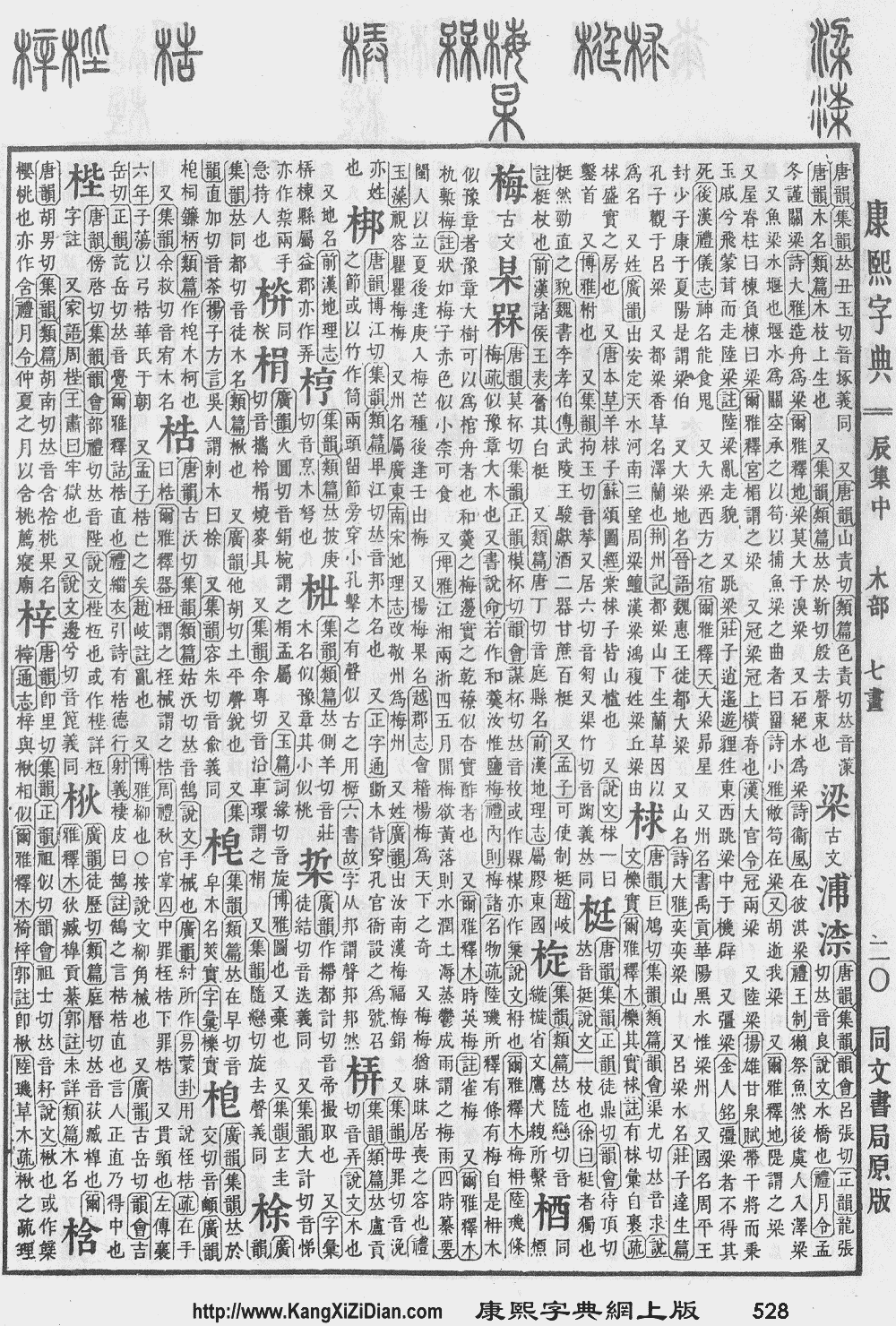
- Kangxi Dictionary: page 528, character 8
- Dai Kanwa Jiten: character 14795
- Dae Jaweon: page 916, character 23
- Hanyu Da Zidian (first edition): volume 2, page 1215, character 13
- Unihan data for U+6885
- Unihan data for U+FA44
- Unihan data for U+2F8E2
Chinese
| simp. and trad. |
梅 | |
|---|---|---|
| alternative forms | ||
Glyph origin
| Old Chinese | |
|---|---|
| 脢 | *mɯːs, *mɯː, *mɯːs |
| 挴 | *mlɯːʔ, *mɯːʔ |
| 海 | *hmlɯːʔ |
| 毐 | *ʔmɯː, *ʔmɯːʔ |
| 呣 | *mɯ |
| 拇 | *mɯʔ |
| 母 | *mɯʔ |
| 胟 | *mɯʔ |
| 姆 | *mɯʔ, *mɯs, *maːʔ |
| 畮 | *mɯʔ |
| 踇 | *mɯʔ |
| 苺 | *mɯs, *mɯːʔ, *mɯːs |
| 莓 | *mɯs, *mɯː, *mɯːs |
| 敏 | *mrɯʔ, *mrɯŋʔ |
| 鰵 | *mrɯŋʔ |
| 慜 | *mrɯŋʔ |
| 毋 | *ma |
| 梅 | *mɯː |
| 酶 | *mɯː |
| 鋂 | *mɯː |
| 每 | *mɯːʔ |
| 毎 | *mɯːs |
| 痗 | *mɯːs, *hmɯːs |
| 晦 | *hmɯːs |
| 誨 | *hmɯːs |
| 悔 | *hmɯːʔ, *hmɯːs |
| 霉 | *mrɯl |
Phono-semantic compound (形聲/形声, OC *mɯː) : semantic 木 (“tree”) + phonetic 每 (OC *mɯːʔ).
Etymology
Seemingly related to Old Japanese 梅 (ume2) (Shibatani, 1990; Miyake, 1997; apud Schuessler, 2007) (which was possibly borrowed from Middle Chinese). Its origin is unknown (Schuessler, 2007); its referent, prunus mume, originated around the Yangtze River,[1] now in south China yet initially outside the Chinese civilization's cradle in the Central Plain.
Pronunciation
Definitions
梅
- Prunus mume (Chinese plum or Japanese apricot)
- (in compounds) A plant sharing similarities with Prunus mume in habit, flowers or fruits
- (obsolete) Alternative name for 楠 (nán, “Machilus nanmu”).
- Short for 梅雨 (méiyǔ).
- Short for 梅州 (Méizhōu).
- a surname
Compounds
- 乾梅/干梅
- 二度梅
- 入梅 (rùméi)
- 出梅
- 妻梅子鶴/妻梅子鹤
- 寒梅 (hánméi)
- 恩梅開江/恩梅开江 (Ēnméikāi Jiāng)
- 摽有梅
- 摽梅
- 摽梅之年
- 望梅止渴 (wàngméizhǐkě)
- 望梅消渴
- 杏梅
- 梅乾/梅干
- 梅仙
- 梅天
- 梅妃
- 梅妝/梅妆
- 梅妻鶴子/梅妻鹤子 (méiqīhèzǐ)
- 梅子 (méizi)
- 梅子溝/梅子沟 (Méizigōu)
- 梅家岩 (Méijiāyán)
- 梅家河 (Méijiāhé)
- 梅山 (Méishān)
- 梅山鄉/梅山乡
- 梅嶺/梅岭
- 梅川 (Méichuān)
- 梅市 (Méishì)
- 梅店 (Méidiàn)
- 梅拉尼婭/梅拉尼娅 (Méilāníyà)
- 梅月 (Méiyuè)
- 梅梅
- 梅樹/梅树
- 梅毒 (méidú)
- 梅湯/梅汤
- 梅田
- 梅花 (méihuā)
- 梅花三弄
- 梅花大鼓
- 梅花妝/梅花妆
- 梅花小娘
- 梅花嶺/梅花岭
- 梅花席
- 梅花樁/梅花桩
- 梅花鹿 (méihuālù)
- 梅菉 (Méilù)
- 梅豆
- 梅酒 (méijiǔ)
- 梅酢
- 梅鋪/梅铺 (Méipù)
- 梅開二度/梅开二度 (méikāi'èrdù)
- 梅雨 (méiyǔ)
- 梅風/梅风
- 梅香
- 梅鶴因緣/梅鹤因缘
- 楊梅/杨梅 (yángméi)
- 榆葉梅/榆叶梅
- 檕梅 (jìméi)
- 止渴思梅
- 江梅
- 洛梅
- 滷梅水/卤梅水
- 澆梅根/浇梅根
- 烏梅/乌梅 (wūméi)
- 烏梅酒/乌梅酒
- 米高梅 (Mǐ-Gāo-Méi)
- 紅梅記/红梅记
- 老梅 (Lǎoméi)
- 臘梅/腊梅 (làméi)
- 茶梅 (cháméi)
- 落梅風/落梅风
- 蠟梅/蜡梅 (làméi)
- 話梅/话梅 (huàméi)
- 說梅止渴/说梅止渴
- 踏雪尋梅/踏雪寻梅
- 酸梅 (suānméi)
- 酸梅湯/酸梅汤 (suānméitāng)
- 金梅草
- 金瓶梅 (Jīnpíngméi)
- 金鏤梅科/金镂梅科
- 陳皮梅/陈皮梅 (chénpíméi)
- 青梅竹馬/青梅竹马 (qīngméizhúmǎ)
- 鹽梅/盐梅
- 黃梅/黄梅 (huángméi)
- 黃梅天/黄梅天 (huángméitiān)
- 黃梅季/黄梅季 (huángméijì)
- 黃梅戲/黄梅戏 (huángméixì)
- 黃梅時候/黄梅时候
- 黃梅調/黄梅调
- 黃梅雨/黄梅雨
References
- “梅”, in 漢語多功能字庫 (Multi-function Chinese Character Database), 香港中文大學 (the Chinese University of Hong Kong), 2014–
- Uematsu, Chiyomi, Sasakuma, Tetsuo, Ogihara, Yasunari (1991) “Phylogenetic relationships in the stone fruit group of Prunus as revealed by restriction fragment analysis of chloroplast DNA”, in The Japanese Journal of Genetics, volume 66, number 1, , →PMID, page 60: “P. mume had its origin in South China around the Yangtze River (Kyotani, 1989b).”
Japanese
| Shinjitai | 梅 | |
| Kyūjitai [1][2][3][4] |
梅 梅or 梅+ ︀? |
|
| 梅󠄀 梅+ 󠄀?(Adobe-Japan1) | ||
| 梅󠄃 梅+ 󠄃?(Hanyo-Denshi) (Moji_Joho) | ||
| The displayed kanji may be different from the image due to your environment. See here for details. | ||
Readings
Etymology 1
| Kanji in this term |
|---|
| 梅 |
| うめ Grade: 4 |
| kun’yomi |
| Alternative spellings |
|---|
| 梅 (kyūjitai) 楳 |


⟨me2⟩ → */mːəɨ/ → *⟨mume2⟩ → ⟨ume2⟩ → */uməɨ/ → /ume/
From Old Japanese.[5][6][7]
Probably ultimately from Middle Chinese 梅 (MC mwoj),[6][7] with the borrowed me reading gaining a pronounced kind of initial m- sound, perhaps realized as *mme. The phonetic spelling was often rendered as むめ (*mme, mume) from the Heian period,[5][7] with *mme/mume and ume apparently existing in free variation. The reading eventually settled on うめ (ume). Compare the similar pattern of phonetic shift for 馬 (ma → *mma → muma → uma, “horse”), likely from Middle Chinese 馬 (MC maeX).
Noun
梅 or 梅 • (ume)
- Japanese plum or apricot, Prunus mume
- a white plum blossom, as opposed to 紅梅 (kōbai, “red plum blossom”)
- Synonym: 白梅 (hakubai)
- the lowest of a three-level rank system
- a 家紋 (kamon, “family crest”) with varying designs of plum blossoms
- Short for 梅襲 (ume-gasane): a style of layering garments with dark crimson over light crimson
- (card games) the suit of plum blossoms in 花札 (hanafuda), representing the month of February
- (historical, colloquial) Synonym of 天神 (tenjin): the second-highest ranked prostitute in Edo-period Kamigata, below the 大夫 (tayū)
Usage notes
- As with many terms that name organisms, this term is often spelled in katakana, especially in biological contexts (where katakana is customary), as ウメ.
Quotations
For quotations using this term, see Citations:梅.
Derived terms
{{ja-r/multi|data=
- ⦃⦃ja-r¦梅が枝¦うめ が え⦄⦄
- ⦃⦃ja-r¦梅%返し¦うめ%がえし⦄⦄
- ⦃⦃ja-r¦梅%笠%草¦ウメ%ガサ%ソウ⦄⦄
- ⦃⦃ja-r¦梅%襲¦うめ%-がさね⦄⦄
- ⦃⦃ja-r¦梅%暦¦うめ%-ごよみ⦄⦄
- ⦃⦃ja-r¦梅%崎¦^うめ%ざき⦄⦄
- ⦃⦃ja-r¦梅%沢¦^うめ%ざわ⦄⦄
- ⦃⦃ja-r¦梅%酒¦うめ%しゅ¦plum wine⦄⦄
- ⦃⦃ja-r¦梅 醬%油¦うめ しょう%ゆ⦄⦄
- ⦃⦃ja-r¦梅%酢¦うめ%ず⦄⦄
- ⦃⦃ja-r¦梅%助¦うめ%すけ⦄⦄
- ⦃⦃ja-r¦梅%染め¦うめ%ぞめ⦄⦄
- ⦃⦃ja-r¦梅%園¦うめ%ぞの⦄⦄
- ⦃⦃ja-r¦梅%田¦^うめ%だ⦄⦄
- ⦃⦃ja-r¦梅%津¦^うめ%づ⦄⦄
- ⦃⦃ja-r¦梅つ五%月¦うめ つ さ%つき⦄⦄
- ⦃⦃ja-r¦梅%辻¦^うめ%つじ⦄⦄
- ⦃⦃ja-r¦梅%壺¦うめ%つぼ⦄⦄
- ⦃⦃ja-r¦梅%根¦^うめ%ね⦄⦄
- ⦃⦃ja-r¦梅%鉢¦うめ%ばち⦄⦄
- ⦃⦃ja-r¦梅%春¦うめ%はる⦄⦄
- ⦃⦃ja-r¦梅%醬¦うめ%びしお⦄⦄
- ⦃⦃ja-r¦梅%干し¦うめ%ぼし⦄⦄
- ⦃⦃ja-r¦梅%見¦うめ%み⦄⦄
- ⦃⦃ja-r¦梅%結び¦うめ%むすび⦄⦄
- ⦃⦃ja-r¦梅%擬¦うめ%もどき⦄⦄
- ⦃⦃ja-r¦梅%谷%渋¦うめ%や%しぶ⦄⦄
- ⦃⦃ja-r¦梅%羊%羹¦うめ% よう%かん⦄⦄
- ⦃⦃ja-r¦梅%割り¦うめ%わり⦄⦄
- ⦃⦃ja-r¦青%梅¦あお.%うめ⦄⦄
- ⦃⦃ja-r¦杏%子 梅¦アン%ズ ウメ⦄⦄
- ⦃⦃ja-r¦庵の梅¦^いおり の ^うめ⦄⦄
- ⦃⦃ja-r¦岩%梅¦イワ%ウメ⦄⦄
- ⦃⦃ja-r¦裏%梅¦うら%うめ⦄⦄
- ⦃⦃ja-r¦箙の梅¦^えびら の ^うめ⦄⦄
- ⦃⦃ja-r¦青%梅¦^お%うめ⦄⦄
- ⦃⦃ja-r¦唐%梅¦から%うめ⦄⦄
- ⦃⦃ja-r¦甲%州%梅¦こう%しゅう% うめ⦄⦄
- ⦃⦃ja-r¦小%梅¦こ%うめ⦄⦄
- ⦃⦃ja-r¦氷%梅¦こおり%うめ⦄⦄
- ⦃⦃ja-r¦零れ梅¦こぼれうめ⦄⦄
- ⦃⦃ja-r¦枝%垂れ梅¦し%だれうめ⦄⦄
- ⦃⦃ja-r¦白%梅¦しら%うめ⦄⦄
- ⦃⦃ja-r¦袖の梅¦^そで-の-うめ⦄⦄
- ⦃⦃ja-r¦漬%梅¦つけ%うめ¦rom=-⦄⦄, ⦃⦃ja-r¦漬け梅¦つけうめ⦄⦄
- ⦃⦃ja-r¦天%梅¦テン ノ% ウメ⦄⦄
- ⦃⦃ja-r¦飛び梅¦とびうめ⦄⦄
- ⦃⦃ja-r¦冬%至%梅¦とう%じ% うめ⦄⦄
- ⦃⦃ja-r¦夏%梅¦なつ.%うめ⦄⦄
- ⦃⦃ja-r¦煮%梅¦に%うめ⦄⦄
- ⦃⦃ja-r¦捩じ梅¦ねじうめ⦄⦄
- ⦃⦃ja-r¦熨%梅¦のし%うめ⦄⦄
- ⦃⦃ja-r¦一%重 梅¦ひと%え うめ⦄⦄
- ⦃⦃ja-r¦燻べ梅¦ふすべうめ⦄⦄
- ⦃⦃ja-r¦豊%後%梅¦^ぶん%ご% うめ⦄⦄
- ⦃⦃ja-r¦干し梅¦ほしうめ⦄⦄
- ⦃⦃ja-r¦実%梅¦み%うめ⦄⦄
- ⦃⦃ja-r¦梅桃¦ユスラウメ⦄⦄
Proverbs
Descendants
- English: ume
Etymology 2
| Kanji in this term |
|---|
| 梅 |
| むめ Grade: 4 |
| irregular |
| Alternative spelling |
|---|
| 梅 (kyūjitai) |
⟨me2⟩ → */mːəɨ/ → *⟨mume2⟩ → /mume/
Possibly from Old Japanese.
This reading becomes common during the Heian period,[5][7] later falling into disuse.
Superseded by the ume reading above.
Quotations
For quotations using this term, see Citations:梅.
Derived terms
- 唐梅 (karamume)
Descendants
- → Translingual: mume
Etymology 3
| Kanji in this term |
|---|
| 梅 |
| ばい Grade: 4 |
| kan’on |
| Alternative spelling |
|---|
| 梅 (kyūjitai) |
From a later borrowing of Middle Chinese 梅 (MC mwoj).
Noun
梅 • (bai)
- (usually in Chinese contexts) the Japanese plum or apricot, Prunus mume
- (historical, colloquial) Synonym of 天神 (tenjin): the second-highest ranked prostitute in Edo-period Kamigata, below the 大夫 (tayū)
Derived terms
- 梅雨 (baiu)
- 梅園 (baien)
- 梅花 (baika)
- 梅果 (baika)
- 梅蕙草 (baikeisō)
- 梅子 (baishi)
- 梅天 (baiten)
- 梅毒 (baidoku)
- 梅肉 (bainiku)
- 梅林 (bairin)
- 梅霖 (bairin)
- 梅瓶 (meipin)
- 塩梅 (anbai)
- 烏梅 (ubai)
- 塩梅 (enbai)
- 鶯宿梅 (ōshukubai)
- 黄梅 (ōbai)
- 臥竜梅 (garyōbai)
- 寒梅 (kanbai)
- 観梅 (kanbai, “plum blossom viewing”)
- 甘露梅 (kanrobai)
- 金糸梅 (kinshibai)
- 金梅 (kinbai)
- 金露梅 (kinrōbai)
- 駆梅 (kubai)
- 検梅 (kenbai)
- 紅梅 (kōbai)
- 黄梅 (kōbai)
- 車輪梅 (sharinbai)
- 松竹梅 (shōchikubai)
- 早梅 (sōbai)
- 探梅 (tanbai)
- 茶梅 (chabai, Chinese name for camellia)
- 入梅 (nyūbai)
- 白梅 (hakubai)
- 盆梅 (bonbai, “plum bonsai”)
- 野梅 (yabai)
- 楊梅 (yōbai)
- 落梅 (rakubai)
- 利休梅 (Rikyū-bai)
- 老梅 (rōbai)
- 﨟梅 (rōbai), 蠟梅 (rōbai), 臘梅 (rōbai)
References
- “梅”, in 漢字ぺディア (Kanjipedia) (in Japanese), 日本漢字能力検定協会, 2015–2024
- 白川静 (Shirakawa Shizuka) (2014) “梅”, in 字通 (Jitsū) (in Japanese), popular edition, Tōkyō: Heibonsha, →ISBN
- Haga, Gōtarō (1914) 漢和大辞書 [The Great Kanji-Japanese Dictionary] (in Japanese), Fourth edition, Tōkyō: Kōbunsha, , page 1133 (paper), page 617 (digital)
- Shōundō Henshūjo, editor (1927), 新漢和辞典 [The New Kanji-Japanese Dictionary] (in Japanese), Ōsaka: Shōundō, , page 685 (paper), page 355 (digital)
- Shōgaku Tosho (1988) 国語大辞典(新装版) [Unabridged Dictionary of Japanese (Revised Edition)] (in Japanese), Tōkyō: Shogakukan, →ISBN
- Matsumura, Akira, editor (2006), 大辞林 [Daijirin] (in Japanese), Third edition, Tōkyō: Sanseidō, →ISBN
- Matsumura, Akira (1995) 大辞泉 [Daijisen] (in Japanese), First edition, Tōkyō: Shogakukan, →ISBN
Korean
Etymology
From Middle Chinese 梅 (MC mwoj). Recorded as Middle Korean ᄆᆡ (moy) (Yale: moy) in Hunmong Jahoe (訓蒙字會 / 훈몽자회), 1527.
Hanja
Wikisource 梅 (eumhun 매화나무 매 (maehwanamu mae))
- Hanja form? of 매 (“Prunus mume, a fruit tree”).
- Hanja form? of 매 (“plum blossom, a blossom of this tree”).
- Hanja form? of 매 (“a Korean surname”).
Old Japanese
Etymology
Possibly a shift from Middle Chinese 梅 (MC mwoj).[1][2]
Usage notes
- Also used phonetically as 借音 (shakuon) for ⟨me2⟩.
Quotations
For quotations using this term, see Citations:梅.
References
- Matsumura, Akira (1995) 大辞泉 [Daijisen] (in Japanese), First edition, Tōkyō: Shogakukan, →ISBN
- Matsumura, Akira, editor (2006), 大辞林 [Daijirin] (in Japanese), Third edition, Tōkyō: Sanseidō, →ISBN