臽
See also: ⿱⺈旧
| ||||||||
Translingual
Han character
臽 (Kangxi radical 134, 臼+2, 8 strokes, cangjie input 弓竹難 (NHX), composition ⿱⺈臼(G) or ⿱勹臼(TJK))
Derived characters
References
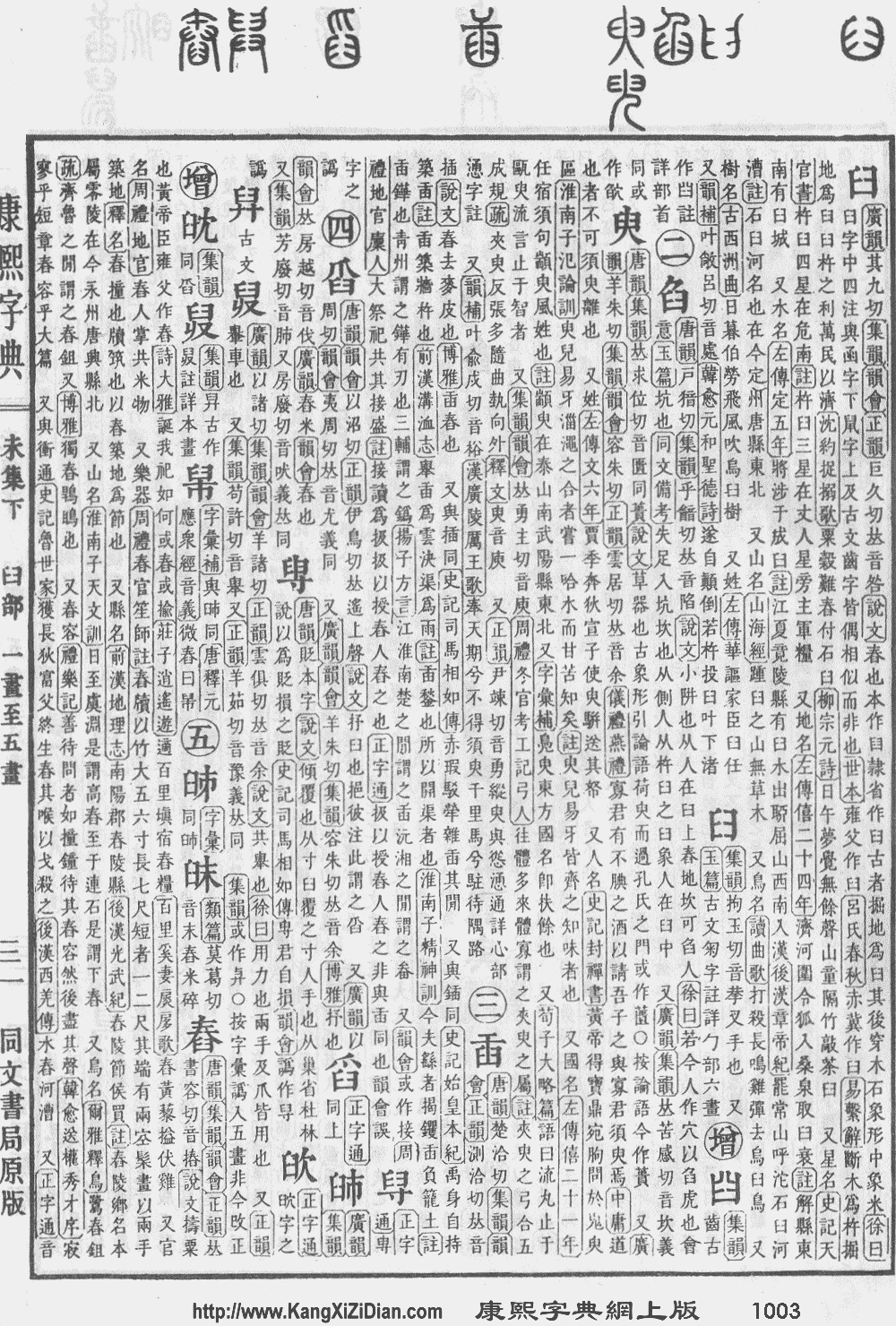
- Kangxi Dictionary: page 1003, character 4
- Dai Kanwa Jiten: character 30177
- Dae Jaweon: page 1459, character 14
- Hanyu Da Zidian (first edition): volume 5, page 3037, character 6
- Unihan data for U+81FD
Chinese
| simp. and trad. |
臽 | |
|---|---|---|
| 2nd round simp. | ⿱ク曰 | |
Glyph origin
| Historical forms of the character 臽 | ||
|---|---|---|
| Shang | Western Zhou | Shuowen Jiezi (compiled in Han) |
| Oracle bone script | Bronze inscriptions | Small seal script |
 |
 |
 |
Characters in the same phonetic series (臽) (Zhengzhang, 2003)
| Old Chinese | |
|---|---|
| 萏 | *l'oːmʔ |
| 窞 | *l'oːmʔ |
| 惂 | *kʰloːmʔ |
| 輡 | *kʰloːmʔ |
| 錎 | *kʰloːmʔ, *ɡroːms |
| 埳 | *kʰloːmʔ |
| 臽 | *kʰloːmʔ, *ɡroːms |
| 淊 | *ɡloːmʔ, *qroːm, *qroːms, *lomʔ |
| 欿 | *ɡloːmʔ |
| 蜭 | *ɡloːmʔ, *ɡluːms |
| 啗 | *l'aːmʔ, *l'aːms |
| 鵮 | *ʔr'oːm, *kʰroːm, *kʰroːms |
| 餡 | *ɡroːms |
| 陷 | *ɡroːms |
| 爓 | *ljom, *loms |
| 諂 | *l̥ʰomʔ |
| 讇 | *l̥ʰomʔ |
| 閻 | *lom |
| 焰 | *loms |
| 壛 | *lom |
| 櫩 | *lom |
| 燄 | *lomʔ |
| 掐 | *kʰroːb |
In the oracle bone script, an ideogrammic compound (會意/会意) : 鹿 (“deer”) + 凵 (“pit”) – a deer falling into a trap.
From the bronze inscriptions, now an ideogrammic compound (會意/会意) : 人 (“person”) + 臼 (“trap”) – a person falling into a trap.
Original form of 陷.
Pronunciation
Etymology 2
| For pronunciation and definitions of 臽 – see 陷 (“to submerge; to sink; to plunge; to be captured; etc.”). (This character is an ancient form of 陷). |
References
- (Cantonese) Jyutping Database (iso10646hk.net) - Cantonese Pronunciation List (Part 3), p. 186
- “臽”, in 漢語多功能字庫 (Multi-function Chinese Character Database), 香港中文大學 (the Chinese University of Hong Kong), 2014–
This article is issued from Wiktionary. The text is licensed under Creative Commons - Attribution - Sharealike. Additional terms may apply for the media files.