裃
| ||||||||
Translingual
| Stroke order | |||
|---|---|---|---|
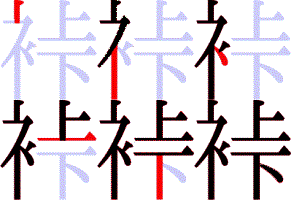 | |||
Han character
裃 (Kangxi radical 145, 衣+6, 12 strokes, cangjie input 中卜一卜 (LYMY), composition ⿰衤𠧗)
References
- Kangxi Dictionary: not present, would follow page 1116, character 34
- Dai Kanwa Jiten: character 34282
- Hanyu Da Zidian (first edition): not present, would follow volume 5, page 3088, character 14
- Unihan data for U+88C3

Japanese
Glyph origin
A 国字 (kokuji, “Japanese-coined character”).
Ideogrammic compound (會意/会意) : 衤 (“clothing”) + 上 + 下. Kamishimo is etymologically spelled as 上下 and is a compound of 上 (kami, “upper”) and 下 (shimo, “lower”).
Readings
Lua error in Module:utilities at line 142: attempt to perform arithmetic on local 'h' (a nil value)
Etymology
| Kanji in this term |
|---|
| 裃 |
| かみしも Hyōgaiji |
| kun’yomi |
This article is issued from Wiktionary. The text is licensed under Creative Commons - Attribution - Sharealike. Additional terms may apply for the media files.