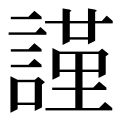
謹
See also: 谨
| ||||||||
 | ||||||||
 | ||||||||
Translingual
| Japanese | 謹 |
|---|---|
| Simplified | 谨 |
| Traditional | 謹 |
Alternative forms
Note that in Japanese shinjitai, the top right component of 堇 is written 艹 instead of 廿. Due to Han unification, both characters (謹/謹) are encoded under the same Unicode codepoint. A CJK compatibility ideograph (U+FA63) exists for the kyūjitai form of 謹.
Han character
謹 (Kangxi radical 149, 言+11 in Chinese, 言+10 in Japanese, 18 strokes in Chinese, 17 strokes in Japanese, cangjie input 卜口廿中一 (YRTLM), four-corner 04614, composition ⿰訁堇 or ⿰訁𦰌)
Descendants
References
- Kangxi Dictionary: page 1178, character 23
- Dai Kanwa Jiten: character 35850
- Dae Jaweon: page 1642, character 28
- Hanyu Da Zidian (first edition): volume 6, page 4010, character 13
- Unihan data for U+8B39
- Unihan data for U+FA63
- Unihan data for U+FABF

Chinese
| trad. | 謹 | |
|---|---|---|
| simp. | 谨 | |
Glyph origin
Characters in the same phonetic series (堇) (Zhengzhang, 2003)
Phono-semantic compound (形聲/形声, OC *kɯnʔ) : semantic 言 (“speech”) + phonetic 堇 (OC *ɡrɯn, *kɯnʔ) – to speak caution.
Etymology
Cognate with 兢 (OC *kɯŋ, “to be cautious”), which is possibly the vocalic variant of 驚 (OC *kreŋ, “to be afraid; to alarm”) (Schuessler, 2007).
Pronunciation
Compounds
- 修謹以俟/修谨以俟
- 勤謹/勤谨
- 卑謹/卑谨
- 嚴謹/严谨 (yánjǐn)
- 奉命唯謹/奉命唯谨
- 小廉曲謹/小廉曲谨
- 小心謹慎/小心谨慎 (xiǎoxīnjǐnshèn)
- 恭謹/恭谨 (gōngjǐn)
- 恭謹謙和/恭谨谦和
- 慎小謹微/慎小谨微
- 拘謹/拘谨 (jūjǐn)
- 敬謹/敬谨
- 曲謹/曲谨
- 細謹/细谨
- 謙謹/谦谨
- 謹上/谨上 (jǐnshàng)
- 謹厚/谨厚
- 謹嚴/谨严 (jǐnyán)
- 謹守/谨守 (jǐnshǒu)
- 謹密/谨密
- 謹小慎微/谨小慎微 (jǐnxiǎoshènwēi)
- 謹慎/谨慎 (jǐnshèn)
- 謹慎行事/谨慎行事
- 謹於心/谨于心
- 謹毛失貌/谨毛失貌
- 謹祕/谨秘
- 謹稟/谨禀
- 謹細/谨细
- 謹終追遠/谨终追远
- 謹肅/谨肃
- 謹言/谨言
- 謹言慎行/谨言慎行 (jǐnyánshènxíng)
- 謹記/谨记 (jǐnjì)
- 謹謹慎慎/谨谨慎慎
- 謹防/谨防 (jǐnfáng)
- 謹領/谨领
- 謹飭/谨饬
Japanese
| Shinjitai | 謹 | |
| Kyūjitai [1][2][3] |
謹 謹or 謹+ ︀? |
|
| 謹󠄀 謹+ 󠄀?(Adobe-Japan1) | ||
| 謹󠄄 謹+ 󠄄?(Hanyo-Denshi) (Moji_Joho) | ||
| The displayed kanji may be different from the image due to your environment. See here for details. | ||
Readings
Compounds
References
- “謹”, in 漢字ぺディア (Kanjipedia) (in Japanese), 日本漢字能力検定協会, 2015–2024
- Haga, Gōtarō (1914) 漢和大辞書 [The Great Kanji-Japanese Dictionary] (in Japanese), Fourth edition, Tōkyō: Kōbunsha, , page 1992 (paper), page 1048 (digital)
- Shōundō Henshūjo, editor (1927), 新漢和辞典 [The New Kanji-Japanese Dictionary] (in Japanese), Ōsaka: Shōundō, , page 1137 (paper), page 581 (digital)
Korean
Hanja
Compounds
Compounds
- 근계 (謹啓, geun'gye)
- 근고 (謹告, geun'go)
- 근상 (謹上, geunsang)
- 근신 (謹愼, geunsin)
- 근언 (謹言, geuneon)
- 근엄 (謹嚴, geuneom)
- 근엄 실직 (謹嚴實直, geuneom siljik)
- 근정 (謹呈, geunjeong)
- 근제 (謹製, geunje)
- 근직 (謹直, geunjik)
- 근청 (謹聽, geuncheong)
- 근칙 (謹飭, geunchik)
- 근하신년 (謹賀新年, geunhasinnyeon)
- 불근신 (不謹愼, bulgeunsin)
- 황공 근언 (恐惶謹言, hwanggong geuneon)
Vietnamese
This article is issued from Wiktionary. The text is licensed under Creative Commons - Attribution - Sharealike. Additional terms may apply for the media files.