逮

See also: 迨
逮 U+902E, 逮
CJK UNIFIED IDEOGRAPH-902E
← 逭
[U+902D]
CJK Unified Ideographs 逯 →
[U+902F]

Translingual

Han character

逮 (Kangxi radical 162, 辵+8, 12 strokes in traditional Chinese and Korean, 11 strokes in mainland China and Japanese, cangjie input 卜中水 (YLE), four-corner 35303, composition ⿺辶隶)

References

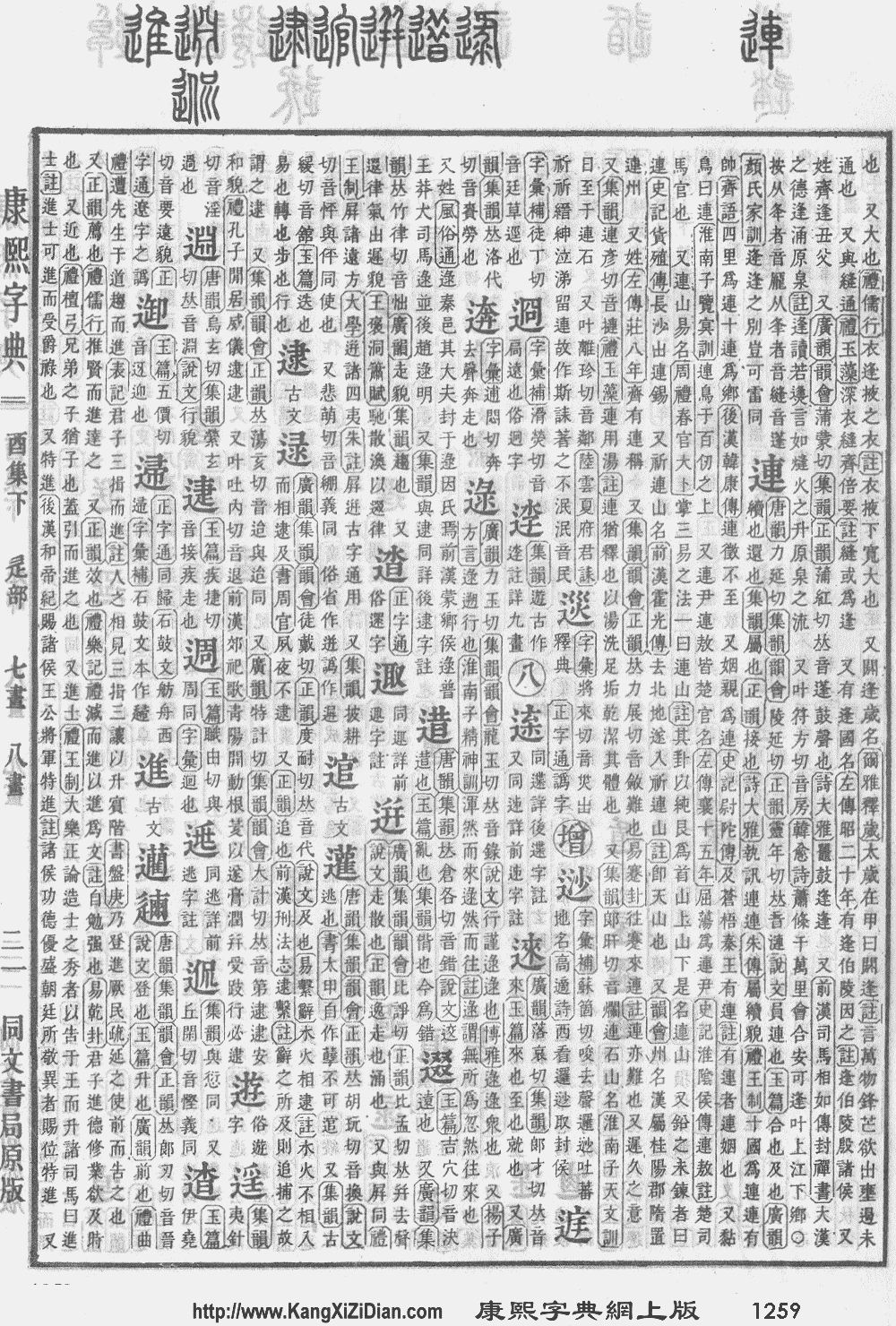
  • Kangxi Dictionary: page 1259, character 18
  • Dai Kanwa Jiten: character 38931
  • Dae Jaweon: page 1748, character 20
  • Hanyu Da Zidian (first edition): volume 6, page 3854, character 1
  • Unihan data for U+902E

Chinese

trad. 逮
simp. # 逮
alternative forms 隶

Glyph origin

Phono-semantic compound (形聲/形声, OC *l'ɯːds, *l'ɯːds) : semantic 辶 + phonetic 隶 (OC *lɯds).

Pronunciation 1


Note: dǎi, děi, dēi - "to catch; to seize".

Rime
Character 逮
Reading # 2/2
Initial (聲) 定 (7)
Final (韻) 咍 (41)
Tone (調) Departing (H)
Openness (開合) Open
Division (等) I
Fanqie 徒耐切
Baxter dojH
Reconstructions
Zhengzhang
Shangfang
/dʌiH/
Pan
Wuyun
/dəiH/
Shao
Rongfen
/dɒiH/
Edwin
Pulleyblank
/dəjH/
Li
Rong
/dᴀiH/
Wang
Li
/dɒiH/
Bernard
Karlgren
/dʱɑ̆iH/
Expected
Mandarin
Reflex
dài
Expected
Cantonese
Reflex
doi6
Baxter–Sagart system 1.1 (2014)
Character 逮
Reading # 1/1
Modern
Beijing
(Pinyin)
dài
Middle
Chinese
‹ dojH ›
Old
Chinese
/*m-rˁəp-s/
English reach to

Notes for Old Chinese notations in the Baxter–Sagart system:

* Parentheses "()" indicate uncertain presence;
* Square brackets "[]" indicate uncertain identity, e.g. *[t] as coda may in fact be *-t or *-p;
* Angle brackets "<>" indicate infix;
* Hyphen "-" indicates morpheme boundary;

* Period "." indicates syllable boundary.
Zhengzhang system (2003)
Character 逮
Reading # 1/2
No. 7955
Phonetic
component
隶
Rime
group
隊
Rime
subdivision
1
Corresponding
MC rime
代
Old
Chinese
/*l'ɯːds/
Notes 隸轉註字

Definitions

逮

  1. to catch; to seize
    逮捕  ―  dàibǔ  ―  to arrest
    逮小偷兒/逮小偷儿  ―  dǎi xiǎotōur  ―  to catch a thief
  2. (literary) to reach
  3. (literary) until
    alt. forms: 迨 (dài)
  4. (Eastern Min) to throw; to cast

Compounds

  • 不逮 (bùdài)
  • 不逮人倫/不逮人伦
  • 力有未逮 (lìyǒuwèidài)
  • 匡我不逮
  • 就逮
  • 狗逮老鼠
  • 被逮 (bèidǎi)
  • 襲逮/袭逮
  • 言不逮意
  • 辭不意逮/辞不意逮
  • 逮下
  • 逮拘
  • 逮捕
  • 逮治
  • 逮繫/逮系
  • 隨逮/随逮

Pronunciation 2


Rime
Character 逮
Reading # 1/2
Initial (聲) 定 (7)
Final (韻) 齊 (39)
Tone (調) Departing (H)
Openness (開合) Open
Division (等) IV
Fanqie 特計切
Baxter dejH
Reconstructions
Zhengzhang
Shangfang
/deiH/
Pan
Wuyun
/deiH/
Shao
Rongfen
/dɛiH/
Edwin
Pulleyblank
/dɛjH/
Li
Rong
/deiH/
Wang
Li
/dieiH/
Bernard
Karlgren
/dʱieiH/
Expected
Mandarin
Reflex
dì
Expected
Cantonese
Reflex
dai6
Zhengzhang system (2003)
Character 逮
Reading # 2/2
No. 7959
Phonetic
component
隶
Rime
group
隊
Rime
subdivision
1
Corresponding
MC rime
第
Old
Chinese
/*l'ɯːds/
Notes 隸轉註字

Definitions

逮

  1. Used in 逮逮 (dìdì).

Compounds

Japanese

Shinjitai 逮
Kyūjitai
[1][2]

逮󠄁
逮+&#xE0101;?
(Adobe-Japan1)
逮󠄃
逮+&#xE0103;?
(Hanyo-Denshi)
(Moji_Joho)
The displayed kanji may be different from the image due to your environment.
See here for details.

Kanji

逮

(common “Jōyō” kanji)

  1. to apprehend

Readings

From Middle Chinese 逮 (MC dojH); compare Mandarin 逮 (dài):

  • Go-on: だい (dai)
  • Kan-on: たい (tai, Jōyō)

From Middle Chinese 逮 (MC dejH); compare Mandarin 逮 (dì):

From native Japanese roots:

References

  1. “逮”, in 漢字ぺディア (Kanjipedia)‎ (in Japanese), 日本漢字能力検定協会, 2015–2024
  2. Haga, Gōtarō (1914) 漢和大辞書 [The Great Kanji-Japanese Dictionary] (in Japanese), Fourth edition, Tōkyō: Kōbunsha, →DOI, page 2111 (paper), page 1107 (digital)

Korean

Hanja

逮 • (che, dae, tae) (hangeul 체, 대, 태, revised che, dae, tae, McCune–Reischauer ch'e, tae, t'ae, Yale chey, tay, thay)

  1. This term needs a translation to English. Please help out and add a translation, then remove the text {{rfdef}}.

Vietnamese

Han character

逮: Hán Việt readings: đãi[1][2][3]
逮: Nôm readings: đãi[1]

  1. chữ Hán form of đãi (“(as used in ancient works) waiting [in anticipation], before”).
  2. chữ Hán form of đãi (“to be able, to arrest”).

References

  1. Trần (2004).
  2. Trần (1999).
  3. Nguyễn (1974).
This article is issued from Wiktionary. The text is licensed under Creative Commons - Attribution - Sharealike. Additional terms may apply for the media files.