遁

遁 U+9041, 遁
CJK UNIFIED IDEOGRAPH-9041
← 遀
[U+9040]
CJK Unified Ideographs 遂 →
[U+9042]

Translingual

Han character

遁 (Kangxi radical 162, 辵+9, 13 strokes, cangjie input 卜竹十山 (YHJU), four-corner 32306, composition ⿺辶盾)

References

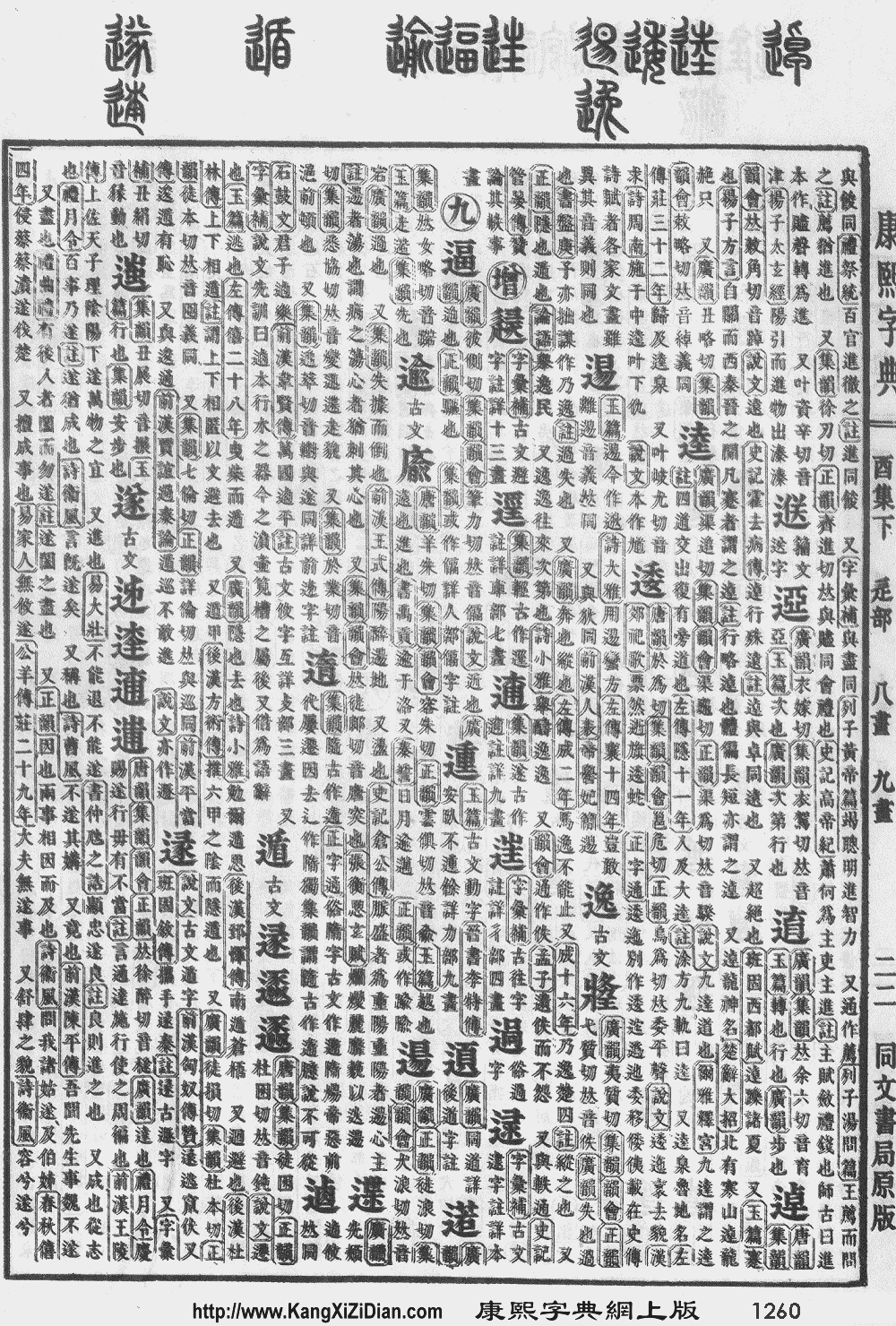
  • Kangxi Dictionary: page 1260, character 26
  • Dai Kanwa Jiten: character 38982
  • Dae Jaweon: page 1750, character 28
  • Hanyu Da Zidian (first edition): volume 6, page 3859, character 12
  • Unihan data for U+9041

Chinese

trad. 遁
simp. # 遁

Glyph origin

Phono-semantic compound (形聲/形声, OC *l'uːnʔ, *l'uːns) : semantic 辶 + phonetic 盾 (OC *l'uːnʔ, *ɦljunʔ).

Pronunciation


Rime
Character 遁 遁
Reading # 1/2 2/2
Initial (聲) 定 (7) 定 (7)
Final (韻) 魂 (55) 魂 (55)
Tone (調) Rising (X) Departing (H)
Openness (開合) Closed Closed
Division (等) I I
Fanqie 徒損切 徒困切
Baxter dwonX dwonH
Reconstructions
Zhengzhang
Shangfang
/duənX/ /duənH/
Pan
Wuyun
/duonX/ /duonH/
Shao
Rongfen
/duənX/ /duənH/
Edwin
Pulleyblank
/dwənX/ /dwənH/
Li
Rong
/duənX/ /duənH/
Wang
Li
/duənX/ /duənH/
Bernard
Karlgren
/dʱuənX/ /dʱuənH/
Expected
Mandarin
Reflex
dùn dùn
Expected
Cantonese
Reflex
deon6 deon6
Baxter–Sagart system 1.1 (2014)
Character 遁 遁
Reading # 1/2 2/2
Modern
Beijing
(Pinyin)
dùn dùn
Middle
Chinese
‹ dwonX › ‹ dwonH ›
Old
Chinese
/*lˁu[n]ʔ/ /*lˁu[n]ʔ-s/
English withdraw withdraw

Notes for Old Chinese notations in the Baxter–Sagart system:

* Parentheses "()" indicate uncertain presence;
* Square brackets "[]" indicate uncertain identity, e.g. *[t] as coda may in fact be *-t or *-p;
* Angle brackets "<>" indicate infix;
* Hyphen "-" indicates morpheme boundary;

* Period "." indicates syllable boundary.
Zhengzhang system (2003)
Character 遁 遁
Reading # 1/2 2/2
No. 2624 2625
Phonetic
component
盾 盾
Rime
group
文 文
Rime
subdivision
2 2
Corresponding
MC rime
囤 鈍
Old
Chinese
/*l'uːnʔ/ /*l'uːns/

Definitions

遁

  1. to escape; to flee; to evade
  2. to hide away; to conceal oneself

Compounds

  • 土遁
  • 奇門遁甲/奇门遁甲
  • 支遁
  • 支遁買山/支遁买山
  • 望風而遁/望风而遁
  • 棲遁/栖遁
  • 水遁
  • 深藏遠遁/深藏远遁
  • 潛身遠遁/潜身远遁
  • 無所遁形/无所遁形 (wúsuǒdùnxíng)
  • 禽奔獸遁/禽奔兽遁
  • 肥遁
  • 逃遁 (táodùn)
  • 遁世 (dùnshì)
  • 遁世逃名
  • 違世遁俗/违世遁俗
  • 遁世離群/遁世离群
  • 遁佚
  • 遁入空門/遁入空门 (dùnrùkōngmén)
  • 遁化
  • 遁北
  • 遁名匿跡/遁名匿迹
  • 遁形
  • 遁甲 (dùnjiǎ)
  • 遁藏
  • 遁走 (dùnzǒu)
  • 遁跡/遁迹 (dùnjì)
  • 遁跡潛形/遁迹潜形
  • 遁跡銷聲/遁迹销声
  • 遁身
  • 遁辭/遁辞
  • 遁逃 (dùntáo)
  • 遜遁/逊遁
  • 遠遁/远遁 (yuǎndùn)
  • 遠遁山林/远遁山林
  • 隱遁/隐遁
  • 高飛遠遁/高飞远遁

Japanese

Alternative forms

  • 遁れ, 逃れ, 逃

Kanji

遁

(“Jinmeiyō” kanji used for names)

  1. escape

Readings

Etymology

Kanji in this term
遁
のがれ
Jinmeiyō
kun’yomi

The 連用形 (ren'yōkei, “stem or continuative form”) of verb 遁れる (nogareru, “to run away, to escape”).[1][2]

Pronunciation

  • (Tokyo) のがれ​ [nògáréꜜ] (Odaka – [3])[2]
  • IPA(key): [no̞ɡa̠ɾe̞]

Noun

遁(のがれ) • (nogare) 

  1. an escape, a dodge, avoidance, evasion

Usage notes

The 逃れ spelling is more common.

References

  1. Shōgaku Tosho (1988) 国語大辞典(新装版) [Unabridged Dictionary of Japanese (Revised Edition)] (in Japanese), Tōkyō: Shogakukan, →ISBN
  2. Matsumura, Akira, editor (2006), 大辞林 [Daijirin] (in Japanese), Third edition, Tōkyō: Sanseidō, →ISBN

Korean

Hanja

遁 • (dun, don) (hangeul 둔, 돈, revised dun, don, McCune–Reischauer tun, ton, Yale twun, ton)

  1. This term needs a translation to English. Please help out and add a translation, then remove the text {{rfdef}}.

Vietnamese

Han character

遁: Hán Nôm readings: độn, rộn, trốn, dọn, nhộn, trộn, tuần

  1. This term needs a translation to English. Please help out and add a translation, then remove the text {{rfdef}}.

References

This article is issued from Wiktionary. The text is licensed under Creative Commons - Attribution - Sharealike. Additional terms may apply for the media files.