遂
See also: 逐
| ||||||||
Translingual
Han character
遂 (Kangxi radical 162, 辵+9, 13 strokes in traditional Chinese and Korean, 12 strokes in mainland China and Japanese, cangjie input 卜廿心人 (YTPO), four-corner 38303, composition ⿺辶㒸)
References
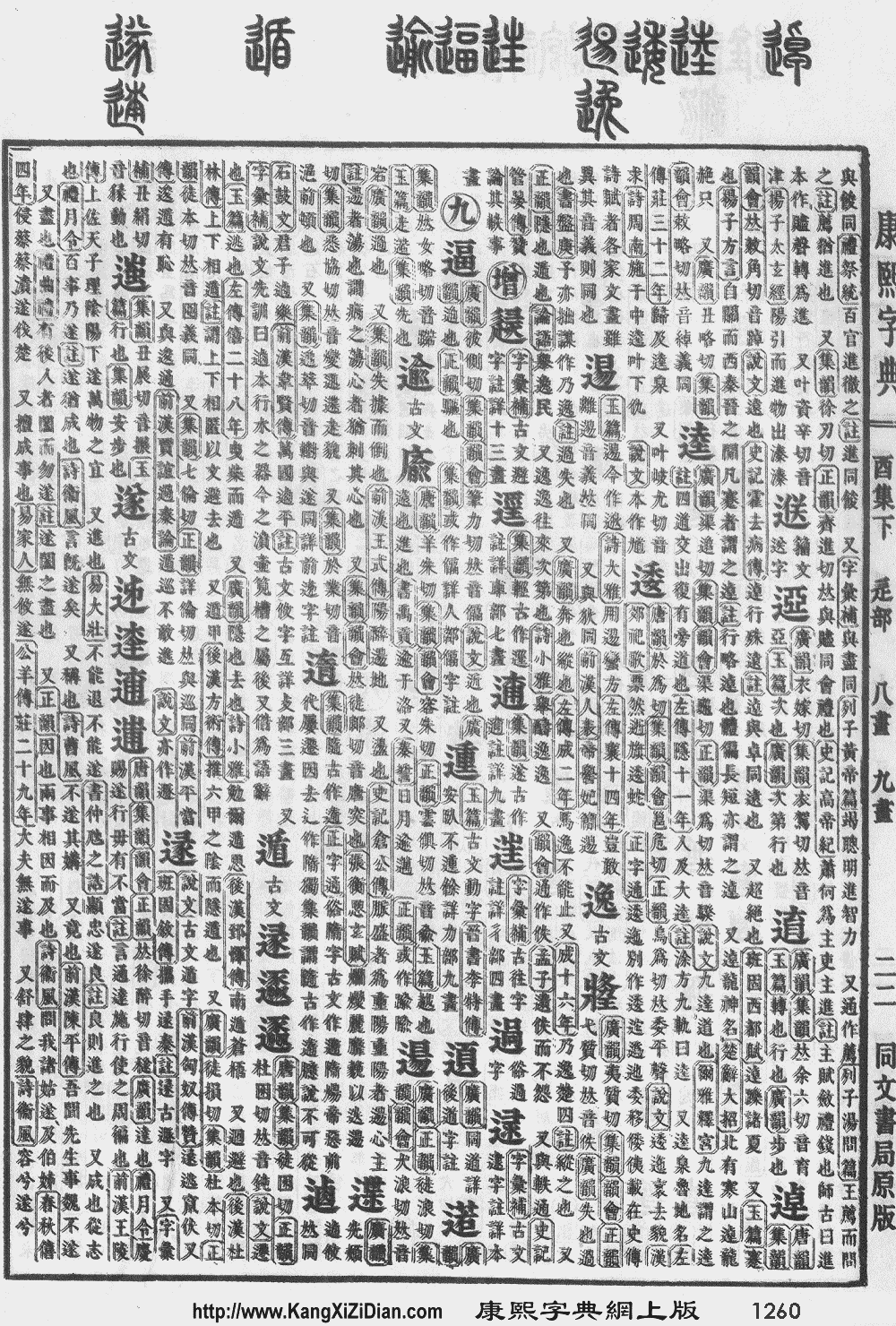
- Kangxi Dictionary: page 1260, character 32
- Dai Kanwa Jiten: character 38985
- Dae Jaweon: page 1751, character 3
- Hanyu Da Zidian (first edition): volume 6, page 3862, character 3
- Unihan data for U+9042
Chinese
| trad. | 遂 | |
|---|---|---|
| simp. # | 遂 | |
Glyph origin
| Historical forms of the character 遂 | ||
|---|---|---|
| Western Zhou | Shuowen Jiezi (compiled in Han) | Liushutong (compiled in Ming) |
| Bronze inscriptions | Small seal script | Transcribed ancient scripts |
 |
 |
 |
Characters in the same phonetic series (遂) (Zhengzhang, 2003)
Phono-semantic compound (形聲/形声, OC *ljuds) : semantic 辵 + phonetic 㒸 ().
Pronunciation
Definitions
遂
- to fulfill; to satisfy
- to comply; to follow along
- to complete; to succeed
- 金玉滿堂,莫之能守;富貴而驕,自遺其咎。功遂身退天之道。 [Classical Chinese, trad.]
- From: Tao Te Ching, 4th century BCE
- Jīnyùmǎntáng, mò zhī néng shǒu; fùguì ér jiāo, zì yí qí jiù. Gōng suì shēn tuì tiān zhī dào. [Pinyin]
- When gold and jade fill the hall, their possessor cannot keep them safe. When wealth and honours lead to arrogancy, this brings its evil on itself. When the work is completed, and one's name is becoming distinguished, to withdraw into obscurity is the way of Heaven.
金玉满堂,莫之能守;富贵而骄,自遗其咎。功遂身退天之道。 [Classical Chinese, simp.]
- then; consequently; thereupon
- 遂命子貢為之主,曰:「為爾哭也來者,拜之。知伯高而來者,勿拜也。」 [Classical Chinese, trad.]
- From: The Book of Rites, c. 4th – 2nd century BCE
- Suì mìng Zǐgòng wèi zhī zhǔ, yuē: “Wèi ěr kū yě lái zhě, bài zhī. Zhī Bógāo ér lái zhě, wù bài yě.” [Pinyin]
- Thus he ordered Zi-gong to act as presiding mourner on the occasion, saying to him, "Bow to those who come because you have a wailing in your house, but do not bow to those who come (simply) because they knew Bo-gao."
遂命子贡为之主,曰:「为尔哭也来者,拜之。知伯高而来者,勿拜也。」 [Classical Chinese, simp.]- 反歸取之,及反,市罷,遂不得履。 [Classical Chinese, trad.]
- From: Han Feizi, circa 2nd century BCE
- Fǎn guī qǔ zhī, jí fǎn, shì bà, suì bùdé lǚ. [Pinyin]
- He returned home to get the measurements, but by the time he got back to the market, it had already closed. Therefore, he could not buy the shoes.
反归取之,及反,市罢,遂不得履。 [Classical Chinese, simp.]
- † to proceed; to head for
- † to recommend; to promote
- † to grow; to ripen
Japanese
| Shinjitai | 遂 | |
| Kyūjitai [1] |
遂󠄂 遂+ 󠄂?(Adobe-Japan1) |
 |
| 遂󠄅 遂+ 󠄅?(Hanyo-Denshi) (Moji_Joho) | ||
| The displayed kanji may be different from the image due to your environment. See here for details. | ||
Readings
- Go-on: ずい (zui)←ずゐ (zwi, historical)
- Kan-on: すい (sui, Jōyō)←すゐ (swi, historical)
- Kun: とぐ (togu, 遂ぐ); とげる (togeru, 遂げる, Jōyō); ついに (tsuini, 遂に)←つひに (tufini, 遂に, historical)
- Nanori: かつ (katsu); つく (tsuku); つぐ (tsugu); とげる (togeru); なり (nari); なる (naru); みち (michi); もろ (moro); やす (yasu); ゆき (yuki); より (yori)
Usage notes
- Most dictionaries do not have "すゐ" and "ずゐ" as a historical reading for 遂. According to historical data, its on-reading are the modern "すい" and "ずい". However, the Dai Kanwa Jiten has the -ゐ historical on-readings.
Etymology
| Kanji in this term |
|---|
| 遂 |
| つい Grade: S |
| kun’yomi |
| For pronunciation and definitions of 遂 – see the following entry. | ||
| ||
| (This term, 遂, is an alternative spelling of the above term.) |
References
- “遂”, in 漢字ぺディア (Kanjipedia) (in Japanese), 日本漢字能力検定協会, 2015–2024
Korean
Hanja
遂 • (su) (hangeul 수, revised su, McCune–Reischauer su, Yale swu)
- This term needs a translation to English. Please help out and add a translation, then remove the text
{{rfdef}}.
Vietnamese
Han character
References
- Génibrel (1898).
- Bonet (1899).
- Thiều Chửu (1942).
- Nguyễn (1974).
- Trần (1999).
- Nguyễn et al. (2009).
This article is issued from Wiktionary. The text is licensed under Creative Commons - Attribution - Sharealike. Additional terms may apply for the media files.