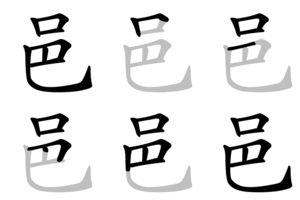
邑

See also: 阝, 𢀳, and 巴
邑 U+9091, 邑
CJK UNIFIED IDEOGRAPH-9091
← 邐
[U+9090]
CJK Unified Ideographs 邒 →
[U+9092]
⾢ U+2FA2, ⾢
KANGXI RADICAL CITY
← ⾡
[U+2FA1]
Kangxi Radicals ⾣ →
[U+2FA3]

Translingual

Stroke order

Alternative forms

  • 阝 (when used as a right radical component)

Han character

邑 (Kangxi radical 163, 邑+0, 7 strokes, cangjie input 口日山 (RAU) or 難口日山 (XRAU), four-corner 60717, composition ⿱口巴)

  1. Kangxi radical #163, ⾢.
  2. Shuowen Jiezi radical №229

Derived characters

Further reading

  • Kangxi Dictionary: page 1267, character 42
  • Dai Kanwa Jiten: character 39269
  • Dae Jaweon: page 1767, character 1
  • Hanyu Da Zidian (first edition): volume 6, page 3753, character 1
  • Unihan data for U+9091

Chinese

simp. and trad.
邑
alternative forms 阝 radical

Glyph origin

Historical forms of the character 邑
Shang Western Zhou Shuowen Jiezi (compiled in Han) Liushutong (compiled in Ming)
Oracle bone script Bronze inscriptions Small seal script Transcribed ancient scripts

Ideogrammic compound (會意/会意) : 囗 (“enclosure; city wall”) + 卪 (“kneeling person”).

Etymology

Possibly Sino-Tibetan. Schuessler (2007) proposes two possible etymologies:

Pronunciation


Note: ig4 - Chenghai.
  • Wu
    • (Shanghai):
      • Wugniu: 7iq
      • MiniDict: ih入
      • Wiktionary Romanisation (Shanghai): 4iq
      • Sinological IPA (Shanghai): /iɪʔ⁵⁵/
  • Xiang
    • (Changsha)
      • Wiktionary: xi6
      • Sinological IPA (key): /ɕi²⁴/

Rime
Character 邑
Reading # 1/1
Initial (聲) 影 (34)
Final (韻) 侵 (142)
Tone (調) Checked (Ø)
Openness (開合) Open
Division (等) III
Fanqie 於汲切
Baxter 'ip
Reconstructions
Zhengzhang
Shangfang
/ʔˠiɪp̚/
Pan
Wuyun
/ʔᵚip̚/
Shao
Rongfen
/ʔiep̚/
Edwin
Pulleyblank
/ʔjip̚/
Li
Rong
/ʔjəp̚/
Wang
Li
/ĭĕp̚/
Bernard
Karlgren
/ʔi̯əp̚/
Expected
Mandarin
Reflex
yi
Expected
Cantonese
Reflex
jap1
Baxter–Sagart system 1.1 (2014)
Character 邑
Reading # 1/1
Modern
Beijing
(Pinyin)
yì
Middle
Chinese
‹ ʔip ›
Old
Chinese
/*q(r)[ə]p/
English city, town

Notes for Old Chinese notations in the Baxter–Sagart system:

* Parentheses "()" indicate uncertain presence;
* Square brackets "[]" indicate uncertain identity, e.g. *[t] as coda may in fact be *-t or *-p;
* Angle brackets "<>" indicate infix;
* Hyphen "-" indicates morpheme boundary;

* Period "." indicates syllable boundary.
Zhengzhang system (2003)
Character 邑
Reading # 1/1
No. 15021
Phonetic
component
邑
Rime
group
緝
Rime
subdivision
1
Corresponding
MC rime
邑
Old
Chinese
/*qrɯb/

Definitions

邑

  1. state; country; nation
  2. capital; capital city
  3. city; town
  4. area; district
  5. Original form of 悒 (yì, “to worry; anxious”).

Compounds

  • 下邑
  • 京邑 (jīngyì)
  • 伊邑
  • 伯邑考
  • 四邑 (Sìyì)
  • 城邑 (chéngyì)
  • 大邑
  • 大邑商 (Dàyìshāng)
  • 天邑
  • 家邑
  • 巖邑/岩邑 (yányì)
  • 左阜右邑
  • 悁邑
  • 新邑
  • 於邑/于邑
  • 湯沐邑/汤沐邑
  • 皇邑
  • 蒲邑三善
  • 通都大邑
  • 邑人 (yìrén)
  • 邑侯
  • 邑君
  • 邑子
  • 邑宰
  • 邑庠
  • 邑犬群吠
  • 邑邑
  • 邑里
  • 郡邑
  • 都邑 (dūyì)
  • 鄹邑
  • 采邑 (càiyì)
  • 阿邑
  • 雒邑 (Luòyì)
  • 食邑 (shíyì)
  • 馬邑/马邑 (Mǎyì)
  • 鬱邑/郁邑

References

Japanese

Kanji

邑

(“Jinmeiyō” kanji used for names)

  1. capital; capital city
  2. a type of administrative division

Readings

Etymology 1

Kanji in this term
邑
ゆう
Jinmeiyō
kan’on

Noun

邑(ゆう) • (yū) ←いふ (ifu)?

  1. eup (an administrative division in Korea like a town)

Etymology 2

Kanji in this term
邑
おおざと
Jinmeiyō
kun’yomi

Noun

邑(おおざと) • (ōzato) ←おほざと (ofozato)?

  1. the "large village" radical, radical 163

Korean

Hanja

邑 (eumhun 고을 읍 (go'eul eup))

  1. (geography) Hanja form? of 읍 (“Town or eup, an administrative division larger and more populous than a "리" (village) but smaller and less populous than a "군" (county) or "시" (city)”).

Vietnamese

Han character

邑: Hán Nôm readings: ấp, óp, ốp, phấp, ọp

  1. chữ Hán form of ấp (“hamlet”).
This article is issued from Wiktionary. The text is licensed under Creative Commons - Attribution - Sharealike. Additional terms may apply for the media files.