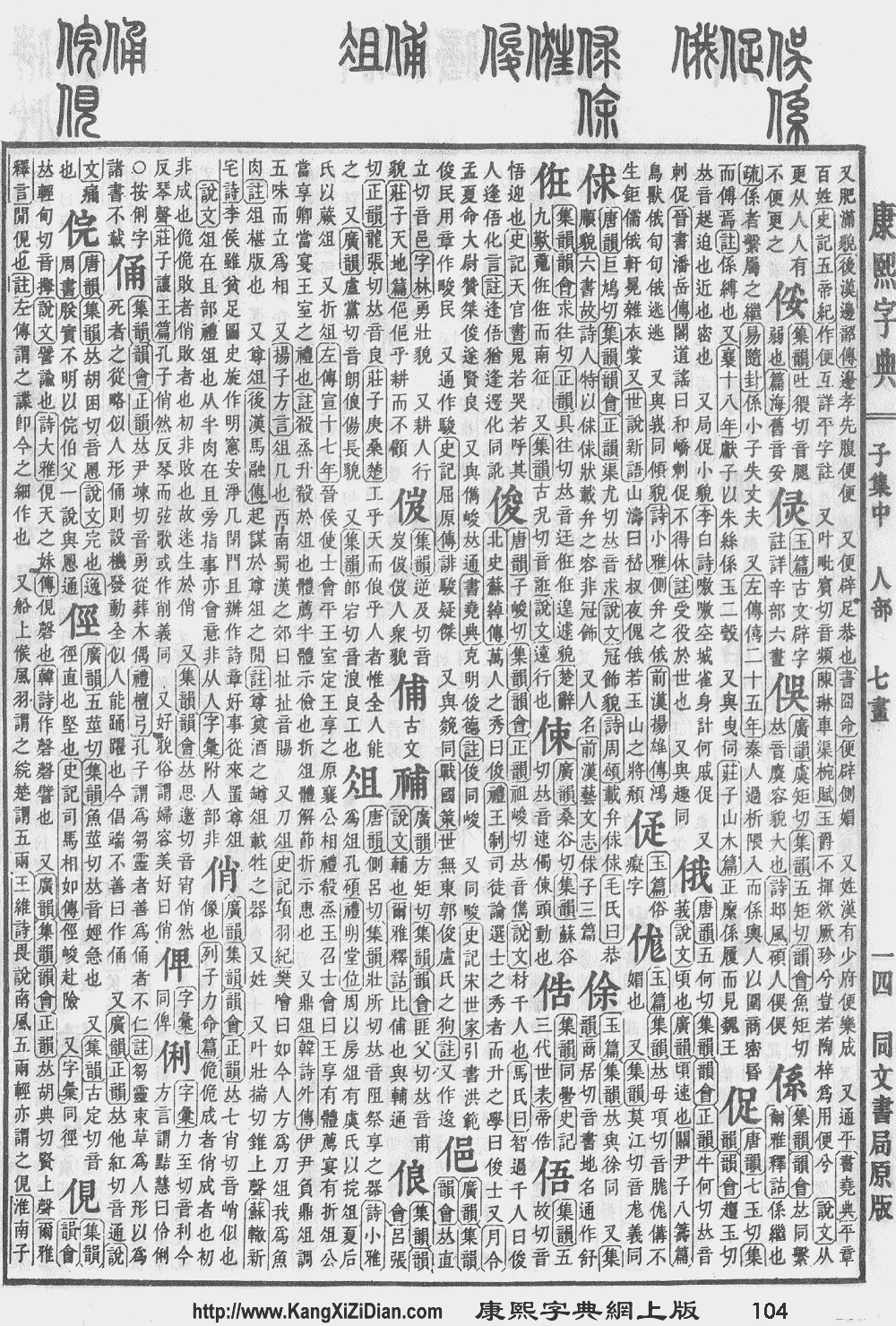
俅

俅 U+4FC5, 俅
CJK UNIFIED IDEOGRAPH-4FC5
← 俄
[U+4FC4]
CJK Unified Ideographs 俆 →
[U+4FC6]

Translingual

Han character

俅 (Kangxi radical 9, 人+7, 9 strokes, cangjie input 人戈十水 (OIJE), four-corner 23232, composition ⿰亻求)

References

  • Kangxi Dictionary: page 104, character 9
  • Dai Kanwa Jiten: character 668
  • Dae Jaweon: page 220, character 8
  • Hanyu Da Zidian (first edition): volume 1, page 156, character 17
  • Unihan data for U+4FC5

Chinese

simp. and trad.
俅

Glyph origin

Historical forms of the character 俅


References:

Mostly from Richard Sears' Chinese Etymology site (authorisation),
which in turn draws data from various collections of ancient forms of Chinese characters, including:

  • Shuowen Jiezi (small seal),
  • Jinwen Bian (bronze inscriptions),
  • Liushutong (Liushutong characters) and
  • Yinxu Jiaguwen Bian (oracle bone script).

Phono-semantic compound (形聲/形声, OC *ɡu) : semantic 人 (“man”) + phonetic 求 (OC *ɡu)

Pronunciation


Rime
Character 俅
Reading # 1/1
Initial (聲) 群 (30)
Final (韻) 尤 (136)
Tone (調) Level (Ø)
Openness (開合) Open
Division (等) III
Fanqie 巨鳩切
Baxter gjuw
Reconstructions
Zhengzhang
Shangfang
/ɡɨu/
Pan
Wuyun
/ɡiu/
Shao
Rongfen
/ɡiəu/
Edwin
Pulleyblank
/guw/
Li
Rong
/ɡiu/
Wang
Li
/ɡĭəu/
Bernard
Karlgren
/gi̯ə̯u/
Expected
Mandarin
Reflex
qiú
Expected
Cantonese
Reflex
kau4
Zhengzhang system (2003)
Character 俅
Reading # 1/1
No. 10568
Phonetic
component
求
Rime
group
幽
Rime
subdivision
1
Corresponding
MC rime
𧚍
Old
Chinese
/*ɡu/

Definitions

俅

  1. † appearance of headwear and decorative wear

Compounds

  • 俅俅

Japanese

Kanji

俅

(uncommon “Hyōgai” kanji)

  1. ornamental cap

Readings

Compounds

Korean

Hanja

俅 • (gu) (hangeul 구, revised gu, McCune–Reischauer ku)

  1. respectful
  2. polite
This article is issued from Wiktionary. The text is licensed under Creative Commons - Attribution - Sharealike. Additional terms may apply for the media files.