儀
| ||||||||
Translingual
Han character
儀 (Kangxi radical 9, 人+13, 15 strokes, cangjie input 人廿土戈 (OTGI), four-corner 28253, composition ⿰亻義)
References
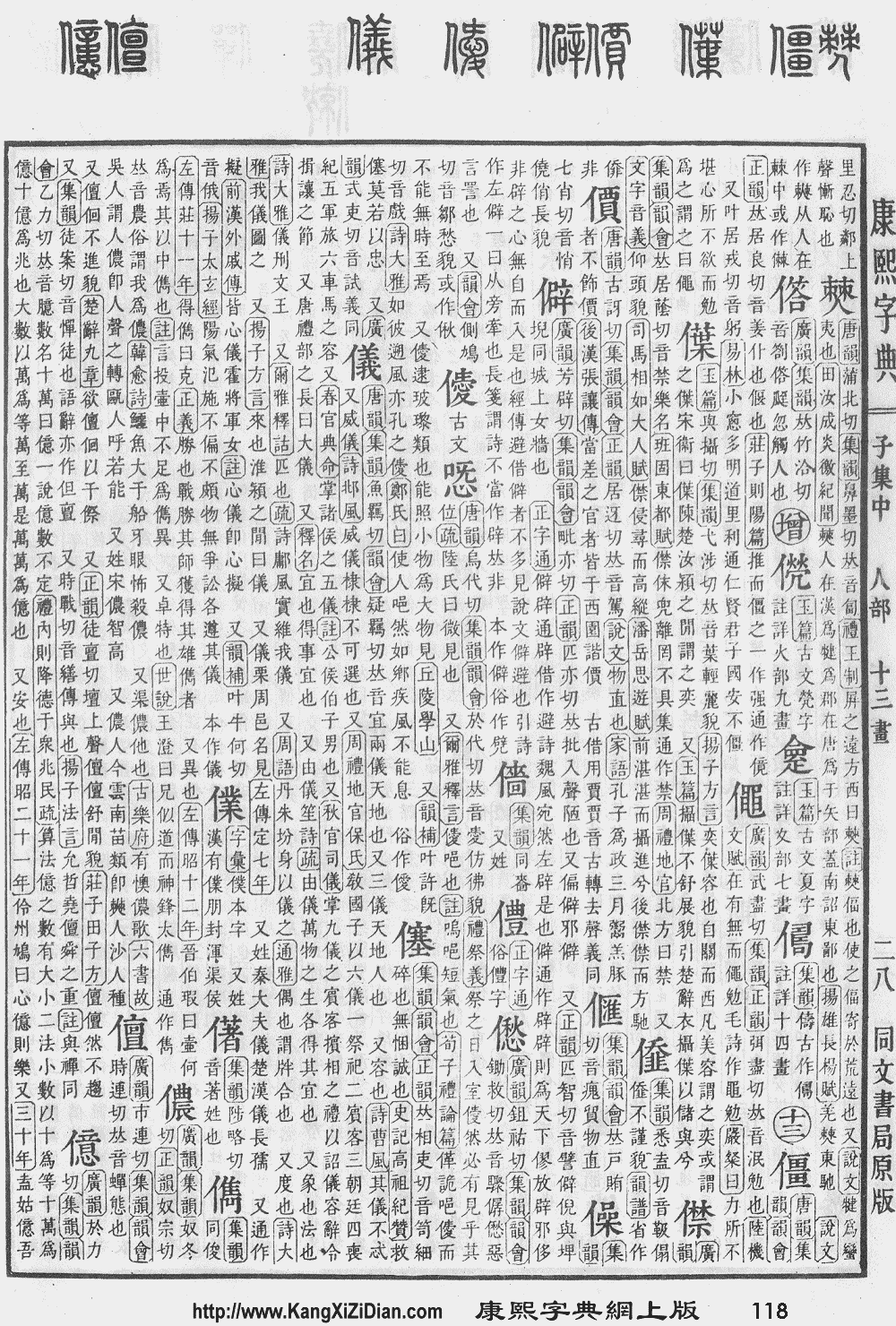
- Kangxi Dictionary: page 118, character 21
- Dai Kanwa Jiten: character 1172
- Dae Jaweon: page 251, character 5
- Hanyu Da Zidian (first edition): volume 1, page 228, character 2
- Unihan data for U+5100
Chinese
| trad. | 儀 | |
|---|---|---|
| simp. | 仪 | |
Glyph origin
| Historical forms of the character 儀 | |||||||||||
|---|---|---|---|---|---|---|---|---|---|---|---|
| Western Zhou | Shuowen Jiezi (compiled in Han) | Liushutong (compiled in Ming) | |||||||||
| Bronze inscriptions | Small seal script | Transcribed ancient scripts | |||||||||
 |
 |
 | |||||||||
||
|
References: Mostly from Richard Sears' Chinese Etymology site (authorisation),
| |||||||||||


Phono-semantic compound (形聲/形声, OC *ŋral) : semantic 亻 + phonetic 義 (OC *ŋrals).
Etymology
Sino-Tibetan in origin. Cognate with the following (Schuessler (2007), STEDT):
- 宜 (OC *ŋral, “proper; suitable”)
- 義 (OC *ŋrals, “righteous”)
- 議 (OC *ŋrals, “to discuss; to comment; to criticize”)
- 犧 (OC *hŋral, “sacrifice (v., n.)”)
Schuessler (2007) considers them to be cognate with Mizo ŋaiᴴ / ŋaiʔᴸ (“to think; consider; be necessary; have need to; be customary”), Khumi Chin ŋài (“to wish; to need”), Lai ŋaaj / ŋaʔj (“to yearn; to long for”), Tedim Chin ŋaːi² (“to love”).
On the other hand, STEDT provisionally sets up Proto-Kuki-Chin *ŋaay (“listen; hark”), which is compared to the 5 Sinitic words.
Pronunciation
Definitions
儀
Compounds
- 三儀/三仪
- 三錄儀/三录仪 (sānlùyí)
- 丰儀
- 中星儀/中星仪
- 二儀/二仪
- 來儀/来仪
- 儀仗/仪仗 (yízhàng)
- 儀仗隊/仪仗队 (yízhàngduì)
- 儀制/仪制 (yízhì)
- 儀器/仪器 (yíqì)
- 儀容/仪容 (yíróng)
- 儀式/仪式 (yíshì)
- 儀形/仪形
- 儀從/仪从
- 儀態/仪态 (yítài)
- 儀態萬千/仪态万千
- 儀態萬方/仪态万方
- 儀曹/仪曹
- 儀檢/仪检
- 儀注
- 儀狄/仪狄
- 儀禮/仪礼 (yílǐ)
- 儀範/仪范
- 儀表/仪表 (yíbiǎo)
- 儀表板/仪表板 (yíbiǎobǎn)
- 儀賓/仪宾
- 儀軌/仪轨 (yíguǐ)
- 儀錶/仪表 (yíbiǎo)
- 儀門/仪门
- 儀隊/仪队
- 光儀/光仪
- 光學儀器/光学仪器
- 光譜儀/光谱仪 (guāngpǔyí)
- 兩儀/两仪 (liǎngyí)
- 八分儀/八分仪 (bāfēnyí)
- 六分儀/六分仪 (liùfēnyí)
- 典儀/典仪
- 凶儀
- 分光儀/分光仪
- 司儀/司仪 (sīyí)
- 四分儀/四分仪
- 土儀/土仪 (tǔyí)
- 地動儀/地动仪
- 地球儀/地球仪 (dìqiúyí)
- 地震儀/地震仪 (dìzhènyí)
- 坤儀/坤仪
- 塵儀/尘仪
- 夜視儀器/夜视仪器
- 太儀/太仪
- 天球儀/天球仪
- 天象儀/天象仪 (tiānxiàngyí)
- 失儀/失仪
- 奠儀/奠仪 (diànyí)
- 威儀/威仪 (wēiyí)
- 威儀孔時/威仪孔时
- 容儀/容仪 (róngyí)
- 尊儀/尊仪
- 平板儀/平板仪
- 張儀舌/张仪舌
- 律儀/律仪
- 心儀/心仪 (xīnyí)
- 日晷儀/日晷仪
- 昭儀/昭仪 (zhāoyí)
- 書儀/书仪
- 月儀帖/月仪帖
- 月球儀/月球仪
- 朝儀/朝仪 (cháoyí)
- 殯儀/殡仪 (bìnyí)
- 殯儀館/殡仪馆 (bìnyíguǎn)
- 母儀/母仪 (mǔyí)
- 母儀天下/母仪天下
- 母儀足式/母仪足式
- 水平儀/水平仪 (shuǐpíngyí)
- 水準儀/水准仪
- 游儀/游仪
- 渾天儀/浑天仪 (húntiānyí)
- 漢官威儀/汉官威仪
- 潘安容儀/潘安容仪
- 獻儀/献仪
- 玉儀/玉仪
- 祭儀/祭仪
- 禮儀/礼仪 (lǐyí)
- 程儀/程仪
- 穴診儀/穴诊仪
- 節儀/节仪
- 簡儀/简仪
- 經線儀/经线仪
- 經緯儀/经纬仪 (jīngwěiyí)
- 繁禮多儀/繁礼多仪
- 繪圖儀/绘图仪
- 羅盤儀/罗盘仪
- 羽儀/羽仪
- 芝儀/芝仪
- 菲儀/菲仪
- 葬儀社/葬仪社
- 薄儀/薄仪
- 行儀/行仪
- 行星儀/行星仪
- 表儀/表仪
- 謝儀/谢仪
- 象限儀/象限仪
- 賀儀/贺仪 (hèyí)
- 賻儀/赙仪 (fùyí)
- 贐儀/赆仪
- 赤道儀/赤道仪
- 軌儀/轨仪
- 迴轉儀/回转仪
- 鍾儀楚奏/钟仪楚奏
- 風儀/风仪
- 鳳儀/凤仪 (fèngyí)
- 鳳凰來儀/凤凰来仪
- 鴻儀/鸿仪
References
- “儀”, in 漢語多功能字庫 (Multi-function Chinese Character Database), 香港中文大學 (the Chinese University of Hong Kong), 2014–
Japanese
Readings
- Go-on: ぎ (gi, Jōyō)
- Kan-on: ぎ (gi, Jōyō)
- Kun: よい (yoi, 儀い); のり (nori, 儀); のっとる (nottoru)
- Nanori: きたる (kitaru); ただし (tadashi); のり (nori); よし (yoshi)
| Kanji in this term |
|---|
| 儀 |
| ぎ Grade: S |
| on’yomi |
Etymology
Middle Chinese 儀 (ŋˠiᴇ)
Derived terms
Usage notes
Used after a name or personal pronoun in letters and notices.
References
- Matsumura, Akira, editor (2006), 大辞林 [Daijirin] (in Japanese), Third edition, Tōkyō: Sanseidō, →ISBN
- NHK Broadcasting Culture Research Institute, editor (1998), NHK日本語発音アクセント辞典 [NHK Japanese Pronunciation Accent Dictionary] (in Japanese), Tōkyō: NHK Publishing, →ISBN
Korean
Etymology
(This etymology is missing or incomplete. Please add to it, or discuss it at the Etymology scriptorium. Particularly: “Middle Korean readings, if any”)
Pronunciation
- (SK Standard/Seoul) IPA(key): [ɰi]
- Phonetic hangul: [의]