宜
| ||||||||
Translingual
Han character
宜 (Kangxi radical 40, 宀+5, 8 strokes, cangjie input 十月一 (JBM), four-corner 30107, composition ⿱宀且)
Derived characters
- 𰃓
References
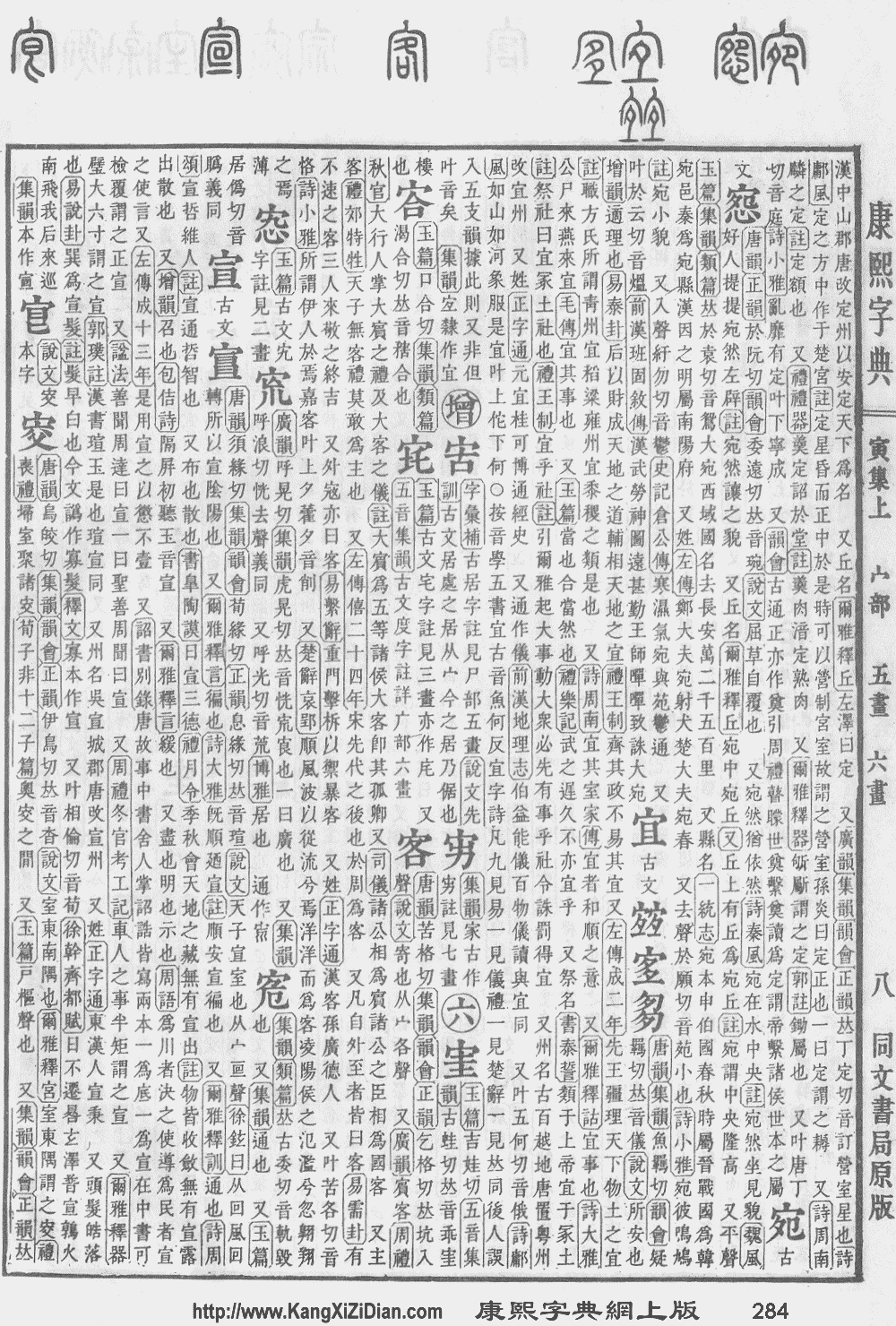
- Kangxi Dictionary: page 284, character 3
- Dai Kanwa Jiten: character 7111
- Dae Jaweon: page 561, character 2
- Hanyu Da Zidian (first edition): volume 2, page 920, character 6
- Unihan data for U+5B9C
Chinese
| simp. and trad. |
宜 | |
|---|---|---|
| alternative forms | ||
Glyph origin
| Historical forms of the character 宜 | |||||||||||||||||||||||||||||||||||||||||||||||||||||||
|---|---|---|---|---|---|---|---|---|---|---|---|---|---|---|---|---|---|---|---|---|---|---|---|---|---|---|---|---|---|---|---|---|---|---|---|---|---|---|---|---|---|---|---|---|---|---|---|---|---|---|---|---|---|---|---|
| Shang | Western Zhou | Warring States | Shuowen Jiezi (compiled in Han) | Liushutong (compiled in Ming) | |||||||||||||||||||||||||||||||||||||||||||||||||||
| Oracle bone script | Bronze inscriptions | Chu slip and silk script | Small seal script | Transcribed ancient scripts | |||||||||||||||||||||||||||||||||||||||||||||||||||
 |
 |
 |
 |
 | |||||||||||||||||||||||||||||||||||||||||||||||||||
||||
|
References: Mostly from Richard Sears' Chinese Etymology site (authorisation),
| |||||||||||||||||||||||||||||||||||||||||||||||||||||||


| Old Chinese | |
|---|---|
| 多 | *ʔl'aːl |
| 哆 | *ʔl'aːlʔ, *ʔl'aːls, *ʔr'aːls, *hr'aːl, *l̥ʰjaːlʔ, *l̥ʰjalʔ, *l̥ʰjɯs |
| 跢 | *ʔl'aːls, *ʔl'aːds |
| 痑 | *ʔl'aːls, *l̥ʰaːl, *l̥ʰaːn |
| 爹 | *daːʔ, *tjaː |
| 陊 | *l'aːlʔ, *l'alʔ |
| 橠 | *naːlʔ |
| 袲 | *naːlʔ, *l̥ʰjalʔ, *lal |
| 奓 | *ʔr'aːl, *ʔr'aːls |
| 栘 | *ɦljeːl, *lal |
| 黟 | *ʔleːl, *ʔlil |
| 趍 | *sʰlo, *l'al |
| 誃 | *l'al, *l̥ʰjalʔ |
| 簃 | *l'al, *lal |
| 眵 | *ʔljjal, *l̥ʰjal |
| 恀 | *ʔljalʔ, *l̥ʰjalʔ, *ɦljalʔ |
| 侈 | *l̥ʰjalʔ |
| 姼 | *l̥ʰjalʔ, *ɦljal, *ɦljalʔ |
| 鉹 | *l̥ʰjalʔ, *lal |
| 垑 | *l̥ʰjalʔ |
| 袳 | *l̥ʰjalʔ |
| 卶 | *l̥ʰjals, *hljals |
| 宜 | *ŋral |
| 誼 | *ŋrals |
| 竩 | *ŋrals |
| 移 | *lal |
| 迻 | *lal |
| 扅 | *lal |
| 拸 | *lal, *lalʔ |
| 熪 | *lal |
| 謻 | *lal |
| 蛥 | *ɢljad |
Originally a pictogram (象形) or ideogrammic compound (會意/会意) : 且 (“sacrifical altar”) + 多 (“two pieces of meat”) – two pieces of sacrificial meat placed in a sacrifical altar.
Etymology
Cognate with 儀 (OC *ŋral, “ceremony; appearance”). See there for more.
Pronunciation
Definitions
宜
- appropriate; suitable; proper
- 主之賞罰爵祿之所加者宜,則親疏遠近賢不肖,皆盡其力而以為用矣。 [Classical Chinese, trad.]
- From: Lü Buwei, Master Lü's Spring and Autumn Annals, 239 BCE
- Zhǔ zhī shǎngfá juélù zhī suǒ jiā zhě yí, zé qīnshū yuǎnjìn xián bùxiào, jiē jìn qí lì ér yǐwéi yòng yǐ. [Pinyin]
- (please add an English translation of this quotation)
主之赏罚爵禄之所加者宜,则亲疏远近贤不肖,皆尽其力而以为用矣。 [Classical Chinese, simp.]- 1930, 朱自清 [Zhu Ziqing], “看花”, in 你我, 商務印書館, published 1936, page 53:
- should; ought to
- 誠宜開張聖聽,以光先帝遺德,恢弘志士之氣,不宜妄自菲薄,引喻失義,以塞忠諫之路也。 [Classical Chinese, trad.]
- From: 227, Zhuge Liang, 出師表
- Chéng yí kāizhāng shèngtīng, yǐ guāng xiāndì yídé, huīhóng zhìshì zhī qì, bùyí wàng zì fēibó, yǐn yù shī yì, yǐ sài zhōngjiàn zhī lù yě. [Pinyin]
- (please add an English translation of this quotation)
诚宜开张圣听,以光先帝遗德,恢弘志士之气,不宜妄自菲薄,引喻失义,以塞忠谏之路也。 [Classical Chinese, simp.]
- (literary) probably; seemingly
- 怪哉!夫子有三軍之懼,而又有桑中之喜,宜將竊妻以逃者也。 [Classical Chinese, trad.]
- From: Commentary of Zuo, c. 4th century BCE, translated based on James Legge's version
- Guài zāi! Fūzǐ yǒu sānjūn zhī jù, ér yòu yǒu sāngzhōng zhī xǐ, yí jiāng qiè qī yǐ táo zhě yě. [Pinyin]
- How strange! You have the anxiety of all the armies of the State on your mind, and yet you are as bright as if proceeding to an encounter among the mulberry trees. You ought to be stealing a marriage with some lady.
怪哉!夫子有三军之惧,而又有桑中之喜,宜将窃妻以逃者也。 [Classical Chinese, simp.]
- a surname
Compounds
- 不便宜
- 不入時宜/不入时宜
- 不合時宜/不合时宜 (bùhéshíyí)
- 不宜 (bùyí)
- 不達時宜/不达时宜
- 事不宜遲/事不宜迟 (shìbùyíchí)
- 事宜 (shìyí)
- 人地相宜
- 便宜
- 便宜主義/便宜主义 (piányi zhǔyì)
- 便宜從事/便宜从事 (biànyícóngshì)
- 便宜施行
- 便宜處分/便宜处分
- 便宜處置/便宜处置
- 便宜行事 (biànyíxíngshì)
- 便宜話/便宜话
- 便宜貨/便宜货 (piányihuò)
- 冤家宜解不宜結/冤家宜解不宜结 (yuānjiā yí jiě bùyí jié)
- 北宜公路
- 占便宜
- 占盡便宜
- 合宜 (héyí)
- 各得其宜
- 合時宜/合时宜 (héshíyí)
- 咸宜 (xiányí)
- 因事制宜
- 因地制宜 (yīndìzhìyí)
- 因時制宜/因时制宜 (yīnshízhìyí)
- 固宜
- 土宜 (tǔyí)
- 失宜 (shīyí)
- 宜人 (yírén)
- 宜侯夨簋
- 宜初
- 宜君 (Yíjūn, “Yijun”)
- 宜和 (Yíhé)
- 宜喜宜嗔
- 宜嗔宜喜
- 宜城 (Yíchéng)
- 宜室宜家
- 宜家 (yíjiā)
- 宜昌 (Yíchāng)
- 宜春 (Yíchūn)
- 宜春帖
- 宜母子 (yímǔzǐ)
- 宜然
- 宜男
- 宜禱/宜祷 (yídǎo)
- 宜興壺/宜兴壶
- 宜興瓷/宜兴瓷
- 宜蘭/宜兰 (Yílán)
- 宜賓/宜宾 (Yíbīn)
- 宜都 (Yídū)
- 宜顰宜笑/宜颦宜笑
- 宜黃腔/宜黄腔
- 小便宜
- 屋宜
- 左宜右有
- 布宜諾/布宜诺
- 廉宜
- 得宜 (déyí)
- 揀便宜/拣便宜
- 撿便宜/捡便宜
- 擇福宜重/择福宜重
- 時宜/时宜 (shíyí)
- 機宜/机宜 (jīyí)
- 權宜/权宜 (quányí)
- 權宜之計/权宜之计 (quányízhījì)
- 氣盛言宜/气盛言宜
- 沾便宜
- 用舍失宜
- 相宜 (xiāngyí)
- 納宜/纳宜
- 老少咸宜 (lǎoshàoxiányí)
- 老幼咸宜
- 落便宜
- 討便宜/讨便宜
- 貪便宜/贪便宜 (tān piányi)
- 貪小便宜/贪小便宜
- 輕重失宜/轻重失宜
- 適宜/适宜 (shìyí)
- 防範得宜/防范得宜
- 隨宜/随宜
- 隨時制宜/随时制宜
- 靜宜園/静宜园
- 靜宜大學/静宜大学
- 面授機宜/面授机宜
- 食宜 (shíyí)
References
- “宜”, in 漢語多功能字庫 (Multi-function Chinese Character Database), 香港中文大學 (the Chinese University of Hong Kong), 2014–
Japanese
Korean
Etymology
(This etymology is missing or incomplete. Please add to it, or discuss it at the Etymology scriptorium. Particularly: “Middle Korean readings, if any”)
Pronunciation
- (SK Standard/Seoul) IPA(key): [ɰi]
- Phonetic hangul: [의]
Hanja
Wikisource 宜 • (ui) (hangeul 의, revised ui, McCune–Reischauer ŭi)
- This term needs a translation to English. Please help out and add a translation, then remove the text
{{rfdef}}.