戾

See also: 戻
戾 U+623E, 戾
CJK UNIFIED IDEOGRAPH-623E
← 戽
[U+623D]
CJK Unified Ideographs 房 →
[U+623F]

Translingual

Han character

戾 (Kangxi radical 63, 戶+4, 8 strokes, cangjie input 竹尸戈大 (HSIK) or 戈尸戈大 (ISIK), four-corner 30234, composition ⿸戶犬 (HTKJV) or ⿸户犬(G))

Derived characters

References

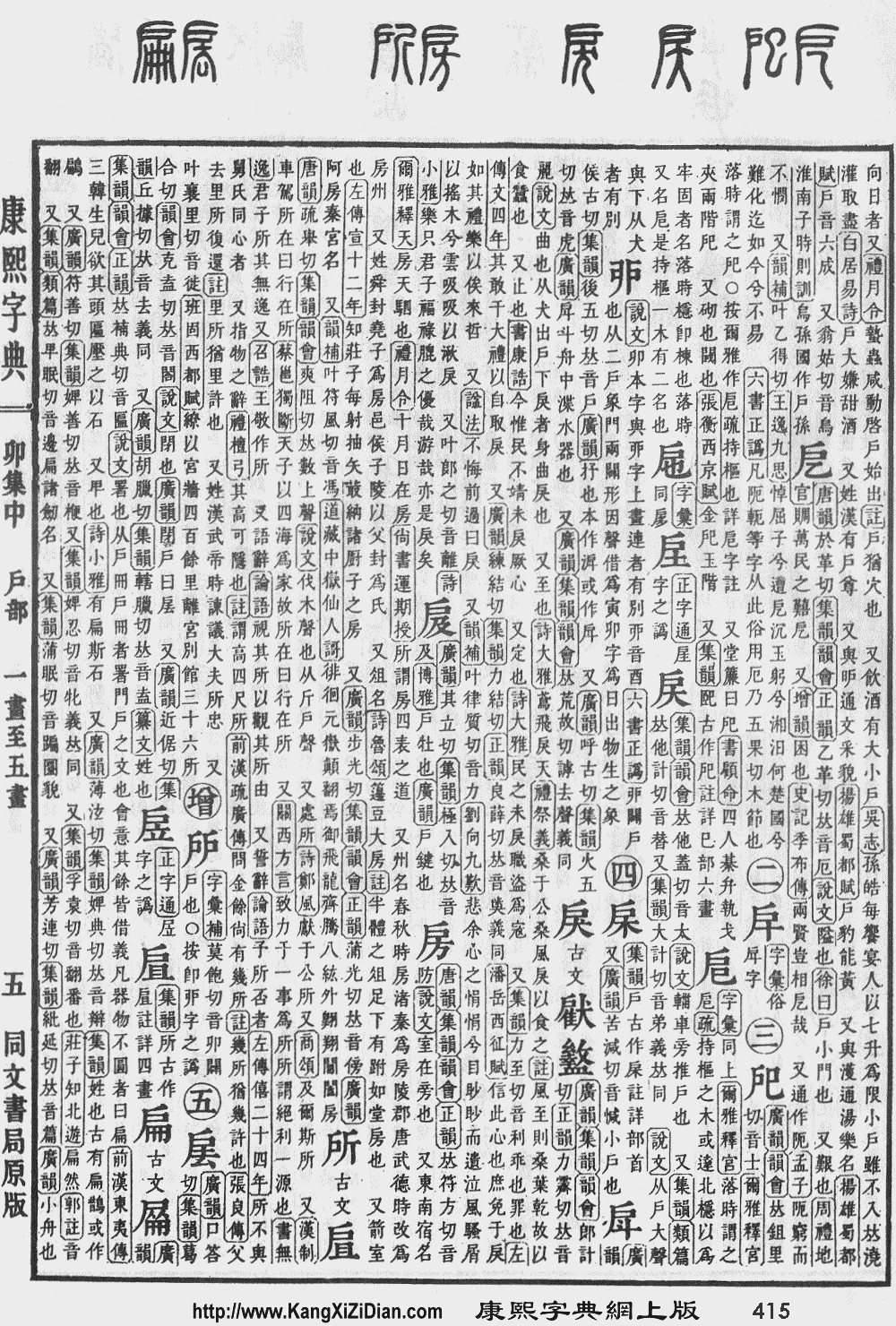
  • Kangxi Dictionary: page 415, character 11
  • Dai Kanwa Jiten: character 11712
  • Dae Jaweon: page 759, character 15
  • Hanyu Da Zidian (first edition): volume 3, page 2258, character 6
  • Unihan data for U+623E

Chinese

trad. 戾
simp. # 戾

Glyph origin

Pronunciation


Rime
Character 戾 戾
Reading # 1/2 2/2
Initial (聲) 來 (37) 來 (37)
Final (韻) 齊 (39) 屑 (87)
Tone (調) Departing (H) Checked (Ø)
Openness (開合) Open Open
Division (等) IV IV
Fanqie 郎計切 練結切
Baxter lejH let
Reconstructions
Zhengzhang
Shangfang
/leiH/ /let̚/
Pan
Wuyun
/leiH/ /let̚/
Shao
Rongfen
/lɛiH/ /lɛt̚/
Edwin
Pulleyblank
/lɛjH/ /lɛt̚/
Li
Rong
/leiH/ /let̚/
Wang
Li
/lieiH/ /liet̚/
Bernard
Karlgren
/lieiH/ /liet̚/
Expected
Mandarin
Reflex
lì liè
Expected
Cantonese
Reflex
lai6 lit6
Baxter–Sagart system 1.1 (2014)
Character 戾
Reading # 1/1
Modern
Beijing
(Pinyin)
lì
Middle
Chinese
‹ lejH ›
Old
Chinese
/*[r]ˁe[t]-s/
English transgress

Notes for Old Chinese notations in the Baxter–Sagart system:

* Parentheses "()" indicate uncertain presence;
* Square brackets "[]" indicate uncertain identity, e.g. *[t] as coda may in fact be *-t or *-p;
* Angle brackets "<>" indicate infix;
* Hyphen "-" indicates morpheme boundary;

* Period "." indicates syllable boundary.
Zhengzhang system (2003)
Character 戾 戾
Reading # 1/2 2/2
No. 7942 7950
Phonetic
component
戾 戾
Rime
group
隊 物
Rime
subdivision
1 1
Corresponding
MC rime
麗 𥸸
Old
Chinese
/*rɯːds/ /*rɯːd/

Definitions

戾

  1. perverse, recalcitrant, rebellious
  2. 6th tetragram of the Taixuanjing; "contrariety" (𝌋)

Compounds

  • 乖戾 (guāilì)
  • 佛戾
  • 剌戾
  • 剛戾/刚戾
  • 剛戾自用/刚戾自用
  • 反戾天常
  • 咎戾
  • 寥戾
  • 忿戾
  • 悍戾
  • 愎戾
  • 戾天 (lìtiān)
  • 戾止
  • 戾氣/戾气
  • 攫戾執猛/攫戾执猛
  • 暴戾 (bàolì)
  • 暴戾之氣/暴戾之气
  • 暴戾恣睢
  • 災戾/灾戾
  • 狠戾
  • 狼戾 (lánglì)
  • 猛戾
  • 獲戾/获戾
  • 粒米狼戾
  • 罪戾 (zuìlì)
  • 詭戾/诡戾
  • 貪戾/贪戾 (tānlì)
  • 颯戾/飒戾
  • 飂戾/𮨵戾
  • 饕戾
  • 鳶飛戾天/鸢飞戾天

References

Japanese

Shinjitai

戻

Kyūjitai

戾

Kanji

戾

(uncommon “Hyōgai” kanji, kyūjitai kanji, shinjitai form 戻)

  1. Kyūjitai spelling of 戻

Readings

Definitions

Kanji in this term
戾
れい
Hyōgaiji
kan’on
For pronunciation and definitions of 戾 – see the following entry.
【戻】S
[kanji] Hyōgaiji kanji
[kanji] This term needs a translation to English.
[kanji] Hyōgaiji kanji
(This term, 戾, is the kyūjitai of the above term.)

Korean

Hanja

戾 • (ryeo>yeo, ryeol>yeol) (hangeul 려>여, 렬>열, revised ryeo>yeo, ryeol>yeol, McCune–Reischauer ryŏ>yŏ, ryŏl>yŏl, Yale lye>ye, lyel>yel)

  1. This term needs a translation to English. Please help out and add a translation, then remove the text {{rfdef}}.

Vietnamese

Han character

戾: Hán Nôm readings: lệ

liệt (xoay lại, turn back)

  1. This term needs a translation to English. Please help out and add a translation, then remove the text {{rfdef}}.
This article is issued from Wiktionary. The text is licensed under Creative Commons - Attribution - Sharealike. Additional terms may apply for the media files.