掘
See also: 撅
| ||||||||
Translingual
Han character
掘 (Kangxi radical 64, 手+8, 11 strokes, cangjie input 手尸山山 (QSUU), four-corner 57072, composition ⿰扌屈)
Derived characters
- 𫁗
References
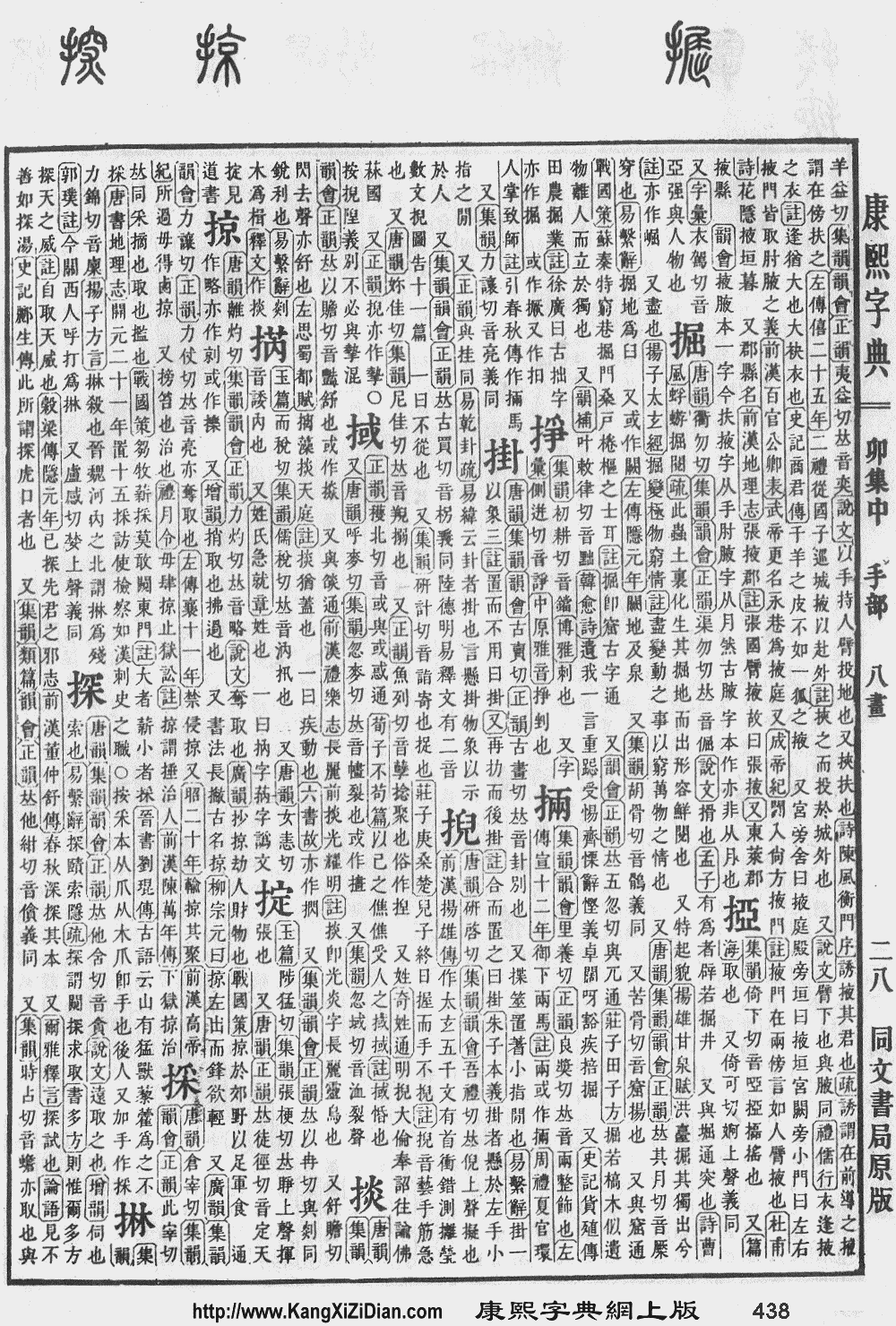
- Kangxi Dictionary: page 438, character 2
- Dai Kanwa Jiten: character 12264
- Dae Jaweon: page 787, character 10
- Hanyu Da Zidian (first edition): volume 3, page 1909, character 2
- Unihan data for U+6398
Chinese
| simp. and trad. |
掘 | |
|---|---|---|
Glyph origin
| Historical forms of the character 掘 | |
|---|---|
| Shuowen Jiezi (compiled in Han) | Liushutong (compiled in Ming) |
| Small seal script | Transcribed ancient scripts |
 |
 |
Characters in the same phonetic series (出) (Zhengzhang, 2003)
| Old Chinese | |
|---|---|
| 聉 | *r̥ʰuːlʔ, *ŋrɯd, *ʔr'uːd, *ŋruːd |
| 贅 | *kljods |
| 祟 | *sqʰluds |
| 出 | *kʰljuds, *kʰljud |
| 茁 | *ʔl'ɯd, *skruːd, *skrod, *skrud |
| 欪 | *qʰlɯd, *l̥ʰud |
| 貀 | *ŋr'uːd |
| 袦 | *ŋr'oːd |
| 咄 | *ʔl'oːd, *ʔl'uːd |
| 柮 | *sɡloːd, *ʔl'uːd |
| 拙 | *kljod |
| 炪 | *kljod, *l̥ʰud |
| 掘 | *ɡlod, *ɡlud |
| 鈯 | *l'uːd |
| 啒 | *kluːd, *qʰluːd |
| 淈 | *kluːd, *ɡluːd |
| 窟 | *kʰluːd |
| 泏 | *kʰluːd, *ʔl'ud |
| 堀 | *kʰluːd, *ɡlud |
| 胐 | *kʰluːd |
| 窋 | *ʔl'ud |
| 絀 | *ʔl'ud |
| 黜 | *l̥ʰud |
| 屈 | *klud, *kʰlud |
| 趉 | *klud |
| 鶌 | *klud |
| 詘 | *kʰlud |
| 倔 | *ɡlud |
| 崛 | *ɡlud, *ŋɡlud |
Phono-semantic compound (形聲/形声, OC *ɡlod, *ɡlud) : semantic 扌 (“hand; action”) + phonetic 屈 (OC *klud, *kʰlud).
Etymology 1
From Proto-Sino-Tibetan *r-(k/g)wa-t (“to dig out; to scoop out”), cognate to Tibetan རྐོད་པ (rkod pa), རྐོ་བ (rko ba, “to dig; to hoe”) (STEDT). Possibly related to 決 (OC *kʷeːd, “to dig an outlet for water; to burst out”).
Pronunciation
Synonyms
Dialectal synonyms of 挖 (“to dig”) [map]
| Variety | Location | Words |
|---|---|---|
| Formal (Written Standard Chinese) | 挖 | |
| Mandarin | Taiwan | 挖 |
| Yantai (Muping) | 挖 | |
| Wanrong | 掘 | |
| Xi'an | 挖 | |
| Ürümqi | 挖 | |
| Wuhan | 挖 | |
| Yangzhou | 挖 | |
| Malaysia | 挖 | |
| Singapore | 挖 | |
| Cantonese | Guangzhou | 掘 |
| Hong Kong | 掘 | |
| Gan | Nanchang | 挖 |
| Pingxiang | 挖 | |
| Jin | Taiyuan | 挖 |
| Eastern Min | Fuzhou | 掘 |
| Southern Min | Xiamen | 搤, 摀, 挖 |
| Quanzhou | 搤, 挖 | |
| Jinjiang | 搤 | |
| Zhangzhou | 摀, 挖 | |
| Tainan | 搤, 摀 | |
| Singapore (Hokkien) | 搤, 摀 | |
| Manila (Hokkien) | 搤 | |
| Leizhou | 掘 | |
| Haikou | 掘 | |
| Southern Pinghua | Nanning (Tingzi) | 挖 |
| Wu | Shanghai | 掘 |
| Shanghai (Chongming) | 挖 | |
| Suzhou | 掘 | |
| Wenzhou | 掘 | |
| Jinhua | 掘 | |
Compounds
Japanese
Korean
Vietnamese
This article is issued from Wiktionary. The text is licensed under Creative Commons - Attribution - Sharealike. Additional terms may apply for the media files.