朋
| ||||||||
Translingual
| Stroke order | |||
|---|---|---|---|
 | |||
Han character
朋 (Kangxi radical 74, 月+4, 8 strokes, cangjie input 月月 (BB), four-corner 77220, composition ⿰月月)
Derived characters
References
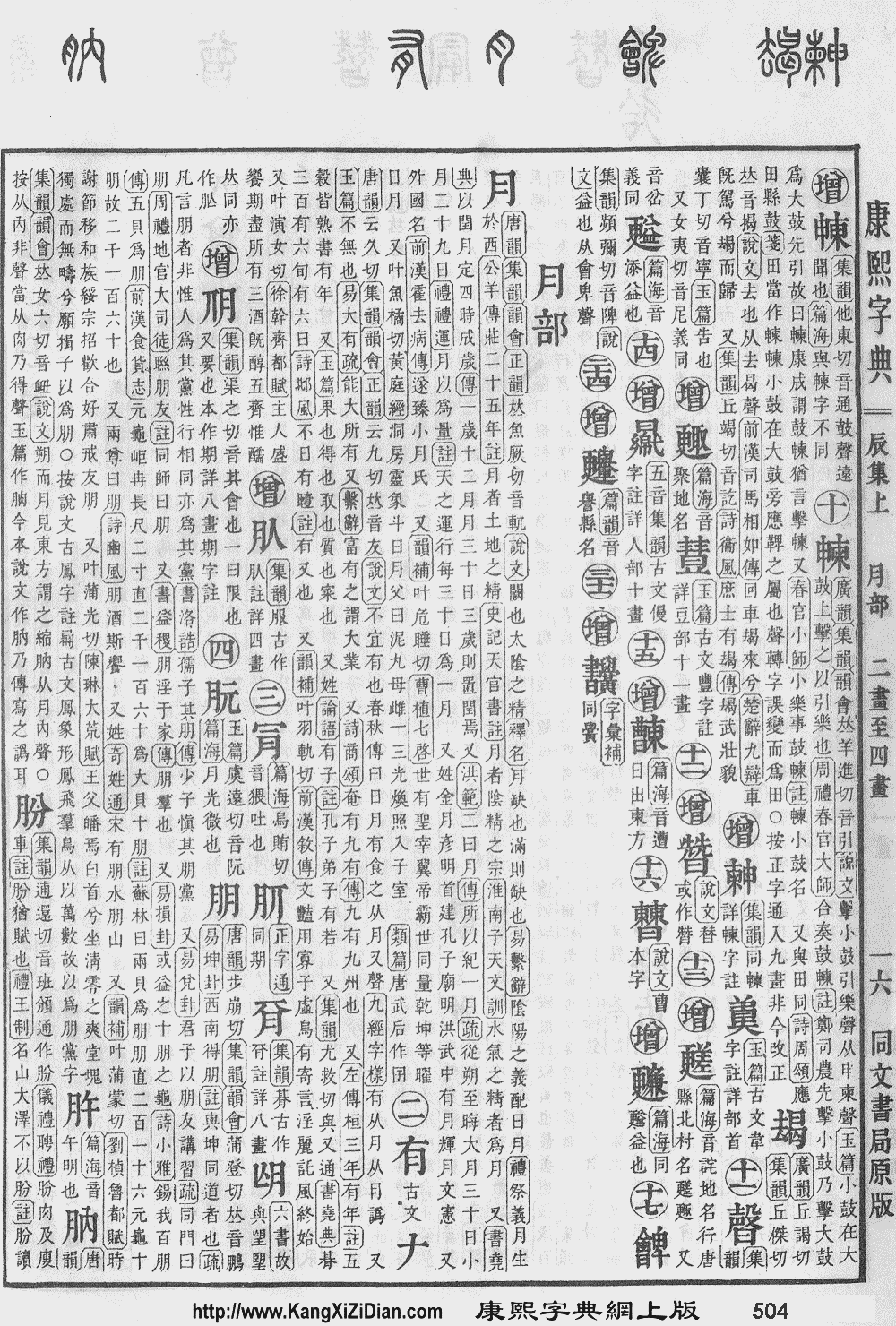
- Kangxi Dictionary: page 504, character 29
- Dai Kanwa Jiten: character 14340
- Dae Jaweon: page 883, character 4
- Hanyu Da Zidian (first edition): volume 3, page 2050, character 6
- Unihan data for U+670B
Chinese
| simp. and trad. |
朋 | |
|---|---|---|
Glyph origin
| Historical forms of the character 朋 | ||||
|---|---|---|---|---|
| Shang | Western Zhou | Warring States | Shuowen Jiezi (compiled in Han) | Liushutong (compiled in Ming) |
| Oracle bone script | Bronze inscriptions | Qin slip script | Small seal script | Transcribed ancient scripts |
 |
 |
 |
 |
 |
Characters in the same phonetic series (朋) (Zhengzhang, 2003)
Pictogram (象形) .
The oracle bone script form consisted of two strings of five cowries. Some forms of the oracle bone script contained an additional 人 which later evolved into 勹 (OC *pruː), which served as a phonetic component. The glyph was eventually corrupted to a duplication of 月 (“moon”).
Shuowen erroneously suggests 朋 (OC *bɯːŋ) was the ancient form of 鳳 (OC *bums).
Pronunciation
Definitions
朋
- † unit of shell money; various theories exist about the exact amount
- 既見君子、錫我百朋。 [Pre-Classical Chinese, trad.]
- From: The Classic of Poetry, c. 11th – 7th centuries BCE, translated based on James Legge's version
- Jì jiàn jūnzǐ, xī wǒ bǎi péng. [Pinyin]
- We see our noble lord,
And he gives us a hundred sets of cowries.
既见君子、锡我百朋。 [Pre-Classical Chinese, simp.]
- friend
- (literary) to gang up; to band together
- (literary) to be similar; to equal
- a surname
Synonyms
Dialectal synonyms of 朋友 (“friend”) [map]
Compounds
- 三朋四友
- 乞拉朋吉
- 交朋結義/交朋结义
- 吉朋
- 呼朋引伴
- 呼朋引類/呼朋引类
- 夠朋友/够朋友
- 好朋友
- 引類呼朋/引类呼朋
- 挾朋樹黨/挟朋树党
- 朋交
- 朋僚 (péngliáo)
- 朋儔/朋俦
- 朋儕/朋侪
- 朋分花用
- 朋友
- 朋友有舊/朋友有旧
- 朋奸
- 朋從/朋从
- 朋比 (péngbǐ)
- 朋比作仇
- 朋比作奸
- 朋比為奸 (péngbǐwéijiān)
- 朋淫
- 朋謀/朋谋
- 朋酒
- 朋頭/朋头
- 朋馳/朋驰
- 朋黨/朋党 (péngdǎng)
- 朋黨之爭/朋党之争
- 朋黨比周/朋党比周
- 朋黨論/朋党论
- 無朋/无朋
- 燕朋
- 狂朋怪友
- 狐朋狗友 (húpénggǒuyǒu)
- 狐朋狗黨/狐朋狗党
- 男朋友
- 碩大無朋/硕大无朋 (shuòdàwúpéng)
- 老朋友
- 耐久朋
- 良朋 (liángpéng)
- 良朋益友
- 親朋/亲朋
- 親朋好友/亲朋好友 (qīnpénghǎoyǒu)
- 詩朋酒侶/诗朋酒侣
- 詩朋酒友/诗朋酒友
- 詩酒朋儕/诗酒朋侪
- 豬朋狗友/猪朋狗友 (zhūpénggǒuyǒu)
- 賓朋/宾朋 (bīnpéng)
- 賓朋滿座/宾朋满座
- 酒肉朋友
- 面朋
- 韓朋/韩朋
- 韓朋賦/韩朋赋
- 韓朋鳥/韩朋鸟
- 高朋 (gāopéng)
- 高朋故戚
- 高朋滿座/高朋满座 (gāopéngmǎnzuò)
References
- “朋”, in 漢語多功能字庫 (Multi-function Chinese Character Database), 香港中文大學 (the Chinese University of Hong Kong), 2014–
Japanese
| Shinjitai | 朋 | |
| Kyūjitai [1][2] |
朋󠄁 朋+ 󠄁?(Adobe-Japan1) |
 |
| 朋󠄃 朋+ 󠄃?(Hanyo-Denshi) (Moji_Joho) | ||
| The displayed kanji may be different from the image due to your environment. See here for details. | ||
Etymology 1
| Kanji in this term |
|---|
| 朋 |
| とも Jinmeiyō |
| kun’yomi |
| For pronunciation and definitions of 朋 – see the following entry. | ||
| ||
| (This term, 朋, is an alternative spelling of the above term.) |
References
Korean
Etymology
From Middle Chinese 朋 (MC bong). Recorded as Middle Korean 브ᇰ (pung) (Yale: pung) in Hunmong Jahoe (訓蒙字會 / 훈몽자회), 1527.
Vietnamese
This article is issued from Wiktionary. The text is licensed under Creative Commons - Attribution - Sharealike. Additional terms may apply for the media files.