朏

See also: 胐
朏 U+670F, 朏
CJK UNIFIED IDEOGRAPH-670F
← 朎
[U+670E]
CJK Unified Ideographs 朐 →
[U+6710]

Translingual

Han character

朏 (Kangxi radical 74, 月+5, 9 strokes, cangjie input 月山山 (BUU), four-corner 72272, composition ⿰月出)

References

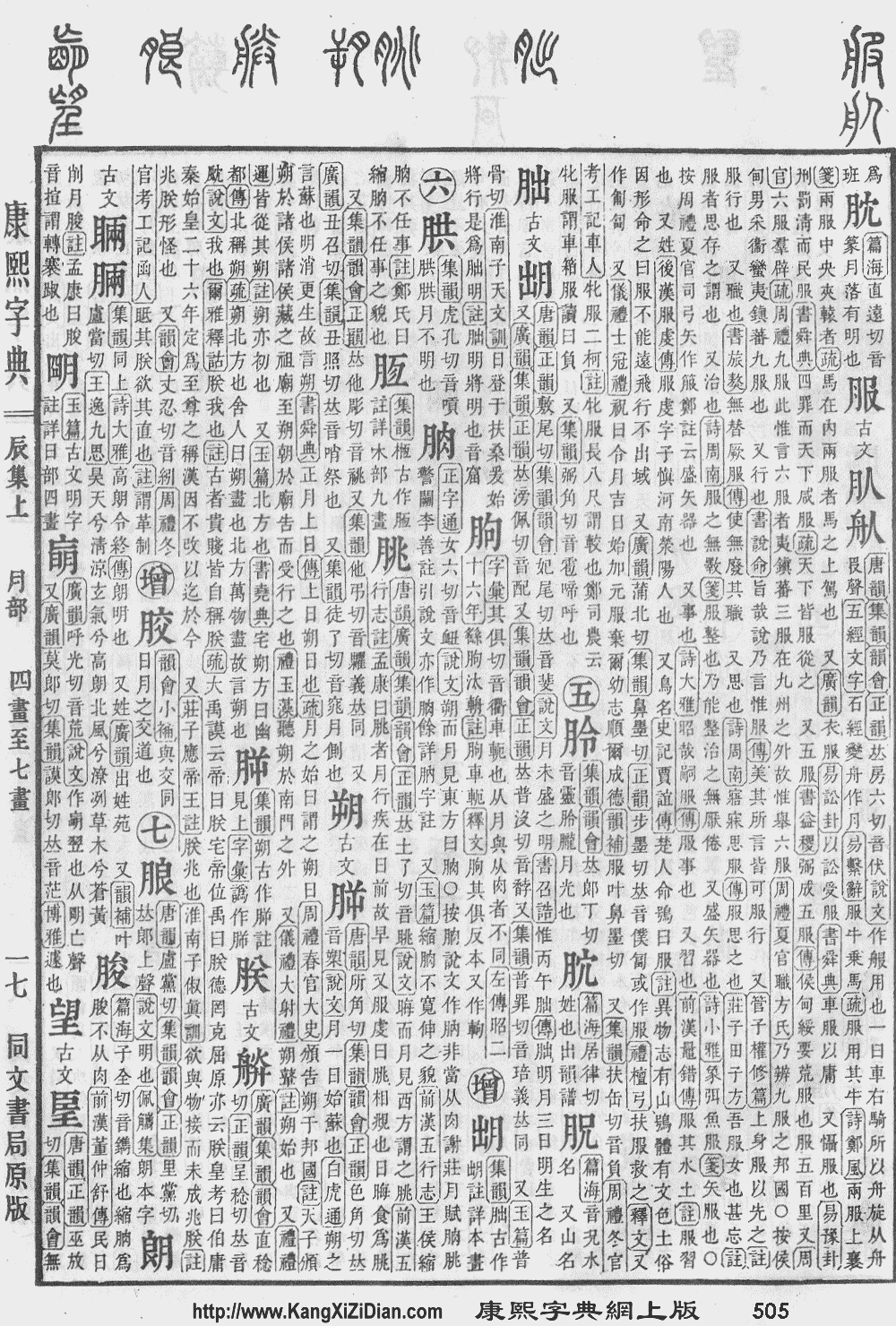
  • Kangxi Dictionary: page 505, character 8
  • Dai Kanwa Jiten: character 14351
  • Dae Jaweon: page 883, character 20
  • Hanyu Da Zidian (first edition): volume 3, page 2065, character 1
  • Unihan data for U+670F

Chinese

simp. and trad.
朏

Glyph origin

Historical forms of the character 朏
Western Zhou Shuowen Jiezi (compiled in Han)
Bronze inscriptions Small seal script

Ideogrammic compound (會意/会意) : 月 (“moon”) + 出 (“to come out; to appear”).

Etymology

Perhaps from Austroasiatic; compare Khmer ពន្លូត (pŭənluut, “to enlarge; to augment”, literally “to cause to appear; to grow”), from លូត (luut, “to sprout; to grow; to become longer”) (Schuessler, 2007).

Pronunciation


Rime
Character 朏 朏 朏
Reading # 1/3 2/3 3/3
Initial (聲) 滂 (2) 滂 (2) 滂 (2)
Final (韻) 微 (21) 咍 (41) 灰 (42)
Tone (調) Rising (X) Rising (X) Departing (H)
Openness (開合) Closed Open Closed
Division (等) III I I
Fanqie 敷尾切 普乃切 滂佩切
Baxter phj+jX phojX phwojH
Reconstructions
Zhengzhang
Shangfang
/pʰʉiX/ /pʰʌiX/ /pʰuʌiH/
Pan
Wuyun
/pʰʷɨiX/ /pʰəiX/ /pʰuoiH/
Shao
Rongfen
/pʰiuəiX/ /pʰɒiX/ /pʰuɒiH/
Edwin
Pulleyblank
/pʰujX/ /pʰəjX/ /pʰwəjH/
Li
Rong
/pʰiuəiX/ /pʰᴀiX/ /pʰuᴀiH/
Wang
Li
/pʰĭwəiX/ /pʰɒiX/ /pʰuɒiH/
Bernard
Karlgren
/pʰwe̯iX/ /pʰɑ̆iX/ /pʰuɑ̆iH/
Expected
Mandarin
Reflex
fěi pǎi pèi
Expected
Cantonese
Reflex
fei2 poi2 pui3
Baxter–Sagart system 1.1 (2014)
Character 朏
Reading # 1/1
Modern
Beijing
(Pinyin)
fěi
Middle
Chinese
‹ phjɨjX ›
Old
Chinese
/*pʰ[ə]jʔ/
English new light of the moon

Notes for Old Chinese notations in the Baxter–Sagart system:

* Parentheses "()" indicate uncertain presence;
* Square brackets "[]" indicate uncertain identity, e.g. *[t] as coda may in fact be *-t or *-p;
* Angle brackets "<>" indicate infix;
* Hyphen "-" indicates morpheme boundary;

* Period "." indicates syllable boundary.
Zhengzhang system (2003)
Character 朏 朏 朏
Reading # 1/3 2/3 3/3
No. 3122 3123 3125
Phonetic
component
朏 朏 朏
Rime
group
微 微 微
Rime
subdivision
1 1 1
Corresponding
MC rime
俖 配 斐
Old
Chinese
/*pʰlɯːlʔ/ /*pʰlɯːls/ /*pʰlɯlʔ/

Definitions

朏

  1. † light of crescent moon
  2. † third day of a lunar month
  3. † (of the moon, a star) to rise
  4. † to approach daybreak

Compounds

  • 朏明
  • 朏朏
  • 朏朒
  • 朏魄 (fěipò)

Japanese

Kanji

朏

(uncommon “Hyōgai” kanji)

  1. crescent moon

Readings

Definitions

Kanji in this term
朏
みかづき
Hyōgaiji
kun’yomi
For pronunciation and definitions of 朏 – see the following entry.
【三日月みかづき】
[noun] a crescent moon on the third day of a lunar month, especially on the eighth lunar month
[noun] (by extension) Short for 三日月形 (mikazuki-gata): a crescent moon in general
[noun] Synonym of 小爪 (kozume): a claw in the shape of a crescent moon
[noun] a type of mask used in Noh
[proper noun] a placename
[proper noun] a surname
[proper noun] a male given name
(This term, 朏, is an alternative spelling (rare) of the above term.)

Korean

Hanja

朏 (eum 비 (bi))

  1. crescent

Vietnamese

Han character

朏: Hán Nôm readings: xoét

  1. This term needs a translation to English. Please help out and add a translation, then remove the text {{rfdef}}.
This article is issued from Wiktionary. The text is licensed under Creative Commons - Attribution - Sharealike. Additional terms may apply for the media files.