森
| ||||||||
Translingual
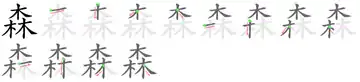
| Stroke order | |||
|---|---|---|---|
 | |||
Han character
森 (Kangxi radical 75, 木+8, 12 strokes, cangjie input 木木木 (DDD), four-corner 40994, composition ⿱木林)
Further reading
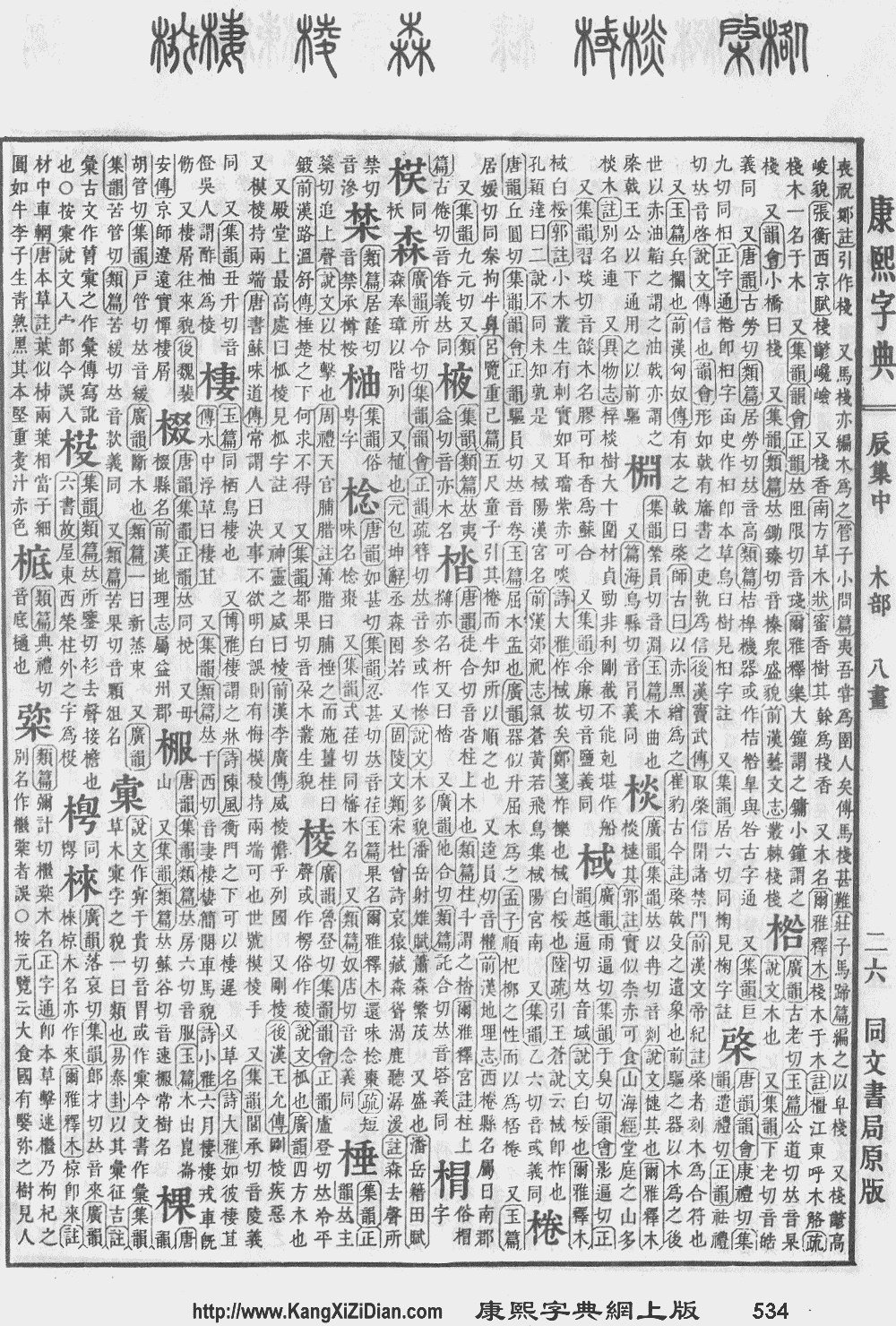
- Kangxi Dictionary: page 534, character 11
- Dai Kanwa Jiten: character 14974
- Dae Jaweon: page 922, character 8
- Hanyu Da Zidian (first edition): volume 2, page 1226, character 2
- Unihan data for U+68EE
Chinese
| trad. | 森 | |
|---|---|---|
| simp. # | 森 | |
Glyph origin
| Historical forms of the character 森 | |
|---|---|
| Shang | Shuowen Jiezi (compiled in Han) |
| Oracle bone script | Small seal script |
 |
 |
Ideogrammic compound (會意/会意) : Triplication of 木 (“tree”), to suggest a large number (compare 三) of trees such as one would find in a forest. Compare 林 (*ɡ·rɯm).
Etymology
From Proto-Sino-Tibetan *ram (“jungle; forest; country; field”) (STEDT). Schuessler (2007) suggests that it may be an intensive derivation of 林 (*ɡ·rɯm, “forest”), perhaps influenced by parallels in Austroasiatic, such as Old Khmer sarāma, sarāṃ (“a tract of stunted vegetation”), derived from rām (“inundated forest along a watercourse”). Alternatively, Mei (2012) suggests that the prefix *s- has a denominative function.
Pronunciation
Definitions
森
Compounds
- 亞松森/亚松森 (yàsōngsēn)
- 冷森森
- 劍戟森森/剑戟森森
- 壁壘森嚴/壁垒森严 (bìlěisēnyán)
- 寒森森
- 布倫森/布伦森
- 林森 (Línsēn)
- 柏格森
- 森冷
- 森嚴/森严 (sēnyán)
- 森岑
- 森巴 (sēnbā)
- 森林 (sēnlín)
- 森林學/森林学
- 森林法
- 森林浴 (sēnlínyù)
- 森森 (sēnsēn)
- 森然 (sēnrán)
- 森羅殿/森罗殿
- 森羅萬象/森罗万象 (sēnluó-wànxiàng)
- 森美蘭/森美兰 (Sēnměilán)
- 森蚺 (sēnrán)
- 森豎/森竖
- 森鬱/森郁
- 毛骨森然
- 毛骨森竦
- 毛髮森豎/毛发森竖
- 海森堡 (Hǎisēnbǎo)
- 涼森森/凉森森
- 班強森/班强森
- 白森森 (báisēnsēn)
- 盧森堡/卢森堡 (Lúsēnbǎo)
- 萬象森羅/万象森罗
- 艾森豪 (Àisēnháo)
- 葉斯沛森/叶斯沛森
- 蕭森/萧森
- 號令森嚴/号令森严
- 詹森
- 警備森嚴/警备森严
- 門禁森嚴/门禁森严
- 陰森/阴森 (yīnsēn)
- 陰森森/阴森森
- 麻森 (másēn)
- 黃森森/黄森森
- 黑森林 (Hēi Sēnlín)
References
- “森”, in 漢語多功能字庫 (Multi-function Chinese Character Database), 香港中文大學 (the Chinese University of Hong Kong), 2014–
Japanese
Readings
Compounds
Etymology
| Kanji in this term |
|---|
| 森 |
| もり Grade: 1 |
| kun’yomi |
From Old Japanese, first attested in the Man'yōshū (c. 759 CE).[1]
Probably cognate with 盛り (mori, “heap, pile”), the 連用形 (ren'yōkei, “continuative or stem form”) of verb 盛る (moru, “to heap up, to build up into a significant amount”), from the way a forest can look like a heap or mound from a distance.[2]
Noun
森 • (mori)
Derived terms
- 森青蛙 (mori aogaeru)
- 森薊 (mori-azami)
- 森ガール (mori-gāru)
- 森陰 (morikage)
- 森神 (morigami)
- 森川 (Morikawa)
- 森下 (Morishita)
- 森島 (Morishima)
- 森嶋 (Morishima)
- 森田 (Morita)
- 森派 (Mori-ha)
- 森番 (moriban)
- 森本 (Morimoto)
- 森嫁 (mori yome, “forest nymph”)
- 青森 (Aomori, “Aomori Prefecture”, literally "green forest")
- 雨森 (Amenomori)
- 生田の森 (Ikuta no Mori)
- 池子の森 (Ikego no Mori)
- 稲森草 (inamorisō)
- 岩瀬の森 (Iwase no Mori)
- 磐手の森 (Iwade no Mori)
- 浮田の森 (Ukita no Mori)
- 老蘇森, 老曽森 (Oiso no Mori)
- 大森 (Ōmori)
- 笠森 (Kasamori)
- 金森 (Kanamori)
- 気色の森 (Keshiki no mori)
- 小森 (Komori)
- 笹森 (Sasamori)
- 重森 (Shigemori)
- 信太の森 (Shinoda no mori)
- 杉森 (Sugimori)
- 鈴ヶ森 (Suzugamori)
- 高森 (Takamori)
- 糺の森, 糺ノ森, 糾ノ森 (Tadasu no Mori)
- 鎮守の森 (chinju no Mori)
- 成らずの森 (narazu no Mori)
- 羽束師の森 (Hatsukashi no Mori)
- 花森 (Hanamori)
- 柞の森 (hahaso no mori)
- 藤森 (Fujimori)
- 丸森 (Marumori)
- 明治の森 (Meiji no Mori)
- 万木の森 (Yurugi no Mori)
Proverbs
- 木を見て森を見ず (ki o mite mori o mizu, “to not see the wood for the trees”)
Proper noun
森 • (Mori)
References
- , text here
- Kindaichi, Kyōsuke et al., editors (1997), 新明解国語辞典 [Shin Meikai Kokugo Jiten] (in Japanese), Fifth edition, Tōkyō: Sanseidō, →ISBN
- Matsumura, Akira, editor (2006), 大辞林 [Daijirin] (in Japanese), Third edition, Tōkyō: Sanseidō, →ISBN
- NHK Broadcasting Culture Research Institute, editor (1998), NHK日本語発音アクセント辞典 [NHK Japanese Pronunciation Accent Dictionary] (in Japanese), Tōkyō: NHK Publishing, →ISBN
Vietnamese
Han character
森: Hán Việt readings: sâm, sum
森: Nôm readings: chùm, dâm, dúm, râm, sâm, sum, xum
- This term needs a translation to English. Please help out and add a translation, then remove the text
{{rfdef}}.