維
See also: 维
| ||||||||
Translingual
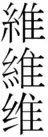
Han character
維 (Kangxi radical 120, 糸+8, 14 strokes, cangjie input 女火人土 (VFOG), four-corner 20914, composition ⿰糹隹)
Related characters
References
- Kangxi Dictionary: page 927, character 15
- Dai Kanwa Jiten: character 27568
- Dae Jaweon: page 1364, character 22
- Hanyu Da Zidian (first edition): volume 5, page 3415, character 5
- Unihan data for U+7DAD

Chinese
| trad. | 維 | |
|---|---|---|
| simp. | 维 | |
Glyph origin
| Historical forms of the character 維 | ||
|---|---|---|
| Western Zhou | Warring States | Shuowen Jiezi (compiled in Han) |
| Bronze inscriptions | Chu slip and silk script | Small seal script |
 |
 |
 |
Characters in the same phonetic series (唯) (Zhengzhang, 2003)
Phono-semantic compound (形聲/形声, OC *ɢʷi) : semantic 糸 (“thread”) + abbreviated phonetic 唯 (OC *ɢʷi, *ɢʷiʔ).
The original pronunciation of 隹 (OC *ɢʷi) was lost after the classical period, but can still be seen in other characters of the phonetic series:
Pronunciation 1
Definitions
維
- † to tie; to fasten; to tie up
- † to link; to connect
- to hold together; to maintain; to preserve; to safeguard
- † thick rope for tying objects; cord
- † corner; nook; recess
- † net; mesh; netting
- (geometry) dimension
- † order; law; outline
- † long and thin object; fibre; string
- † Alternative form of 惟 (wéi, “to think; to contemplate”)
- † Alternative form of 唯 (“only”)
- † (alt. form 惟, 唯) meaningless particle of interjection
- Short for 維生素/维生素 (wéishēngsù, “vitamin”).
- Short for 維吾爾/维吾尔 (Wéiwú'ěr, “Uyghur”).
- a surname
Compounds
- 三維空間/三维空间
- 伏維尚饗/伏维尚飨
- 八維/八维
- 創業維艱/创业维艰
- 哈維/哈维
- 四維/四维 (sìwéi)
- 國維/国维
- 地維/地维
- 坤維/坤维
- 塞爾維亞/塞尔维亚
- 多維/多维 (duōwéi)
- 奧維爾/奥维尔
- 孟什維克/孟什维克 (mèngshíwéikè)
- 屋大維/屋大维 (Wūdàwéi)
- 巴勒維/巴勒维
- 布干維爾/布干维尔 (Bùgānwéi'ěr)
- 思維/思维 (sīwéi)
- 恭維/恭维 (gōngwéi)
- 恭維話/恭维话
- 我武維揚/我武维扬
- 拉脫維亞/拉脱维亚 (Lātuōwéiyà)
- 新疆維吾爾自治區/新疆维吾尔自治区 (Xīnjiāng Wéiwú'ěr Zìzhìqū)
- 明治維新/明治维新 (Míngzhì Wéixīn)
- 步履維艱/步履维艰 (bùlǚwéijiān)
- 物力維艱/物力维艰
- 玻利維亞/玻利维亚 (Bōlìwéiyà)
- 百日維新/百日维新 (Bǎirì Wéixīn)
- 睢維/睢维
- 維也納/维也纳 (Wéiyěnà)
- 維京人/维京人 (wéijīngrén)
- 維他命/维他命 (wéitāmìng)
- 維修/维修 (wéixiū)
- 維吉尼亞/维吉尼亚 (Wéijíníyà)
- 維吾爾/维吾尔 (Wéiwú'ěr)
- 維基/维基 (wéijī)
- 維多米/维多米
- 維天之命/维天之命
- 維妙維肖/维妙维肖 (wéimiàowéixiào)
- 維持/维持 (wéichí)
- 維摩經/维摩经
- 維摩詰/维摩诘
- 維斗
- 維新/维新 (wéixīn)
- 維新圖強/维新图强
- 維新運動/维新运动 (Wéixīn Yùndòng)
- 維清/维清
- 維生/维生 (wéishēng)
- 維生素/维生素 (wéishēngsù)
- 維管束/维管束 (wéiguǎnshù)
- 維納斯/维纳斯 (Wéinàsī)
- 綱維/纲维 (gāngwéi)
- 維縶/维絷
- 維繫/维系 (wéixì)
- 維艱/维艰 (wéijiān)
- 維護/维护 (wéihù)
- 維那/维那 (wéinà)
- 縶維/絷维
- 纖維/纤维 (xiānwéi)
- 臭恭維/臭恭维
- 臺維斯杯/台维斯杯
- 舉步維艱/举步维艰 (jǔbùwéijiān)
- 蘇維埃/苏维埃 (sūwéi'āi)
- 進退維谷/进退维谷 (jìntuìwéigǔ)
Pronunciation 2
Japanese
Readings
Usage notes
- Most dictionaries proscribe historical -uwi readings すゐ (suwi), ずゐ (zuwi), つゐ (tuwi), ゆゐ (yuwi), and るゐ (ruwi) as attested in many historical documents.
Pronunciation
- IPA(key): [i]
Etymology 2
| Kanji in this term |
|---|
| 維 |
| これ Grade: S |
| kun’yomi |
| For pronunciation and definitions of 維 – see the following entry. | ||
| ||
| (This term, 維, is an alternative spelling of the above term.) |
Korean
Hanja
Vietnamese
References
- Trần (2004).
- Trần (1999).
- Nguyễn (1974).
- Thiều Chửu (1942).
This article is issued from Wiktionary. The text is licensed under Creative Commons - Attribution - Sharealike. Additional terms may apply for the media files.