唯
| ||||||||
Translingual
Han character
唯 (Kangxi radical 30, 口+8, 11 strokes, cangjie input 口人土 (ROG), four-corner 60014, composition ⿰口隹)
References
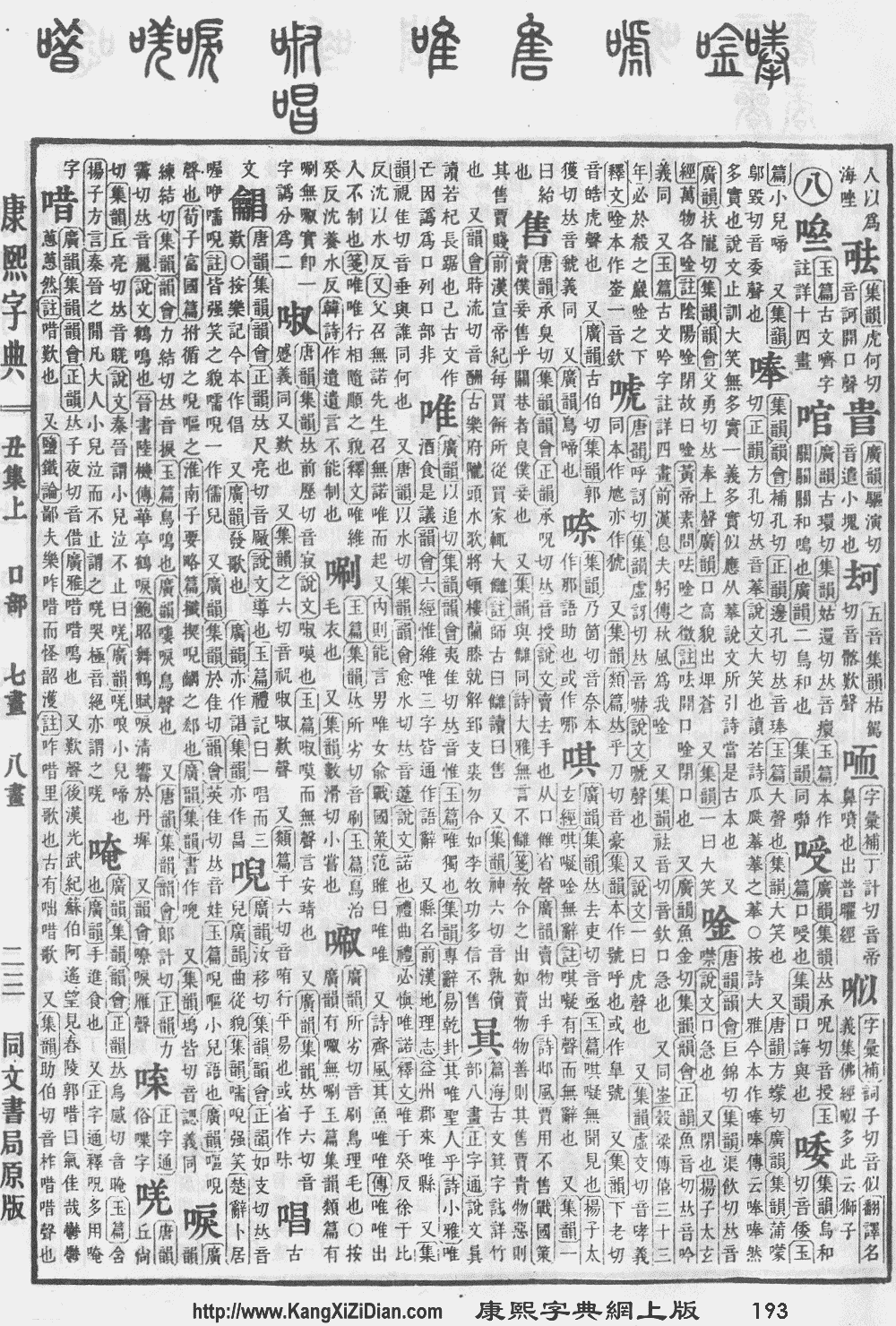
- Kangxi Dictionary: page 193, character 17
- Dai Kanwa Jiten: character 3761
- Dae Jaweon: page 413, character 17
- Hanyu Da Zidian (first edition): volume 1, page 642, character 5
- Unihan data for U+552F
Chinese
| simp. and trad. |
唯 | |
|---|---|---|
Glyph origin
Phono-semantic compound (形聲/形声, OC *ɢʷi, *ɢʷiʔ) : semantic 口 (“mouth”) + phonetic 隹.
Etymology
From Proto-Sino-Tibetan *way (“be, copula, nominalizer, subordinator”); cognate with Proto-Lolo-Burmese *wəy (“to be”) > Proto-Loloish *ʔ-way²/³ (> Luquan ve³³ ~ ve⁵⁵ ("subordinator, final particle"), Lahu ve (“nominalizer; relativizer; genitivizer”), Akha ø ~ ø̀ (“subordinator; citation-form marker; terminator of utterances in declarative mood”)), Mizo ve (“also, too, as well”), Jingpho we (“present tense particle”), and possibly Tibetan ཡིན (yin, “to be”) < *wi-n (with earlier w- disappearing before -i).(STEDT; Schuessler, 2007).
Related to 惠 (OC *ɢʷiːds) (Schuessler, 2007)
Pronunciation 1
Definitions
唯
- (alt. form 維/维, 惟) to be
- 予惟小子 [Classical Chinese, trad. and simp.]
- From: The Book of Documents, circa 4th – 3rd century BCE
- yǔ wéi xiǎozǐ [Pinyin]
- I am a young person
- (alt. form 維/维, 惟) An introductory particle marking noun phrases as the topic
- 維天有漢。 [Pre-Classical Chinese, trad.]
- From: The Classic of Poetry, c. 11th – 7th centuries BCE, translated based on James Legge's version
- Wéi tiān yǒu hàn. [Pinyin]
- In the sky there is the Milky Way.
维天有汉。 [Pre-Classical Chinese, simp.]
- (alt. form 惟) only; alone
- 知進退存亡而不失其正者,其唯聖人乎! [Pre-Classical Chinese, trad.]
- From: I Ching, 11th – 8th century BCE
- Zhī jìntuì cúnwáng ér bù shī qí zhèng zhě, qí wéi shèngrén hū! [Pinyin]
- He only is the sage who knows to advance and to retire, to maintain and to let perish; and that without ever acting incorrectly. Yes, he only is the sage!
知进退存亡而不失其正者,其唯圣人乎! [Pre-Classical Chinese, simp.]
- (literary) because
- although
- (literary) to allow (often used with 所)
- 然臣有三劍,唯王所用,請先言而後試。 [Classical Chinese, trad.]
- From: Zhuangzi, circa 3rd – 2nd centuries BCE
- Rán chén yǒu sān jiàn, wéi wáng suǒ yòng, qǐng xiān yán ér hòu shì. [Pinyin]
- Any length will suit me, but I have three swords, any one of which I will use, as may please your Majesty. Let me first tell you of them, and then go to the arena.
然臣有三剑,唯王所用,请先言而后试。 [Classical Chinese, simp.]
- Particle for expressing one's wish.
- 夫晉,何厭之有?既東封鄭,又欲肆其西封。不闕秦,焉取之?闕秦以利晉,唯君圖之。 [Classical Chinese, trad.]
- From: Commentary of Zuo, c. 4th century BCE
- Fú Jìn, hé yàn zhī yǒu? Jì dōng fēng Zhèng, yòu yù sì qí xī fēng. Bù què Qín, yān qǔ zhī? Què qín yǐ lì Jìn, wéi jūn tú zhī. [Pinyin]
- How will Jin ever be satisfied? After it has extended its eastern boundaries and annexed Zheng, it will want to freely expand its western boundaries. If it does not carve away Qin, where will it get land? Carving away at Qin to benefit Jin: this is something your lordship should consider carefully.
夫晋,何厌之有?既东封郑,又欲肆其西封。不阙秦,焉取之?阙秦以利晋,唯君图之。 [Classical Chinese, simp.]
- (alt. form 維/维, 惟) Meaningless sentence-initial particle.
- 子曰:「與其進也,不與其退也,唯何甚?人潔己以進,與其潔也,不保其往也。」 [Classical Chinese, trad.]
- From: The Analects of Confucius, c. 475 – 221 BCE
- Zǐyuē: “Yǔ qí jìn yě, bù yǔ qí tuì yě, wéi hé shèn? Rén jiéjǐ yǐ jìn, yǔ qí jié yě, bù bǎo qí wǎng yě.” [Pinyin]
- The Master said, "I admit people's approach to me without committing myself as to what they may do when they have retired; why must one be so severe? If a man purify himself to wait upon me, I receive him so purified, without guaranteeing his past conduct."
子曰:「与其进也,不与其退也,唯何甚?人洁己以进,与其洁也,不保其往也。」 [Classical Chinese, simp.]
Compounds
- 任人唯親/任人唯亲 (rènrénwéiqīn)
- 任人唯賢/任人唯贤 (rènrénwéixián)
- 匪唯
- 唯一 (wéiyī)
- 唯利是圖/唯利是图 (wéilìshìtú)
- 唯利是從/唯利是从
- 唯利是求
- 唯利是視/唯利是视
- 唯名論/唯名论
- 唯吾獨尊/唯吾独尊
- 唯命是從/唯命是从 (wéimìngshìcóng)
- 唯命是聽/唯命是听 (wéimìngshìtīng)
- 唯妙唯肖
- 唯實論/唯实论
- 唯心 (wéixīn)
- 唯心論/唯心论 (wéixīnlùn)
- 唯恐 (wéikǒng)
- 唯恐不及
- 唯恐天下不亂/唯恐天下不乱 (wéi kǒng tiānxià bù luàn)
- 唯我
- 唯我獨尊/唯我独尊 (wéiwǒdúzūn)
- 唯我論/唯我论 (wéiwǒlùn)
- 唯是命題/唯是命题
- 唯有 (wéiyǒu)
- 唯物史觀/唯物史观 (wéiwù shǐguān)
- 唯物論/唯物论 (wéiwùlùn)
- 唯獨/唯独 (wéidú)
- 唯美 (wéiměi)
- 唯美主義/唯美主义 (wéiměi zhǔyì)
- 唯識/唯识
- 唯識宗/唯识宗
- 唯識論/唯识论
- 唯讀/唯读
- 奉命唯謹/奉命唯谨
- 成唯識論/成唯识论
- 萬法唯識/万法唯识
Descendants
Pronunciation 2
Definitions
唯
- (obsolete) A polite particle used to respond to elders: yes
- 子曰:「參乎!吾道一以貫之。」曾子曰:「唯。」子出。門人問曰:「何謂也?」曾子曰:「夫子之道,忠恕而已矣。」 [Classical Chinese, trad.]
- From: The Analects of Confucius, c. 475 – 221 BCE
- Zǐyuē: “Shēn hū! Wú dào yī yǐ guàn zhī.” Zēngzǐ yuē: “Wěi.” Zǐ chū. Ménrén wèn yuē: “Héwèi yě?” Zēngzǐ yuē: “Fūzǐ zhī dào, zhōngshù ér yǐ yǐ.” [Pinyin]
- The Master said, "Shen, my doctrine is that of an all-pervading unity." The disciple Zeng replied, "Yes." The Master went out, and the other disciples asked, saying, "What do his words mean?" Zeng said, "The doctrine of our master is to be true to the principles of our nature and the benevolent exercise of them to others, this and nothing more."
子曰:「参乎!吾道一以贯之。」曾子曰:「唯。」子出。门人问曰:「何谓也?」曾子曰:「夫子之道,忠恕而已矣。」 [Classical Chinese, simp.]
Descendants
References
- “唯”, in 漢語多功能字庫 (Multi-function Chinese Character Database), 香港中文大學 (the Chinese University of Hong Kong), 2014–
Japanese
Readings
Usage notes
- Most dictionaries proscribe historical -uwi readings すゐ (suwi), ずゐ (zuwi), つゐ (tuwi), ゆゐ (yuwi), and るゐ (ruwi).
Derived terms
Derived terms
- 諾唯 (dakui)
Etymology 3
| Kanji in this term |
|---|
| 唯 |
| ただ Grade: S |
| kun’yomi |
| For pronunciation and definitions of 唯 – see the following entry. | ||
| ||
| (This term, 唯, is an alternative spelling of the above term.) |
Etymology 4
| Kanji in this term |
|---|
| 唯 |
| たった Grade: S |
| irregular |
| For pronunciation and definitions of 唯 – see the following entry. | ||
| ||
| (This term, 唯, is an alternative spelling of the above term.) |
Etymology 5
| Kanji in this term |
|---|
| 唯 |
| たんだ Grade: S |
| irregular |
| For pronunciation and definitions of 唯 – see the following entry: たんだ |
(The following entry is uncreated: たんだ.)
Korean
Etymology
(This etymology is missing or incomplete. Please add to it, or discuss it at the Etymology scriptorium. Particularly: “Middle Korean readings, if any”)
Pronunciation
- (SK Standard/Seoul) IPA(key): [ju]
- Phonetic hangul: [유]
Hanja
Wikisource 唯 • (yu) (hangeul 유, revised yu, McCune–Reischauer yu)
- This term needs a translation to English. Please help out and add a translation, then remove the text
{{rfdef}}.
Vietnamese
Han character
唯: Hán Việt readings: duy, dụy/duỵ
唯: Nôm readings: dạ, dói, dúi, duối, duy, giòe/gioè, giói