脹

See also: 胀
脹 U+8139, 脹
CJK UNIFIED IDEOGRAPH-8139
← 脸
[U+8138]
CJK Unified Ideographs 脺 →
[U+813A]

Translingual

Han character

脹 (Kangxi radical 130, 肉+8, 12 strokes, cangjie input 月尸一女 (BSMV), four-corner 71232, composition ⿰⺼長)

Derived characters

  • 𬛙

References

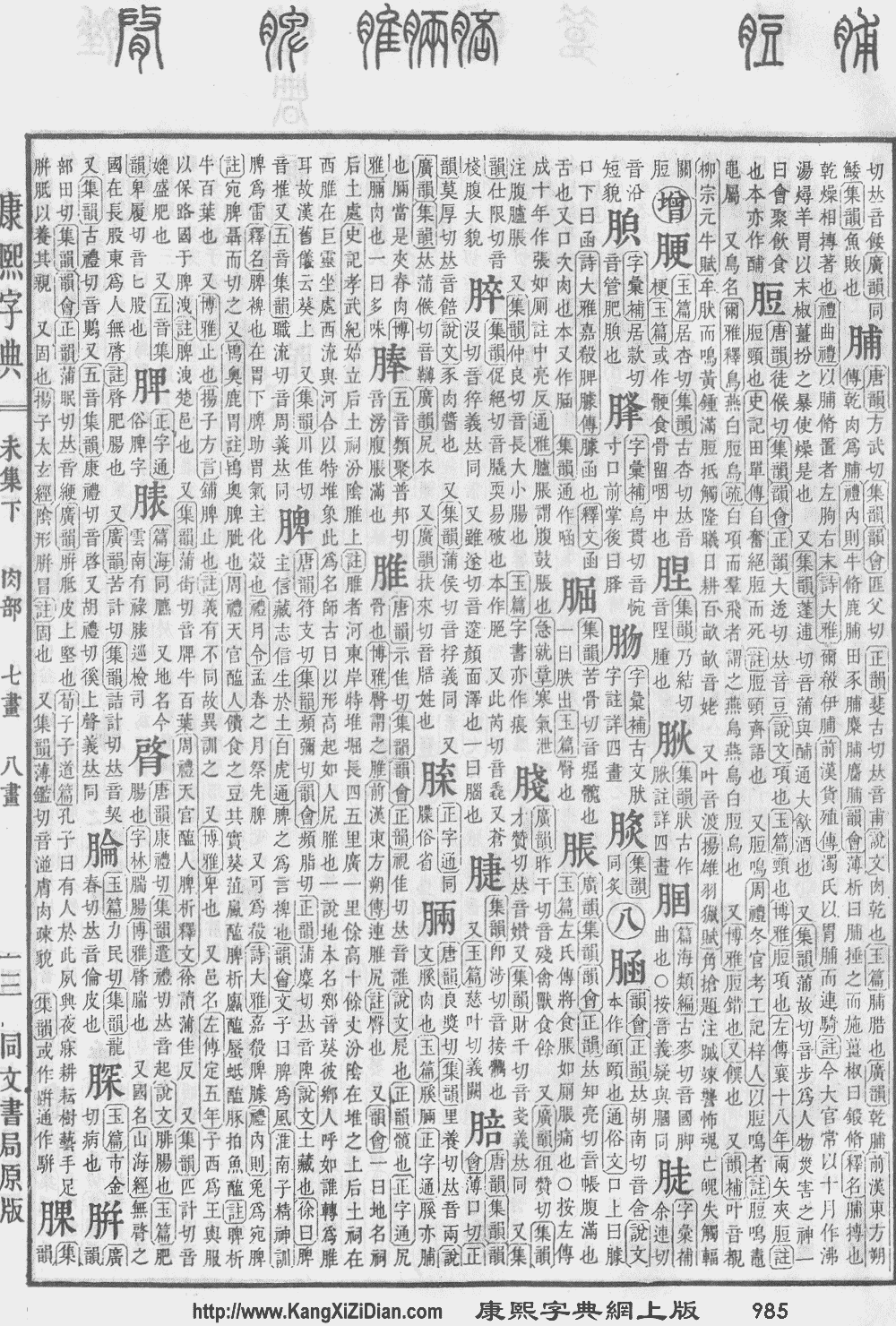
  • Kangxi Dictionary: page 985, character 14
  • Dai Kanwa Jiten: character 29570
  • Dae Jaweon: page 1438, character 10
  • Hanyu Da Zidian (first edition): volume 3, page 2083, character 4
  • Unihan data for U+8139

Chinese

trad. 脹
simp. 胀
2nd round simp. ⿰氵长

Glyph origin

Pronunciation


Note:
  • tiòng/tiàng - literary;
  • tiùⁿ/tiòⁿ - vernacular.
      • (Teochew)
        • Peng'im: ziang3 / dion3 / diên3
        • Pe̍h-ōe-jī-like: tsiàng / tiòⁿ / tièⁿ
        • Sinological IPA (key): /t͡siaŋ²¹³/, /tĩõ²¹³/, /tĩẽ²¹³/
    Note:
    • ziang3 - literary;
    • dion3/diên3 - vernacular (diên3 - Chaozhou).
      • Wu
        • (Shanghai):
          • Wugniu: 5tsan
          • MiniDict: tsan去
          • Wiktionary Romanisation (Shanghai): 2tsan
          • Sinological IPA (Shanghai): /t͡sã³⁴/

Rime
Character 脹
Reading # 1/1
Initial (聲) 知 (9)
Final (韻) 陽 (105)
Tone (調) Departing (H)
Openness (開合) Open
Division (等) III
Fanqie 知亮切
Baxter trjangH
Reconstructions
Zhengzhang
Shangfang
/ʈɨɐŋH/
Pan
Wuyun
/ʈiɐŋH/
Shao
Rongfen
/ȶiɑŋH/
Edwin
Pulleyblank
/ʈɨaŋH/
Li
Rong
/ȶiaŋH/
Wang
Li
/ȶĭaŋH/
Bernard
Karlgren
/ȶi̯aŋH/
Expected
Mandarin
Reflex
zhàng
Expected
Cantonese
Reflex
zoeng3
Zhengzhang system (2003)
Character 脹
Reading # 1/1
No. 1266
Phonetic
component
長
Rime
group
陽
Rime
subdivision
0
Corresponding
MC rime
帳
Old
Chinese
/*taŋs/
Notes 見素問

Definitions

脹

  1. to expand; to increase in size; to swell
  2. (medicine, of muscles, skin, etc.) to swell
  3. (medicine) to have edema; to have dropsy

Synonyms

Compounds

Japanese

Kanji

脹

(“Jinmeiyō” kanji used for names)

  1. swell, dilate, distend, bulge

Readings

Usage notes

Removed from the daily use Jōyō kanji by the Japanese government in 2010.[1]

References

  1. The Japan Times (2009 October 21) “Get set for next year's overhaul of joyo kanji”, in www.kanjiclinic.com‎, archived from the original on 20 November 2021

Korean

Etymology

From Middle Chinese 脹 (MC trjangH).

Historical readings

Pronunciation

  • (SK Standard/Seoul) IPA(key): [t͡ɕʰa̠(ː)ŋ]
  • Phonetic hangul: [창(ː)]
    • Though still prescribed in Standard Korean, most speakers in both Koreas no longer distinguish vowel length.

Hanja

Wikisource 脹 (eumhun 부을 창 (bueul chang))

  1. Hanja form? of 창 (“to expand; to swell”).

Compounds

References

  • 국제퇴계학회 대구경북지부 (國際退溪學會 大邱慶北支部) (2007). Digital Hanja Dictionary, 전자사전/電子字典.

Vietnamese

Han character

脹: Hán Nôm readings: trướng, chương, rướn, chướng

  1. This term needs a translation to English. Please help out and add a translation, then remove the text {{rfdef}}.
This article is issued from Wiktionary. The text is licensed under Creative Commons - Attribution - Sharealike. Additional terms may apply for the media files.