腋

腋 U+814B, 腋
CJK UNIFIED IDEOGRAPH-814B
← 腊
[U+814A]
CJK Unified Ideographs 腌 →
[U+814C]

Translingual

Han character

腋 (Kangxi radical 130, 肉+8, 12 strokes, cangjie input 月卜人大 (BYOK), four-corner 70247, composition ⿰月夜)

References

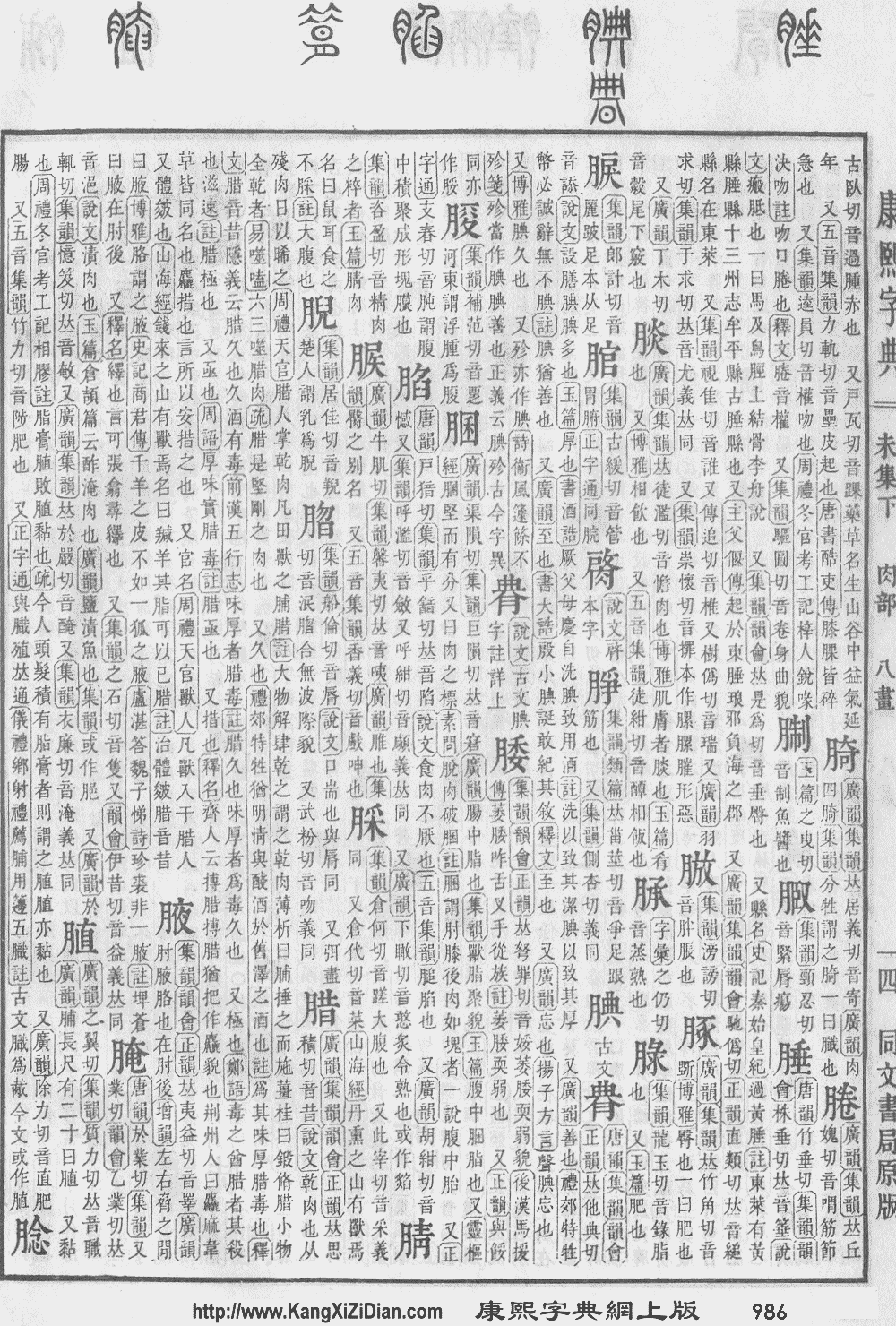
  • Kangxi Dictionary: page 986, character 28
  • Dai Kanwa Jiten: character 29615
  • Dae Jaweon: page 1439, character 7
  • Hanyu Da Zidian (first edition): volume 3, page 2090, character 5
  • Unihan data for U+814B

Chinese

trad. 腋
simp. # 腋
alternative forms 亦 ancient

Glyph origin

Phono-semantic compound (形聲/形声, OC *laːɡ) : semantic 肉 (“flesh”) + phonetic 夜 (OC *laːɡs).

Originally written 亦, see there for more.

Etymology

From Proto-Sino-Tibetan *lak ~ *C-jak (“arm; hand; wing”), either via *jak (STEDT; Schuessler, 2007) or *lak (Shi, 2000; Handel, 2009). Compare Mizo zak (“armpit”), Tibetan ལག་པ (lag pa, “arm; hand”), Burmese လက် (lak, “arm; hand”).

Pronunciation


Rime
Character 腋
Reading # 1/1
Initial (聲) 以 (36)
Final (韻) 昔 (123)
Tone (調) Checked (Ø)
Openness (開合) Open
Division (等) III
Fanqie 羊益切
Baxter yek
Reconstructions
Zhengzhang
Shangfang
/jiᴇk̚/
Pan
Wuyun
/jiɛk̚/
Shao
Rongfen
/iæk̚/
Edwin
Pulleyblank
/jiajk̚/
Li
Rong
/iɛk̚/
Wang
Li
/jĭɛk̚/
Bernard
Karlgren
/i̯ɛk̚/
Expected
Mandarin
Reflex
yì
Expected
Cantonese
Reflex
jik6
Baxter–Sagart system 1.1 (2014)
Character 腋
Reading # 1/1
Modern
Beijing
(Pinyin)
yè
Middle
Chinese
‹ yek ›
Old
Chinese
/*[ɢ](r)Ak/
English armpit

Notes for Old Chinese notations in the Baxter–Sagart system:

* Parentheses "()" indicate uncertain presence;
* Square brackets "[]" indicate uncertain identity, e.g. *[t] as coda may in fact be *-t or *-p;
* Angle brackets "<>" indicate infix;
* Hyphen "-" indicates morpheme boundary;

* Period "." indicates syllable boundary.
Zhengzhang system (2003)
Character 腋
Reading # 1/1
No. 15000
Phonetic
component
亦
Rime
group
鐸
Rime
subdivision
0
Corresponding
MC rime
繹
Old
Chinese
/*laːɡ/

Definitions

腋

  1. armpit; underarm; axilla
  2. (botany) axil
  3. † Alternative form of 掖 (“to help; to assist”)

Synonyms

Compounds

  • 一狐之腋
  • 一腋
  • 事生肘腋
  • 兩腋生風/两腋生风
  • 兩腋風生/两腋风生
  • 千狐腋
  • 山腋
  • 提腋
  • 狐腋
  • 禍生肘腋/祸生肘腋 (huòshēngzhǒuyè)
  • 縫腋/缝腋
  • 肘腋
  • 肘腋之患
  • 肘腋之憂/肘腋之忧
  • 胸腋
  • 腋下 (yèxià)
  • 腋毛 (yèmáo)
  • 腋氣/腋气
  • 腋窩/腋窝 (yèwō)
  • 腋翅
  • 腋臊
  • 腋臭 (yèchòu)
  • 腋芽
  • 葉腋/叶腋
  • 變生肘腋/变生肘腋 (biànshēngzhǒuyè)
  • 集腋
  • 集腋成裘 (jíyèchéngqiú)
  • 集腋為裘/集腋为裘
  • 雉頭狐腋/雉头狐腋

Japanese

Kanji

腋

(uncommon “Hyōgai” kanji)

  1. armpit, underarm, axilla

Readings

  • On (unclassified): えき (eki); せき (seki)
  • Kun: わき (waki, 腋)

Korean

Etymology

From Middle Chinese 腋 (MC yek). Recorded as Middle Korean ᄋᆡᆨ〮 (óyk) (Yale: óyk) in Hunmong Jahoe (訓蒙字會 / 훈몽자회), 1527.

Pronunciation

Hanja

Wikisource 腋 (eumhun 겨드랑이 액 (gyeodeurang'i aek))

  1. Hanja form? of 액 (“armpit”).

Compounds

References

  • 국제퇴계학회 대구경북지부 (國際退溪學會 大邱慶北支部) (2007). Digital Hanja Dictionary, 전자사전/電子字典.

Vietnamese

Han character

腋: Hán Nôm readings: dạ; dịch; nách; nịch

  1. Nôm form of nách (“armpit”).
This article is issued from Wiktionary. The text is licensed under Creative Commons - Attribution - Sharealike. Additional terms may apply for the media files.