益
| ||||||||
 | ||||||||
| ||||||||
Translingual
Alternative forms
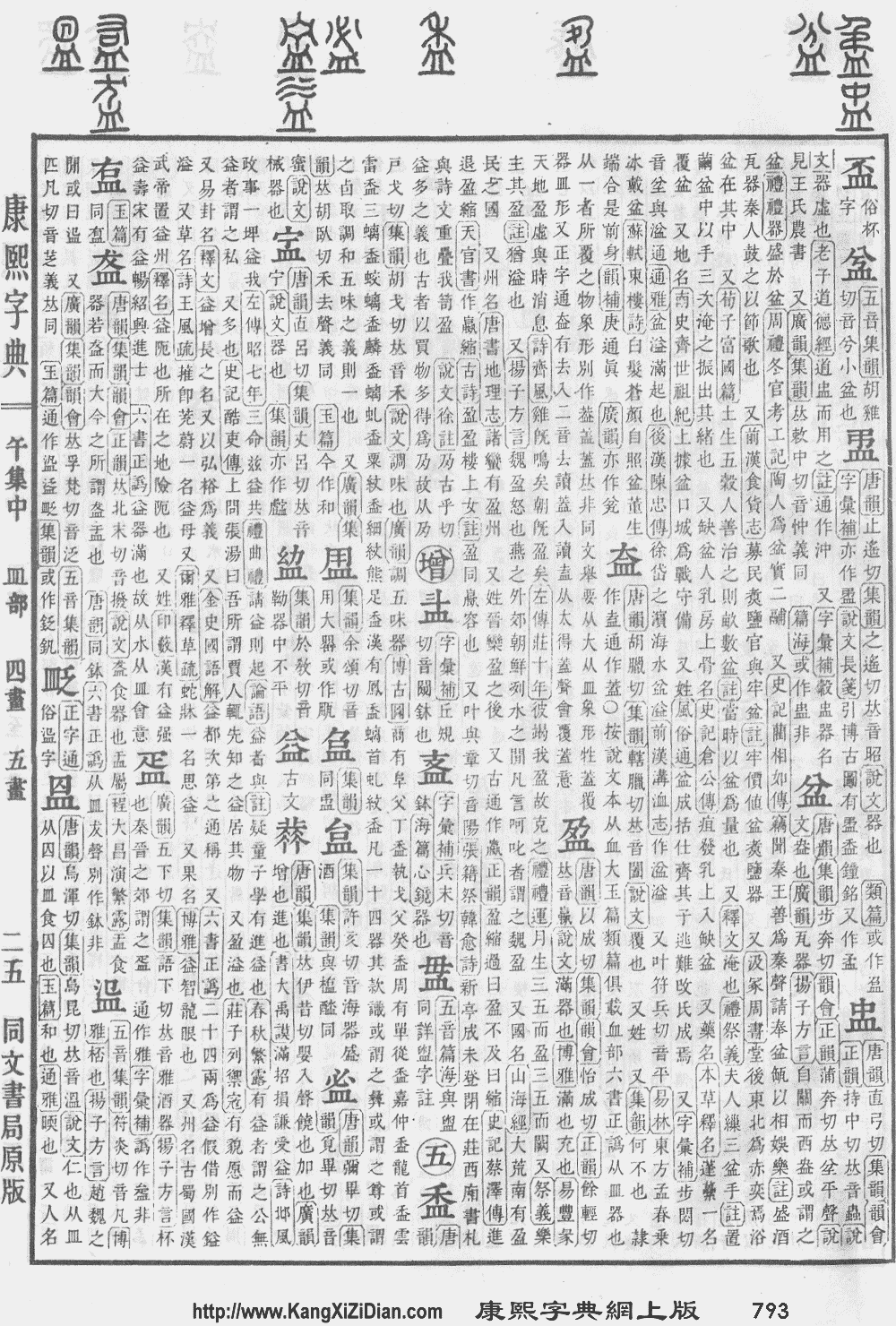
- In Korean hanja, the upper component of the character is written 八 instead of 丷, which is also the historical form found in the Kangxi dictionary.
- A CJK compatibility ideograph exists at
U+FA17for the historical form found in the Kangxi dictionary which contains 八 as its upper component. - A CJK compatibility ideograph exists at
U+FAA6for the alternative hanja used in North Korea which contains 丷 as its upper component.
Han character
益 (Kangxi radical 108, 皿+5, 10 strokes, cangjie input 廿金月廿 (TCBT), four-corner 80107, composition ⿳䒑八皿(GHTJV or U+FAA6) or ⿱⿳八一八皿(K or U+FA17))
Derived characters
References
- Kangxi Dictionary: page 793, character 18
- Dai Kanwa Jiten: character 22972
- Dae Jaweon: page 1208, character 18
- Hanyu Da Zidian (first edition): volume 4, page 2560, character 6
- Unihan data for U+76CA
- Unihan data for U+FA17
- Unihan data for U+FAA6
Chinese
| simp. and trad. |
益 | |
|---|---|---|
| alternative forms | 𠍳 ancient form | |
Glyph origin
| Historical forms of the character 益 | |
|---|---|
| Shang | Western Zhou |
| Oracle bone script | Bronze inscriptions |
 |
 |
Characters in the same phonetic series (益) (Zhengzhang, 2003)
Ideogrammic compound (會意/会意) : 水 (“water”) + 皿 (“vessel”). Original form of 溢 (OC *liɡ, “to overflow”). Upper component resembles 氺 (“water”) in a horizontal form.
Compare 易.
Etymology
Bodman (1980) relates it to Tibetan སྐྱེད (skyed, “growth; increase; profit; to generate”), སྐྱེ (skye, “to be born”).
Pronunciation
Definitions
益
- (obsolete) Original form of 溢 (yì, “to overflow”).
- (literary) affluent; well-off
- to increase; to add; to cause gain
- 為學日益,為道日損。 [Classical Chinese, trad.]
- From: Tao Te Ching, 4th century BCE, translated based on James Legge's version
- Wéixué rì yì, wéidào rì sǔn. [Pinyin]
- He who devotes himself to learning seeks from day to day to increase; he who devotes himself to the Dao seeks from day to day to diminish.
为学日益,为道日损。 [Classical Chinese, simp.]
- profit; benefit; gain
- (literary) more; further; even more
- 日益 ― rìyì ― day by day; increasingly
- 42nd hexagram of the I Ching
- (Cantonese) to benefit; to advantage
Synonyms
- (more):
Compounds
- 一謙四益/一谦四益
- 三益
- 不無小益/不无小益
- 伯益
- 便益
- 保險利益/保险利益
- 兌換利益/兑换利益
- 公益 (gōngyì)
- 公益事業/公益事业 (gōngyì shìyè)
- 公益廣告/公益广告 (gōngyì guǎnggào)
- 公益捐
- 公益軟體/公益软体
- 公益金 (gōngyìjīn)
- 公賣利益/公卖利益
- 共益權/共益权
- 冇益
- 利益 (lìyì)
- 利益團體/利益团体 (lìyì tuántǐ)
- 利益均霑/利益均沾
- 利益輸送/利益输送
- 助益 (zhùyì)
- 受益 (shòuyì)
- 受益人 (shòuyìrén)
- 受益憑證/受益凭证
- 受益無窮/受益无穷
- 受益費/受益费
- 同益 (Tóngyì)
- 增益 (zēngyì)
- 多多益善 (duōduōyìshàn)
- 多多益辦/多多益办
- 大有助益
- 延年益壽/延年益寿 (yánniányìshòu)
- 徒勞無益/徒劳无益
- 徒費無益/徒费无益
- 得益 (déyì)
- 損上益下/损上益下
- 損人益己/损人益己
- 損益/损益 (sǔnyì)
- 收益 (shōuyì)
- 收益稅/收益税
- 效益 (xiàoyì)
- 教益 (jiàoyì)
- 文益
- 斟酌損益/斟酌损益
- 新益 (Xīnyì)
- 既得利益 (jìdé lìyì)
- 日增月益
- 日滋月益
- 日益 (rìyì)
- 日益壯大/日益壮大
- 日益月滋
- 曾益 (zēngyì)
- 有損無益/有损无益
- 有益 (yǒuyì)
- 本益比
- 李益
- 業主權益/业主权益
- 權益/权益 (quányì)
- 欲益反損/欲益反损
- 毗益
- 求益反損/求益反损
- 治絲益棼/治丝益棼
- 潤益/润益
- 無益/无益 (wúyì)
- 營業利益/营业利益
- 獨享權益/独享权益
- 獲益/获益 (huòyì)
- 獲益不淺/获益不浅
- 獲益匪淺/获益匪浅 (huòyìfěiqiǎn)
- 獲益良多/获益良多 (huòyìliángduō)
- 益上損下/益上损下
- 益友 (yìyǒu)
- 益古演段
- 益壽/益寿 (yìshòu)
- 益壽延年/益寿延年 (yìshòuyánnián)
- 益州 (Yìzhōu)
- 益智 (yìzhì)
- 益智圖/益智图
- 益智班
- 益格
- 益母草 (yìmǔcǎo)
- 益氣/益气 (yìqì)
- 益氣生津/益气生津
- 益無忌憚/益无忌惮
- 益發/益发 (yìfā)
- 益者三友
- 益者三樂/益者三乐
- 益處/益处 (yìchù)
- 益蟲/益虫 (yìchóng)
- 益謙虧盈/益谦亏盈
- 益鳥/益鸟 (yìniǎo)
- 相得益彰 (xiāngdéyìzhāng)
- 私益
- 窮且益堅/穷且益坚
- 窮當益堅/穷当益坚
- 精益求精 (jīngyìqiújīng)
- 純益/纯益
- 老當益壯/老当益壮 (lǎodāngyìzhuàng)
- 股東權益/股东权益
- 能源效益
- 自益權/自益权
- 良師益友/良师益友 (liángshīyìyǒu)
- 良朋益友
- 裒多益寡
- 補益/补益 (bǔyì)
- 裨益 (bìyì)
- 請益/请益
- 謙受益/谦受益
- 買菜求益/买菜求益
- 進益/进益 (jìnyì)
- 邊際利益/边际利益
- 錢謙益/钱谦益
- 開卷有益/开卷有益 (kāijuànyǒuyì)
- 附益 (fùyì)
- 集思廣益/集思广益 (jísīguǎngyì)
- 饒益/饶益
- 黈益
References
- “益”, in 漢語多功能字庫 (Multi-function Chinese Character Database), 香港中文大學 (the Chinese University of Hong Kong), 2014–
Japanese
| Shinjitai | 益 | |
| Kyūjitai [1] |
益 益or 益+ ︀? |
|
| 益󠄁 益+ 󠄁?(Adobe-Japan1) | ||
| 益󠄃 益+ 󠄃?(Hanyo-Denshi) (Moji_Joho) | ||
| The displayed kanji may be different from the image due to your environment. See here for details. | ||
Readings
Etymology 1
| Kanji in this term |
|---|
| 益 |
| えき Grade: 5 |
| kan’on |
From Middle Chinese 益 (MC 'jiek, “increase”). The kan'on reading, so likely a later borrowing.
Pronunciation
Derived terms
Etymology 2
| Kanji in this term |
|---|
| 益 |
| やく Grade: 5 |
| goon |
From Middle Chinese 益 (MC 'jiek, “increase”). The goon reading, so likely the initial borrowing.
Etymology 3
| Kanji in this term |
|---|
| 益 |
| ますます Grade: 5 |
| kun’yomi |
| For pronunciation and definitions of 益 – see the following entry. | ||
| ||
| (This term, 益, is an alternative spelling of the above term.) |
References
- “益”, in 漢字ぺディア (Kanjipedia) (in Japanese), 日本漢字能力検定協会, 2015–2024
- Matsumura, Akira, editor (2006), 大辞林 [Daijirin] (in Japanese), Third edition, Tōkyō: Sanseidō, →ISBN
- NHK Broadcasting Culture Research Institute, editor (1998), NHK日本語発音アクセント辞典 [NHK Japanese Pronunciation Accent Dictionary] (in Japanese), Tōkyō: NHK Publishing, →ISBN
Korean
Vietnamese
Han character
益: Hán Việt readings: ích (
益: Nôm readings: ích[1][2][4][6], ịch[3][5]
References
- Nguyễn (2014).
- Nguyễn et al. (2009).
- Trần (2004).
- Bonet (1899).
- Génibrel (1898).
- Taberd & Pigneau de Béhaine (1838).
This article is issued from Wiktionary. The text is licensed under Creative Commons - Attribution - Sharealike. Additional terms may apply for the media files.