趾

趾 U+8DBE, 趾
CJK UNIFIED IDEOGRAPH-8DBE
← 趽
[U+8DBD]
CJK Unified Ideographs 趿 →
[U+8DBF]

Translingual

Han character

趾 (Kangxi radical 157, 足+4, 11 strokes, cangjie input 口一卜中一 (RMYLM), four-corner 61110, composition ⿰𧾷止)

  1. toe
  2. tracks, footprints

References

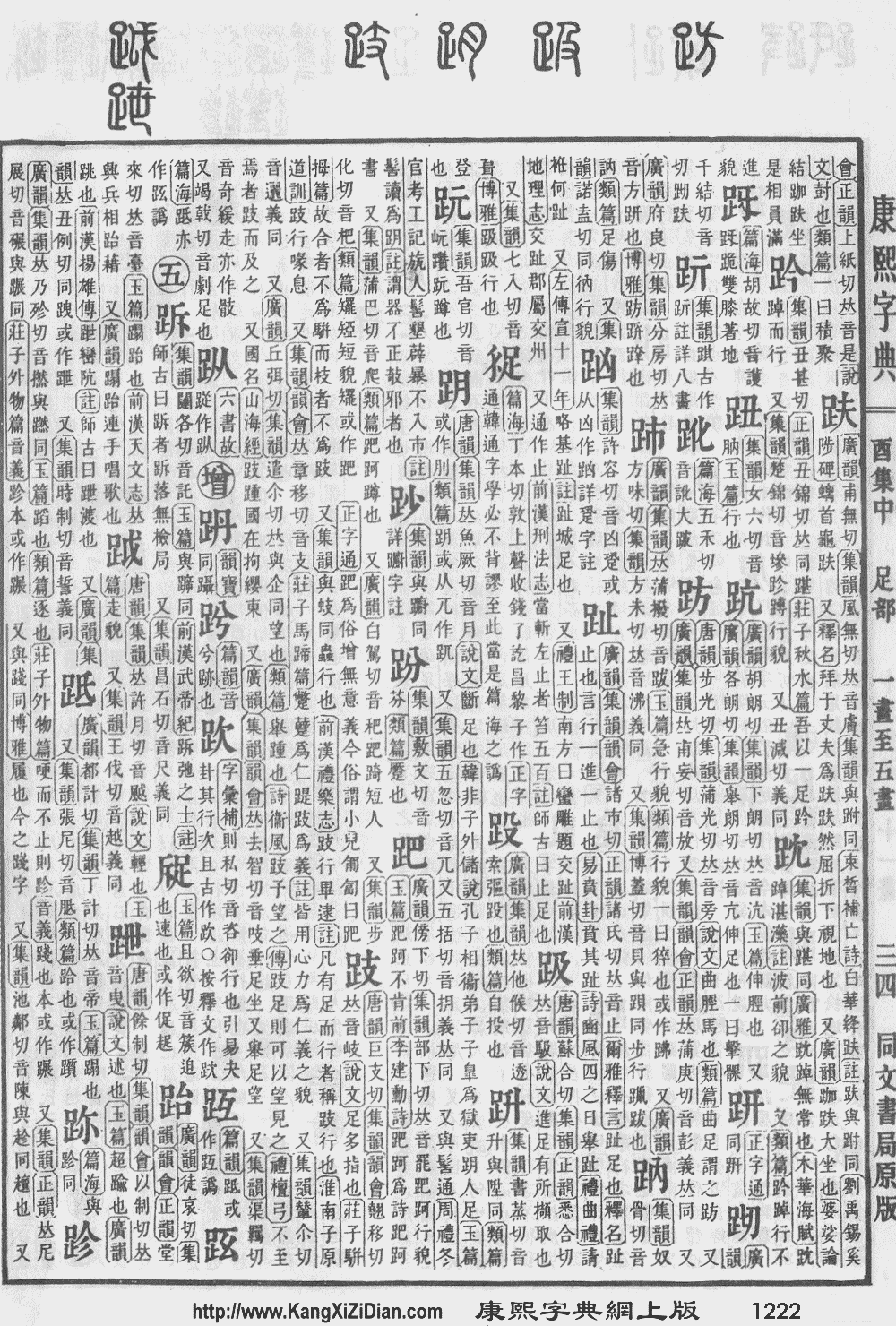
  • Kangxi Dictionary: page 1222, character 15
  • Dai Kanwa Jiten: character 37406
  • Dae Jaweon: page 1693, character 37
  • Hanyu Da Zidian (first edition): volume 6, page 3691, character 1
  • Unihan data for U+8DBE

Chinese

simp. and trad.
趾

Glyph origin

Phono-semantic compound (形聲/形声, OC *kjɯʔ) : semantic 足 (“foot”) + phonetic 止 (OC *kjɯʔ)

Pronunciation


Rime
Character 趾
Reading # 1/1
Initial (聲) 章 (23)
Final (韻) 之 (19)
Tone (調) Rising (X)
Openness (開合) Open
Division (等) III
Fanqie 諸市切
Baxter tsyiX
Reconstructions
Zhengzhang
Shangfang
/t͡ɕɨX/
Pan
Wuyun
/t͡ɕɨX/
Shao
Rongfen
/t͡ɕieX/
Edwin
Pulleyblank
/cɨX/
Li
Rong
/t͡ɕiəX/
Wang
Li
/t͡ɕĭəX/
Bernard
Karlgren
/t͡ɕiX/
Expected
Mandarin
Reflex
zhǐ
Expected
Cantonese
Reflex
zi2
Baxter–Sagart system 1.1 (2014)
Character 趾
Reading # 1/1
Modern
Beijing
(Pinyin)
zhǐ
Middle
Chinese
‹ tsyiX ›
Old
Chinese
/*təʔ/
English foot, heel, toe

Notes for Old Chinese notations in the Baxter–Sagart system:

* Parentheses "()" indicate uncertain presence;
* Square brackets "[]" indicate uncertain identity, e.g. *[t] as coda may in fact be *-t or *-p;
* Angle brackets "<>" indicate infix;
* Hyphen "-" indicates morpheme boundary;

* Period "." indicates syllable boundary.
Zhengzhang system (2003)
Character 趾
Reading # 1/1
No. 17298
Phonetic
component
止
Rime
group
之
Rime
subdivision
0
Corresponding
MC rime
止
Old
Chinese
/*kjɯʔ/
Notes 趾轉註字

Definitions

趾

  1. (anatomy) toe; foot
  2. track; footprint

Compounds

Japanese

Kanji

趾

(uncommon “Hyōgai” kanji)

  1. toe

Readings

Etymology

Kanji in this term
趾
あしゆび
Hyōgaiji
kun’yomi

Noun

趾(あしゆび) • (ashiyubi) 

  1. (anatomy) toe

Alternative forms

Korean

Hanja

趾 • (ji) (hangeul 지, revised ji, McCune–Reischauer chi, Yale ci)

  1. This term needs a translation to English. Please help out and add a translation, then remove the text {{rfdef}}.

Vietnamese

Han character

趾: Hán Nôm readings: chỉ, nhảy

  1. This term needs a translation to English. Please help out and add a translation, then remove the text {{rfdef}}.
This article is issued from Wiktionary. The text is licensed under Creative Commons - Attribution - Sharealike. Additional terms may apply for the media files.