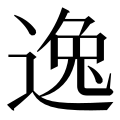
逸
| ||||||||
 | ||||||||
 | ||||||||
Translingual
| Japanese | 逸 |
|---|---|
| Simplified | 逸 |
| Traditional | 逸 |
Alternative forms
In Japanese shinjitai, the upper right component of 逸 is written 免 (without dot, simplified from 兔). In Chinese scripts, the upper right component of 逸 is written 兔 (extra dot above 儿). However, both Japanese and Chinese forms have the same number of strokes. Note that in Japanese, the 免 component is written ⺈+𫩏+儿. In Chinese, the middle part of 兔 is written 口 overlapped by ㇓ (one stroke instead of two). Due to Han unification, both characters are encoded under the same codepoint. A compatibility ideograph 逸(U+FA67) exists to reflect the original form (kyūjitai) of 逸.
Han character
逸 (Kangxi radical 162, 辵+8, 12 strokes in traditional Chinese and Korean, 11 strokes in mainland China and Japanese, cangjie input 卜弓山戈 (YNUI), four-corner 37301, composition ⿺辶兔(GHTKV) or ⿺辶免(J))
Derived characters
- 𣾹, 𮉅, 𥳿
References
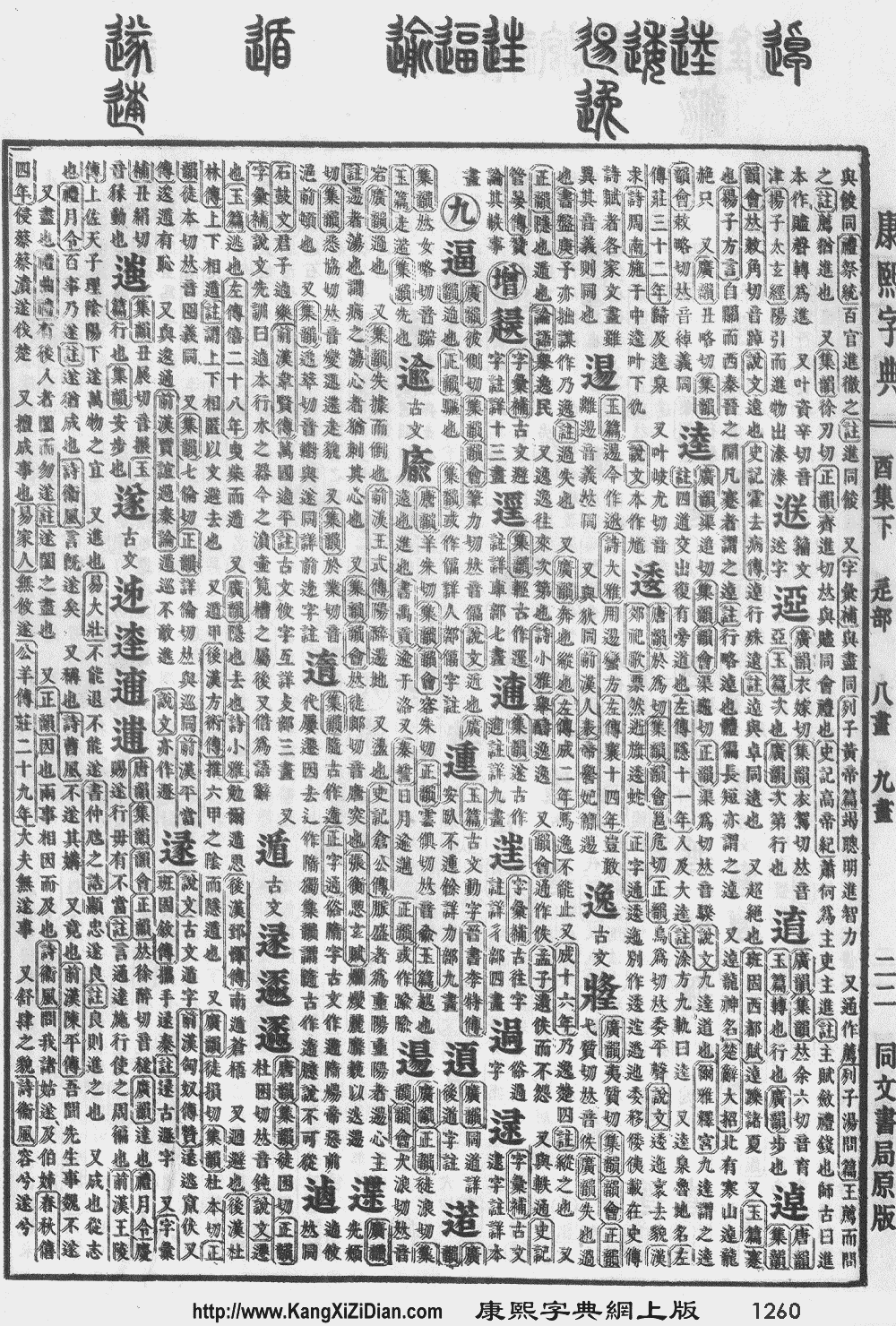
- Kangxi Dictionary: page 1260, character 8
- Dai Kanwa Jiten: character 38951
- Dae Jaweon: page 1750, character 4
- Hanyu Da Zidian (first edition): volume 6, page 3853, character 1
- Unihan data for U+9038
- Unihan data for U+FA25
- Unihan data for U+FA67
Chinese
| trad. | 逸 | |
|---|---|---|
| simp. # | 逸 | |
| alternative forms | ||
Glyph origin
Oracle bone script, Ideogrammic compound (會意/会意) : 止 + 㚔. Later, Ideogrammic compound (會意/会意) : 辵 + 兔.
Pronunciation
Definitions
逸
Compounds
- 一勞久逸/一劳久逸
- 一勞永逸/一劳永逸 (yīláoyǒngyì)
- 不放逸
- 以逸待勞/以逸待劳 (yǐyìdàiláo)
- 以逸擊勞/以逸击劳
- 俊逸 (jùnyì)
- 傲逸
- 勞逸不均/劳逸不均
- 奔逸
- 奔逸絕塵/奔逸绝尘
- 奮逸響/奋逸响
- 好逸惡勞/好逸恶劳 (hàoyìwùláo)
- 嬌逸/娇逸 (jiāoyì)
- 安逸 (ānyì)
- 恬逸 (tiányì)
- 愉逸
- 散逸
- 暇逸
- 暫勞永逸/暂劳永逸
- 曠世逸才/旷世逸才 (kuàngshìyìcái)
- 有勞有逸/有劳有逸
- 橫逸/横逸
- 永逸
- 沉湎淫逸
- 沉雄古逸
- 清新俊逸
- 清麗俊逸/清丽俊逸
- 瑰逸
- 用逸待勞/用逸待劳
- 疾逸
- 盤逸/盘逸
- 秀逸 (xiùyì)
- 竹溪六逸
- 縱逸/纵逸
- 豪奢放逸
- 豪情逸致
- 貪安好逸/贪安好逸
- 超然自逸
- 超逸 (chāoyì)
- 超逸絕塵/超逸绝尘
- 逃逸 (táoyì)
- 逸世超群
- 逸事 (yìshì)
- 逸以待勞/逸以待劳
- 逸口
- 逸周書/逸周书 (Yì Zhōu Shū)
- 逸品 (yìpǐn)
- 逸塵斷鞅/逸尘断鞅
- 逸居
- 逸度
- 逸想
- 逸態橫生/逸态横生
- 逸才 (yìcái)
- 逸文軼事/逸文轶事
- 逸景華庭/逸景华庭 (Yìjǐnghuátíng)
- 逸暇
- 逸書/逸书 (yìshū)
- 逸材 (yìcái)
- 逸樂/逸乐
- 逸欲
- 逸步 (yìbù)
- 逸民 (yìmín)
- 逸氣/逸气
- 逸游自恣
- 逸禮/逸礼
- 逸經/逸经
- 逸群
- 逸群之才
- 逸群絕俗/逸群绝俗
- 逸群絕倫/逸群绝伦
- 逸翮
- 逸聞/逸闻 (yìwén)
- 逸聲/逸声
- 逸興/逸兴
- 逸詩/逸诗
- 逸豫 (yìyù)
- 逸趣橫生/逸趣横生
- 逸足
- 逸逸
- 逸雅
- 遒逸
- 閒情逸致/闲情逸致 (xiánqíngyìzhì)
- 閒情逸趣/闲情逸趣
- 閒逸/闲逸
- 隱逸/隐逸 (yǐnyì)
- 飄逸/飘逸 (piāoyì)
- 馨逸
- 駿逸/骏逸
- 驕奢淫逸/骄奢淫逸 (jiāoshēyínyì)
- 高人逸士
- 高情逸態/高情逸态
- 高情逸興/高情逸兴
- 高逸
- 龍蟠鳳逸/龙蟠凤逸
Japanese
| Shinjitai | 逸 |  |
| Kyūjitai [1][2][3] |
逸 逸or 逸+ ︁? |
|
| 逸󠄁 逸+ 󠄁?(Adobe-Japan1) | ||
| 逸󠄇 逸+ 󠄇?(Hanyo-Denshi) (Moji_Joho) | ||
| The displayed kanji may be different from the image due to your environment. See here for details. | ||
Readings
- Go-on: いち (ichi)←いち (iti, historical)
- Kan-on: いつ (itsu, Jōyō)←いつ (itu, historical)
- Kun: うしなう (ushinau, 逸う)←うしなふ (usinafu, 逸ふ, historical); そらす (sorasu, 逸らす); それる (soreru, 逸れる); のがれる (nogareru, 逸れる); はぐれる (hagureru, 逸れる); はしる (hashiru, 逸る); はやり (hayari, 逸り); はやる (hayaru, 逸る)
- Nanori: すぐる (suguru); とし (toshi); はつ (hatsu); はや (haya); はやし (hayashi); まさ (masa); やす (yasu)
Etymology 1
| Kanji in this term |
|---|
| 逸 |
| いち Grade: S (ateji) |
| goon |
| Alternative spelling |
|---|
| 逸 (kyūjitai) |
/iti/ → /it͡ɕi/
Cognate with adverbs 甚 (ita, ito, “very, exceedingly”).[4][5]
The use of this kanji is an example of phonetic ateji (当て字),[5] possibly by extension of the "great, superb, outstanding" senses.
Pronunciation
- IPA(key): [it͡ɕi]
Derived terms
- 著しい (ichijirushii)
- 逸早 (ichihaya)
- 逸早い (ichihayai)
- 逸物 (ichibutsu), 逸物 (ichimotsu)
Etymology 2
| Kanji in this term |
|---|
| 逸 |
| いつ Grade: S |
| kan’on |
| Alternative spelling |
|---|
| 逸 (kyūjitai) |
From Middle Chinese 逸 (MC yit).
The kan'on pronunciation, so likely a later borrowing.
Pronunciation
- IPA(key): [it͡sɨᵝ]
Affix
逸 • (itsu)
- escape, flee, break loose
- leisure, ease
- lost, not known in the world
- excellent, outstanding
Derived terms
- 逸する (issuru)
- 逸異 (itsui)
- 逸偉 (itsui)
- 逸韻 (itsuin)
- 逸格 (ikkaku)
- 逸軌 (ikki)
- 逸気 (ikki)
- 逸驥 (ikki)
- 逸議 (itsugi)
- 逸去 (ikkyo)
- 逸居 (ikkyo)
- 逸興 (ikkyō)
- 逸響 (ikkyō)
- 逸群 (itsugun)
- 逸言 (itsugen)
- 逸才 (itsusai)
- 逸材 (itsuzai)
- 逸散 (issan)
- 逸事 (itsuji)
- 逸士 (isshi)
- 逸思 (isshi)
- 逸史 (isshi)
- 逸志 (isshi)
- 逸詩 (isshi)
- 逸出 (isshutsu)
- 逸書 (issho)
- 逸情 (itsujō)
- 逸走 (issō)
- 逸足 (issoku)
- 逸態 (ittai)
- 逸脱 (itsudatsu)
- 逸致 (itchi)
- 逸宕 (ittō)
- 逸蕩 (ittō)
- 逸徳 (ittoku)
- 逸美 (itsubi)
- 逸品 (ippin)
- 逸物 (itsubutsu)
- 逸文 (itsubun)
- 逸聞 (itsubun)
- 逸味 (itsumi)
- 逸民 (itsumin)
- 逸遊, 逸游 (itsuyū)
- 逸予 (itsuyo)
- 逸楽 (itsuraku)
- 逸労 (itsurō)
- 逸話 (itsuwa)
- 安逸 (an'itsu) (安佚)
- 遺逸 (ītsu)
- 怡逸 (ītsu)
- 淫逸 (in'itsu)
- 隠逸 (in'itsu)
- 横逸 (ōitsu)
- 暇逸 (kaitsu)
- 間逸 (kan'itsu)
- 久逸 (kyūitsu)
- 驕逸 (kyōitsu)
- 馨逸 (keītsu)
- 古逸 (koitsu)
- 高逸 (kōitsu)
- 後逸 (kōitsu)
- 散逸 (san'itsu)
- 自逸 (jītsu)
- 秀逸 (shūitsu)
- 遒逸 (shūitsu)
- 俊逸 (shun'itsu)
- 駿逸 (shun'itsu)
- 縦逸 (shōitsu)
- 清逸 (seītsu)
- 潜逸 (sen'itsu)
- 贍逸 (sen'itsu)
- 卓逸 (takuitsu)
- 超逸 (chōitsu)
- 恬逸 (ten'itsu)
- 蕩逸 (tōitsu)
- 任逸 (nin'itsu)
- 般逸 (han'itsu)
- 飄逸 (hyōitsu)
- 風逸 (fūitsu)
- 奮逸 (fun'itsu)
- 逋逸 (hoitsu)
- 放逸 (hōitsu)
- 亡逸 (bōitsu)
- 奔逸 (hon'itsu)
- 無逸 (muitsu)
- 愉逸 (yuitsu)
- 楽逸 (rakuitsu)
- 麗逸 (reītsu)
- 老逸 (rōitsu)
- 労逸 (rōitsu)
References
- “逸”, in 漢字ぺディア (Kanjipedia) (in Japanese), 日本漢字能力検定協会, 2015–2024
- 白川静 (Shirakawa Shizuka) (2014) “逸”, in 字通 (Jitsū) (in Japanese), popular edition, Tōkyō: Heibonsha, →ISBN
- Shōundō Henshūjo, editor (1927), 新漢和辞典 [The New Kanji-Japanese Dictionary] (in Japanese), Ōsaka: Shōundō, , page 1218 (paper), page 622 (digital)
- Matsumura, Akira (1995) 大辞泉 [Daijisen] (in Japanese), First edition, Tōkyō: Shogakukan, →ISBN
- Matsumura, Akira, editor (2006), 大辞林 [Daijirin] (in Japanese), Third edition, Tōkyō: Sanseidō, →ISBN
Korean
Hanja
逸 (eum 일 (il))
- This term needs a translation to English. Please help out and add a translation, then remove the text
{{rfdef}}.