免
| ||||||||
 | ||||||||
| ||||||||
| ||||||||
Translingual
| Stroke order | |||
|---|---|---|---|
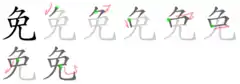 | |||
| Japanese | 免 |
|---|---|
| Simplified | 免 |
| Traditional | 免 |
Alternative forms
A variant form with 刀 rather than ⺈ on top exists.
There is another variant, in which the left-handed stroke ㇓ is written as two separate components. This variant is adopted by Japanese shinjitai.
Han character
免 (Kangxi radical 10, 儿+5 in Chinese, 儿+6 in Japanese, 7 strokes in Chinese, 8 strokes in Japanese, cangjie input 弓日竹山 (NAHU), four-corner 27416, composition ⿱⺈⿸⿻口丿乚(GHTK) or ⿳⺈𫩏儿(JV) or ⿱刀⿸⿻口丿乚(U+FA32))
Derived characters
References
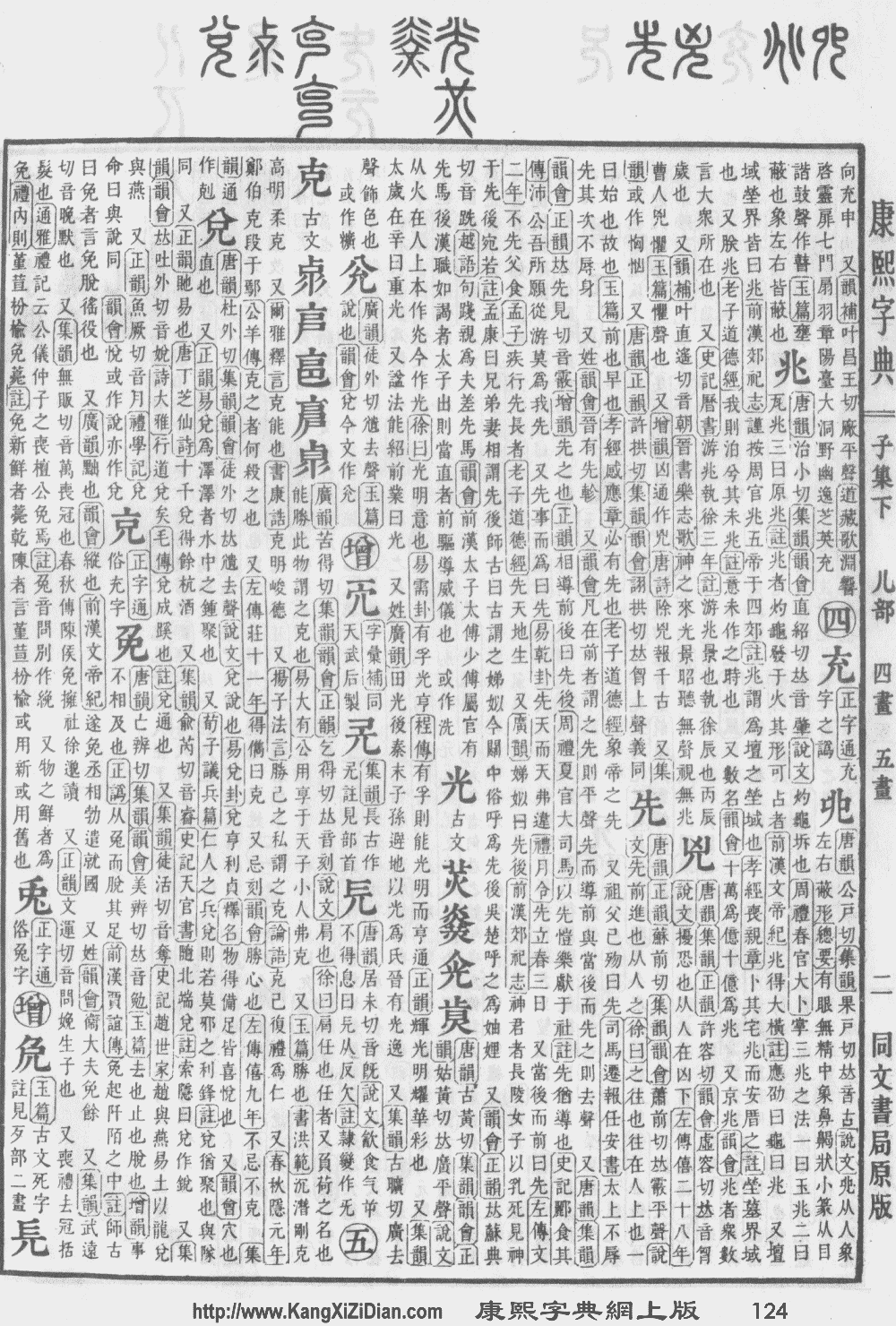
- Kangxi Dictionary: page 124, character 23
- Dai Kanwa Jiten: character 1358
- Dae Jaweon: page 264, character 3
- Hanyu Da Zidian (first edition): volume 1, page 270, character 9
- Unihan data for U+514D
- Unihan data for U+FA32
- Unihan data for U+2F80E
Chinese
| simp. and trad. |
免 | |
|---|---|---|
Glyph origin
| Historical forms of the character 免 | ||||||||||||||
|---|---|---|---|---|---|---|---|---|---|---|---|---|---|---|
| Shang | Western Zhou | Warring States | ||||||||||||
| Bronze inscriptions | Oracle bone script | Bronze inscriptions | Chu slip and silk script | |||||||||||
 |
 |
 |
 | |||||||||||
|||
|
References: Mostly from Richard Sears' Chinese Etymology site (authorisation),
| ||||||||||||||


Pictogram (象形) – a man in a hat. Borrowed for abstract meanings. The derivative 冕 (OC *mronʔ) refers to the original word.
Pronunciation 1
Definitions
免
- to take off; to remove from the body
- to avoid; to escape; to evade
- 同官之人,知而訐之上者,自免於罪。 [Classical Chinese, trad.]
- From: The Book of Lord Shang, circa 3rd century BCE, translated based on J.J.L. Duyvendak's version
- Tóng guān zhī rén, zhī ér jié zhī shàng zhě, zì miǎn yú zuì. [Pinyin]
- Colleagues who, knowing their offence, inform their superiors will themselves escape punishment.
同官之人,知而讦之上者,自免于罪。 [Classical Chinese, simp.]
- to release; to set free
- to excuse from; to exempt
- to discharge; to waive; to forgive
- to remove; to dismiss (from office)
- to be not allowed; to be forbidden to
- (Southern Min) it is not necessary; there is no need
- (obsolete) Alternative form of 娩
Synonyms
- (to remove):
- 免除 (miǎnchú)
- 刷 (colloquial)
- 削 (literary, or in compounds)
- 削除 (xuēchú)
- 去掉 (qùdiào)
- 去除 (qùchú)
- 報銷/报销 (bàoxiāo) (figurative, humorous)
- 屏除 (bǐngchú)
- 廓清 (kuòqīng)
- 打掉 (dǎdiào)
- 掃/扫
- 排解 (páijiě)
- 掃除/扫除 (sǎochú) (figurative)
- 排除 (páichú)
- 摒除 (bìngchú)
- 撤 (chè)
- 撤除 (chèchú)
- 消 (xiāo)
- 消弭 (xiāomǐ) (literary)
- 消解 (xiāojiě)
- 消釋/消释 (xiāoshì) (figurative)
- 消除 (xiāochú)
- 淘汰 (táotài)
- 清洗 (qīngxǐ) (figurative)
- 清除 (qīngchú)
- 破 (pò) (literary, or in compounds)
- 破壞/破坏 (pòhuài)
- 破除 (pòchú)
- 祛除 (qūchú)
- 罷/罢
- 翦落 (jiǎnluò) (literary)
- 肅清/肃清 (sùqīng)
- 蕩/荡 (dàng) (literary, or in compounds)
- 解釋/解释 (jiěshì) (archaic)
- 解除 (jiěchú)
- 鋤/锄 (chú)
- 鏟除/铲除 (chǎnchú)
- 除
- 除去 (chúqù)
- 除忒 (Hakka)
- 除掉 (chúdiào)
- 除開/除开 (chúkāi)
- 革除 (géchú)
- 驅散/驱散 (qūsàn)
- 驅走/驱走 (qūzǒu)
- 驅除/驱除 (qūchú)
Compounds
- 不免 (bùmiǎn)
- 不能自免
- 乞免
- 以免 (yǐmiǎn)
- 倖免/幸免 (xìngmiǎn)
- 俱免
- 僅以身免/仅以身免
- 免丁
- 免不了 (miǎnbùliǎo)
- 免不得
- 免乳
- 免俗
- 免冠 (miǎnguān)
- 免冠解印
- 免刑
- 免卻/免却
- 免參/免参
- 免喪/免丧
- 免官 (miǎnguān)
- 免客氣/免客气 (bián kheh-khì)
- 免帖
- 免席 (miǎnxí)
- 免役 (miǎnyì)
- 免得 (miǎnde)
- 免戰牌/免战牌
- 免洗餐具
- 免疫 (miǎnyì)
- 免疫作用
- 免疫力 (miǎnyìlì)
- 免疫系統/免疫系统 (miǎnyì xìtǒng)
- 免疫血清 (miǎnyì xuèqīng)
- 免票 (miǎnpiào)
- 免禮/免礼
- 免稅/免税 (miǎnshuì)
- 免稅口岸/免税口岸
- 免稅品/免税品
- 免稅商店/免税商店
- 免稅額/免税额
- 免簽/免签 (miǎnqiān)
- 免罪 (miǎnzuì)
- 免職/免职 (miǎnzhí)
- 免苦錢/免苦钱
- 免訴/免诉
- 免試/免试 (miǎnshì)
- 免試升學/免试升学
- 免談/免谈 (miǎntán)
- 免責權/免责权
- 免費/免费 (miǎnfèi)
- 免費軟體/免费软体 (miǎnfèi ruǎntǐ)
- 免身
- 免除 (miǎnchú)
- 免黜
- 在所不免
- 在所難免/在所难免 (zàisuǒnánmiǎn)
- 基礎免疫/基础免疫
- 天然免疫
- 宥免
- 寬免/宽免 (kuānmiǎn)
- 幸免 (xìngmiǎn)
- 庶免
- 抵免
- 推免 (tuīmiǎn)
- 擔免/担免
- 放免
- 斃監免議/毙监免议
- 未免 (wèimiǎn)
- 未能免俗
- 減免/减免 (jiǎnmiǎn)
- 無一倖免/无一幸免 (wúyīxìngmiǎn)
- 病免
- 矜免
- 罷免/罢免 (bàmiǎn)
- 罷免權/罢免权 (bàmiǎnquán)
- 能免則免/能免则免 (néngmiǎnzémiǎn)
- 臨難苟免/临难苟免 (línnàngǒumiǎn)
- 自然免疫
- 苟免 (gǒumiǎn)
- 蠲免 (juānmiǎn)
- 被動免疫/被动免疫
- 豁免 (huòmiǎn)
- 豁免權/豁免权 (huòmiǎnquán)
- 赦免 (shèmiǎn)
- 避免 (bìmiǎn)
- 陽狂自免/阳狂自免
- 難免/难免 (nánmiǎn)
- 黜免 (chùmiǎn)
Pronunciation 2
Compounds
- 袒免
Further reading
- “Entry #2885”, in 臺灣閩南語常用詞辭典 [Dictionary of Frequently-Used Taiwan Minnan] (overall work in Mandarin and Hokkien), Ministry of Education, R.O.C., 2023.
Japanese
| Shinjitai | 免 | |
| Kyūjitai [1] |
免 免or 免+ ︀? |
|
| 免󠄁 免+ 󠄁?(Adobe-Japan1) | ||
| 免󠄄 免+ 󠄄?(Hanyo-Denshi) (Moji_Joho) | ||
| The displayed kanji may be different from the image due to your environment. See here for details. | ||
Kanji
Readings
- Go-on: めん (men, Jōyō)
- Kan-on: べん (ben)
- Kun: まぬかれる (manukareru, 免れる, Jōyō)←まぬかる (manukaru, 免る, historical); まぬがれる (manugareru, 免れる)←まぬかる (manukaru, 免かる, historical); ぬぐ (nugu, 免ぐ); ゆるす (yurusu, 免す)
Compounds
References
- “免”, in 漢字ぺディア (Kanjipedia) (in Japanese), 日本漢字能力検定協会, 2015–2024
- Matsumura, Akira, editor (2006), 大辞林 [Daijirin] (in Japanese), Third edition, Tōkyō: Sanseidō, →ISBN